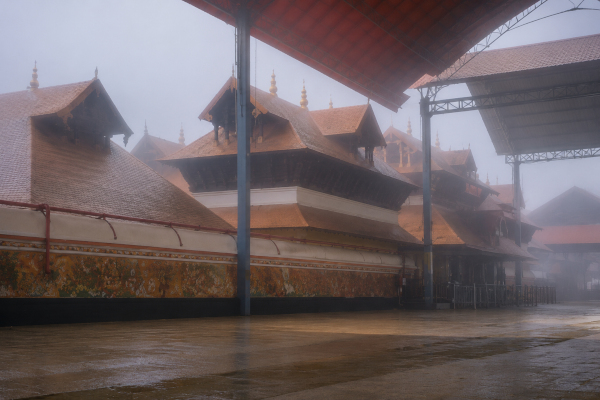
Guruvayur Sri Krishna Temple in Thrissur district is one of Kerala’s most beloved spiritual landmarks and one of South India’s greatest centres of Krishna worship. Revered by devotees as the holy abode of Lord Guruvayurappan, the temple draws pilgrims from across India and abroad, offering them an experience of devotion, discipline, music, ritual, architecture and cultural memory.
Located in Guruvayur, in the culturally rich district of Thrissur, the temple occupies a special place in Kerala’s sacred geography. Thrissur is celebrated as the cultural capital of Kerala, a land of poorams, temple arts, classical music, ritual traditions and festive grandeur. In this atmosphere, Guruvayur stands as a luminous spiritual centre where faith is lived every day through prayer, offerings, vows and devotion.
The presiding deity of the temple is Lord Krishna, worshipped here as Guruvayurappan. The deity is traditionally understood as a form of Vishnu-Krishna, radiating the grace of the child Krishna, the protector, the divine friend and the supreme Lord. For devotees, Guruvayurappan is not a distant deity. He is approached with intimacy, love and surrender. The temple’s spiritual power lies in this personal bond between the Lord and the devotee.
Guruvayur is often called the “Dwarka of the South,” a name that reflects its deep association with Krishna bhakti. The temple has grown over centuries into a major pilgrimage centre, where devotees come seeking blessings for health, marriage, children, education, prosperity, recovery, gratitude and inner peace. The temple is especially known for the strong emotional devotion it inspires among ordinary families, scholars, artists, musicians and saints.
The temple’s architecture follows the traditional Kerala style. Its sacred layout, sloping tiled roofs, wooden elements, lamp-lit spaces and ritual geometry create an atmosphere of quiet intensity. The temple is not designed as a monument alone; it is a living spiritual environment. Every courtyard, lamp, pathway and shrine space is part of a rhythm that has been shaped by worship across generations.
One of the most beautiful features of Guruvayur is the daily flow of rituals. From the early morning opening of the shrine to the final worship of the day, the temple follows a disciplined sequence of pujas, offerings and ceremonies. The experience of standing in the queue, hearing the temple bells, seeing lamps glow in the inner spaces and receiving darshan of Guruvayurappan gives devotees a deep sense of fulfilment.
Guruvayur’s devotional culture is closely linked with music and literature. Kerala’s Krishna bhakti tradition has produced songs, poems, stories and performances inspired by the Lord of Guruvayur. The temple is associated with the spirit of Narayaneeyam, the great devotional Sanskrit work composed by Melpathur Narayana Bhattathiri. The tradition holds that the poet, through his intense devotion, offered the essence of the Bhagavata Purana to Lord Guruvayurappan. This connection has made the temple a centre of both worship and sacred learning.
The temple is also known for offerings that express devotion in deeply personal ways. Thulabharam is one of the most popular offerings, where devotees are weighed against materials such as bananas, sugar, jaggery or coconuts. The offering symbolises humility, gratitude and surrender. For many families, such vows are made during moments of difficulty and fulfilled after receiving blessings.
Another important part of Guruvayur’s sacred atmosphere is its connection with elephants. The Guruvayur temple tradition is closely associated with elephants offered by devotees and used in temple festivals and processions. The image of decorated elephants, temple music and lamps has become part of the cultural memory of Guruvayur and Kerala’s temple heritage.
Guruvayur is also a major centre for weddings and family ceremonies. Thousands of couples begin their married life with the blessings of Guruvayurappan. The temple town becomes especially vibrant during auspicious days, when families gather in traditional attire, carrying flowers, lamps and offerings. This gives Guruvayur a unique social role as a place where personal milestones are woven into sacred tradition.
The annual festivals of the temple add grandeur to its devotional life. The Guruvayur Utsavam is celebrated with ritual splendour, processions, music and community participation. The temple’s festivals reflect the wider cultural character of Thrissur district, where spirituality and art often come together in magnificent public celebration. These festivals preserve Kerala’s older forms of collective worship, music, percussion and temple discipline.
The temple also represents the power of disciplined pilgrimage. Devotees arrive after observing vows, fasting, chanting, offering prayers and maintaining purity of thought and conduct. Many come repeatedly across a lifetime, developing a personal relationship with the deity. For them, Guruvayur is not merely a place to visit; it is a spiritual home.
Guruvayur’s importance extends beyond religion into culture, economy and social life. The temple supports a large ecosystem of priests, musicians, flower sellers, artisans, traditional food providers, lodging facilities, transport services and local businesses. Pilgrimage creates livelihood, sustains heritage skills and keeps the temple town active throughout the year.
The temple also strengthens Kerala’s identity as a land of sacred journeys. Along with major temples, churches, mosques, monasteries and festivals, Guruvayur contributes to the state’s image as a place where spirituality, culture and community life remain deeply connected. For visitors, Guruvayur offers a window into Kerala’s living traditions.
The experience of Guruvayur is marked by simplicity and power. The devotee may wait for hours, walk barefoot through the temple precincts, carry a small offering and finally receive only a brief darshan. Yet that moment often becomes unforgettable. The sight of Guruvayurappan, the sound of bells, the fragrance of sandalwood and flowers, and the glow of oil lamps create a memory that stays with the heart.
In a fast-changing world, Guruvayur Sri Krishna Temple continues to stand as a centre of faith, discipline and continuity. Its greatness lies not only in its age or fame, but in the living devotion that flows through it every day. Generations have come here with prayers, tears, gratitude and hope, and the temple has given them a sense of divine nearness.
Guruvayur is therefore more than a famous temple. It is one of Kerala’s great spiritual treasures, a sacred centre of Krishna bhakti, a pillar of Thrissur’s cultural identity and a living symbol of devotion. For millions of devotees, the name Guruvayur itself carries comfort, blessing and grace.
You may also like
-
Mekala in the Mahabharata: The Ancient Highland Kingdom of Amarkantak and the Maikal Hills
-
Anupa in the Mahabharata: The Ancient Narmada Kingdom of Mahishmati and the Maheshwar Region
-
Sarnath Joins UNESCO World Heritage List as India’s Civilisational Legacy Gains Global Recognition
-
Ancient Bazira-Barikot of Gandhara Gains UNESCO Recognition as 3,000 Years of Urban History Emerge From Swat
-
Vaidisha in the Mahabharata-Era Geography: The Ancient Vidisha Region of Central Madhya Pradesh
