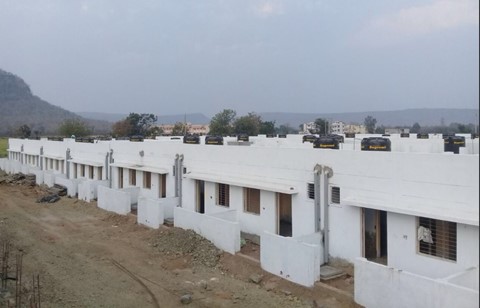
The government has approved more than 2.13 lakh additional houses for eligible urban poor families under Pradhan Mantri Awas Yojana-Urban 2.0, giving a fresh push to the Housing for All mission in India’s cities. The approval was cleared during the 7th meeting of the Central Sanctioning and Monitoring Committee in New Delhi, chaired by Housing and Urban Affairs Secretary Srinivas Katikithala.
With this latest approval, the total number of houses sanctioned under PMAY-Urban 2.0 has crossed 16.13 lakh. The newly approved houses cover 16 states, with around 1.89 lakh houses under the Beneficiary-Led Construction vertical and more than 23,000 houses under the Affordable Housing in Partnership vertical.
The decision carries importance because urban housing is now one of India’s biggest social infrastructure challenges. Rapid migration, rising land prices and expanding city populations have increased demand for affordable, secure and well-connected homes. For low-income families, a formal house is a foundation for stability, dignity, health, education and financial security.
PMAY-Urban 2.0 focuses on eligible urban poor and lower-income families who need support to build, purchase or access affordable homes. The Beneficiary-Led Construction model helps eligible families construct or upgrade their own houses on land available to them. This model is especially useful for families living in smaller cities and towns, where people may have land but lack enough financial capacity to build a proper pucca house.
The Affordable Housing in Partnership model brings public agencies, states, urban local bodies and private developers into the housing ecosystem. It supports larger housing projects where affordable units can be created at scale. This model is important for cities where land is scarce and housing demand is concentrated around employment hubs, transport routes and industrial clusters.
A major feature of the latest approval is its focus on women-led ownership. Around 2.05 lakh houses from the new sanction have been allotted to women. This gives the scheme a strong social empowerment dimension. A house registered in the name of a woman improves household security and gives women stronger control over family assets. It also supports long-term financial inclusion because home ownership can become a gateway to credit access, identity stability and local participation.
The approval also gives attention to vulnerable groups. Around 25,000 houses have been sanctioned for senior citizens, while the list also includes beneficiaries from Scheduled Castes, Scheduled Tribes, Other Backward Classes and transgender communities. This makes the programme a wider social justice intervention, bringing housing support to groups that often face higher barriers in urban property markets.
The government has also reviewed implementation progress and discussed measures to speed up construction, strengthen monitoring and promote housing projects near mass transit corridors. This is an important planning direction. Affordable housing gains far more value when it is connected to public transport, jobs, schools, hospitals and markets. Houses located far from livelihood centres can increase travel costs for poor families. Housing near transit corridors improves quality of life and supports more inclusive urban growth.
The larger impact of PMAY-Urban and PMAY-Urban 2.0 is already visible. Together, the two phases have sanctioned more than 1.27 crore houses across the country. This makes the programme one of India’s largest urban welfare and infrastructure missions.
Urban housing also creates economic momentum. Every new house generates demand for cement, steel, bricks, tiles, electrical equipment, plumbing material, doors, windows, paints, labour, transport and local services. This gives housing schemes a strong multiplier effect, especially in small towns and developing urban areas. When housing construction expands, local employment also rises.
The latest sanction under PMAY-Urban 2.0 shows that India’s urban welfare policy is moving beyond shelter alone. The focus is now on ownership, women’s empowerment, vulnerable groups, construction speed, transport-linked planning and liveable cities. For poor urban families, a sanctioned house represents more than a roof. It represents security, dignity and a stronger place in the city’s economic future.
You may also like
-
India’s Economic Warfare Challenge: Strategic Autonomy, Energy Security and the Rise of a Global Power
-
India-US Trade Deal Stalemate: Why Washington’s Tariff Pressure Has Failed to Secure an Agreement
-
US Double Standards in Foreign Policy: 16 Recent Cases Involving India, Russia, China and Global Trade
-
India’s Arctic Energy Ambitions: Russian Oil, LNG and a New Sea Route to Indian Ports
-
India and Russia Explore Joint Icebreaker Construction as Maritime Industrial Cooperation Expands
