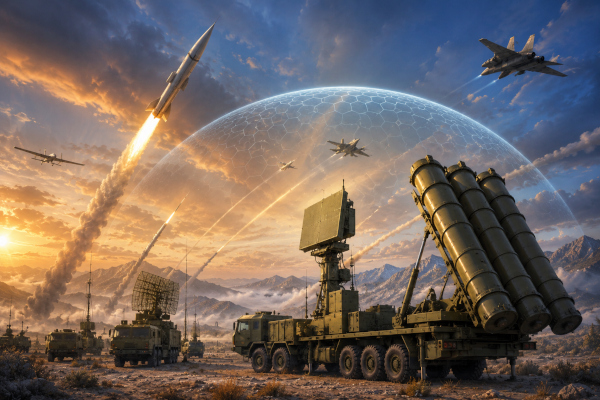
India’s future air defence will depend on the ability to see far, decide fast and strike hostile aerial threats before they reach Indian airspace. Project Kusha is being developed for this exact requirement. Within this programme, the M3 interceptor is expected to form the longest-range layer of the system, giving India a powerful indigenous weapon against aircraft, cruise missiles, drones, standoff platforms and high-value airborne targets.
Kusha M3 belongs to India’s larger effort to build an indigenous extended-range surface-to-air missile system. The system is often described as India’s answer to the need for a long-range air defence shield that can work alongside existing systems such as S-400, Barak-8, Akash and future Indian air-defence networks. Its importance lies in one simple point: India needs a home-built shield that can defend large airspaces, strategic cities, military bases, industrial corridors and critical infrastructure.
The M3 interceptor is the outer sword of Project Kusha. While the shorter-range variants are expected to deal with threats at lower engagement depths, M3 is meant to push the defensive boundary much farther away. Open-source reporting places the M3 class in the 350–400 km range bracket. This gives the system the ability to threaten enemy aircraft, airborne warning platforms, refuelling tankers, electronic warfare aircraft and missile-launching platforms before they can operate freely near Indian territory.
This matters deeply in modern warfare. A hostile aircraft does not need to fly directly over a target to attack it. It can launch standoff weapons from long distances. A drone swarm can be guided from outside the immediate battle zone. An airborne early warning aircraft can support enemy fighters by seeing deep into the battlespace. A long-range air defence system changes this equation by making the enemy think twice before placing such assets close to Indian airspace.
Kusha M3 should be understood as part of a layered defence grid, not as a standalone missile. A modern air defence system works through sensors, radars, command networks, launchers, interceptors and battle-management software. The missile is the visible part. The real strength lies in the network that detects the target, classifies the threat, assigns the weapon and guides the interceptor. For India, this makes integration with systems such as the Integrated Air Command and Control System extremely important.
The M3 layer can give India a stronger area-denial capability. Area denial means the enemy’s air force loses freedom of movement inside a large zone. If hostile aircraft, tankers and surveillance platforms have to remain farther away, their missions become harder. Their weapons may need longer flight paths. Their drones may lose support. Their fighters may have reduced endurance. Their pilots operate under psychological pressure. A good air defence system therefore shapes the enemy’s behaviour even before a missile is fired.
Kusha M3 also strengthens India’s strategic autonomy. India has benefited from imported systems, especially the S-400, yet long-term security demands domestic production, domestic upgrades and domestic control over supply chains. An indigenous long-range interceptor reduces dependence on foreign suppliers and allows India to adapt the system to its own geography, threat environment and command structure. This is the real value of Project Kusha.
The industrial angle is also important. Bharat Electronics Limited has been associated with Project Kusha-related development activity, and Bharat Dynamics Limited is expected to be a key missile-production player as the programme matures. Such programmes build more than weapons. They build radar expertise, seeker technology, propulsion capability, fire-control systems, launcher integration, command software and testing infrastructure. Every successful indigenous air-defence project strengthens the next one.
Kusha M3 will be especially relevant along India’s western and northern threat arcs. Against Pakistan, a long-range air defence layer can protect important bases, cities and forward assets from aircraft, drones and cruise missile threats. Against China, it can help India build deeper air defence coverage across difficult terrain, where reaction time and detection depth are critical. In both theatres, the value of M3 lies in pushing the engagement zone outward.
A strong M3 interceptor also supports India’s offensive air power. Air defence and air offence are connected. When Indian airbases, radars and command centres are better protected, the Indian Air Force gains greater freedom to launch missions, sustain operations and absorb enemy retaliation. A shield protects the sword. Kusha M3, as part of a wider air defence architecture, helps preserve India’s ability to strike back.
The system also fits into the wider idea of a national missile shield. Future wars will bring mixed attacks: drones, loitering munitions, cruise missiles, ballistic threats, fighter aircraft, electronic warfare and cyber disruption. A single weapon cannot handle this entire spectrum. India needs multiple layers: short-range guns and missiles, medium-range interceptors, long-range systems, electronic warfare, counter-drone systems and centralised command networks. Kusha M3 becomes the far-reaching layer in this shield.
The most important lesson is that Kusha M3 is not only a missile. It is a statement of strategic maturity. It shows India moving from buying protection to building protection. It shows a country preparing for air wars where speed, range, networking and autonomy will decide survival. It also shows that India understands the future battlefield: the first battle will often happen in the sky, through sensors and missiles, long before ground forces meet.
In simple terms, Kusha M3 is expected to become the long arm of India’s indigenous air defence. It will extend the reach of Indian protection, complicate enemy planning and strengthen the country’s layered shield. As Project Kusha matures, M3 can become one of the most important pieces in India’s future air-defence architecture.
You may also like
-
Gliders India Seeks Industry Partners as India Expands Heavy-Drop Capability for C-130J and C-17 Aircraft
-
India Sends 60-Member Armed Forces Contingent to Kazakhstan for KAZIND-2026
-
India and Fiji Expand Defence and Maritime Cooperation at Second Joint Working Group Meeting
-
India and Ethiopia Expand Defence Cooperation at Second Joint Defence Cooperation Meeting
-
IndoWings Unveils STRIKE Loitering Munition Concept for MBRL Launchers
