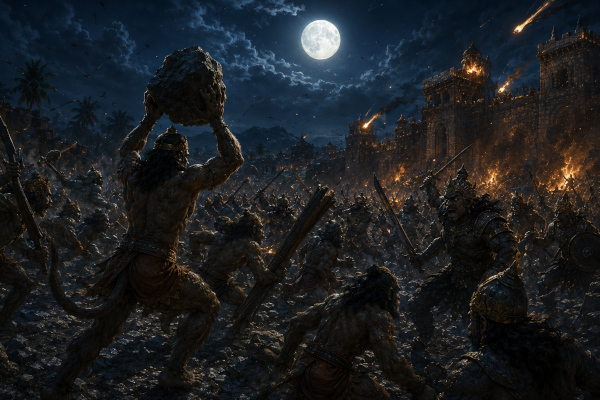
Night warfare in the Ramayana shows one of the most demanding forms of battle. Darkness changes the battlefield into a world of sound, instinct, fear and sudden violence. The Vanaras and Rakshasas clash under low visibility, where every movement becomes uncertain and every shout carries danger. The text describes both sides identifying one another in the darkness and attacking with intensity. This gives the episode a strong military meaning: night turns courage into a test of discipline, awareness and command control.
A battlefield in daylight gives shape to formations, flags, commanders, weapons and movement. Night removes easy recognition and forces fighters to rely on sound, memory, signals and proximity. The Vanaras hear roars, footsteps, weapon strikes and cries from wounded warriors. The Rakshasas move through the same darkness with their own calls, weapons and battle habits. The army that maintains awareness gains advantage. The army that loses orientation begins to strike in confusion.
The Ramayana presents darkness as a force that enters the battle alongside warriors. It creates fear because the enemy appears suddenly. It creates chaos because direction becomes difficult. It creates mistaken identity because warriors recognise one another through voice, shape, movement and battlefield signs. Every fighter must think faster. Every commander must keep the force together. Night warfare turns the mind into a weapon as important as the bow, mace or mountain peak.
The Vanaras face a special challenge in this environment. Their strength lies in mobility, mass assault and physical energy. They leap, climb, rush and strike with stones, trees and bare force. At night, such movement becomes harder to coordinate. A group can scatter quickly. A warrior may enter the enemy line before support arrives. A commander must hold the energy of the force and guide it toward the correct target. This makes night fighting a test of collective discipline.
The Rakshasas possess their own advantages in night battle. Their fierce appearance, deceptive methods and familiarity with Lanka’s terrain give them confidence in darkness. They can exploit shadows, strike from hidden places and create fear through sudden attacks. The Ramayana uses this to show that terrain knowledge and psychological pressure matter deeply in nocturnal combat. A defender who knows the ground can turn darkness into a shield and a weapon.
Modern warfare follows the same principle through night operations. Armies use darkness for surprise, stealth and shock. Special forces raids, infantry assaults, reconnaissance missions, artillery movement and air insertions often take place after sunset because darkness reduces exposure and creates tactical advantage. Night gives the attacker a chance to approach quietly, choose the point of contact and strike before the defender fully understands the situation.
Technology has changed night warfare, yet the basic pressure remains the same. Modern soldiers use night-vision devices, thermal imagers, infrared markers, drones, laser designators, secure radios and battlefield tracking systems. These tools give vision in darkness and reduce confusion. The aim is simple: see the enemy before the enemy sees you, recognise friendly forces quickly and preserve command flow during rapid movement. The Ramayana expresses the older version of this same problem through sound, instinct and battlefield recognition.
Command and control become critical at night. A commander must know where his troops are, where the enemy is moving and where the objective lies. In darkness, a small error in direction can break formation. A delayed message can isolate a unit. A loud rumour can spread fear. Rama’s campaign shows the importance of leadership that keeps the army focused even when the battlefield becomes unclear. Night rewards armies that move with purpose and punish armies that fight as scattered individuals.
The modern concept of identification also fits this episode. Night operations require clear ways to distinguish friend from enemy. Today, this may involve thermal signatures, coded signals, radio procedures, GPS tracking, infrared patches and recognition marks. In the Ramayana, warriors identify one another through voices, forms, calls, movement and battlefield memory. The method is ancient, but the military problem is timeless. Recognition saves cohesion. Confusion weakens strength.
Night warfare also magnifies fear. A fighter in daylight can see the size of the enemy and the direction of the threat. At night, the mind fills the gaps. A roar may sound closer than it is. A shadow may appear larger than reality. A sudden strike may feel like attack from every side. The Ramayana captures this emotional pressure through the violent atmosphere of the night battle. Fear becomes part of the battlefield terrain.
This is why trained forces prepare specifically for night combat. Modern soldiers rehearse movement in darkness, silent communication, target identification, room entry, ambush response and casualty evacuation under limited visibility. Night fighting demands muscle memory. A unit must act correctly when vision, comfort and certainty reduce. The Vanaras in Lanka face the ancient version of this test as they fight amid noise, smoke, darkness and sudden Rakshasa attacks.
The tactical value of night lies in surprise. A force that attacks at night can compress the enemy’s reaction time. The defender wakes into battle, struggles to read the threat and reacts under pressure. This gives the attacker the opening moments of advantage. In the Lanka campaign, night fighting intensifies the sense of a city under relentless pressure. Ravana’s forces must remain alert through darkness, while Rama’s side pushes the tempo of war beyond the comfort of daylight.
The 2016 surgical strikes by Indian special forces across the Line of Control offer a modern Indian parallel to this principle. The operation was carried out during the night, using surprise, stealth, intelligence and disciplined movement to reach terror launch pads and return after striking the targets. The value of the operation lay in timing, secrecy and controlled action. Darkness helped conceal movement, while training and coordination helped maintain clarity. This reflects the same strategic lesson seen in the Ramayana: night gives advantage to the force that controls fear, direction and timing.
Night also affects morale differently on each side. For the attacker, darkness can create confidence when the plan is clear. For the defender, it can create anxiety when threats emerge from unknown directions. In Lanka, every night clash adds pressure on Ravana’s army. The city that once stood secure now faces battle through the hours meant for rest. Fatigue grows. Alertness weakens. Fear travels through the ranks. The war begins to consume day and night alike.
The Ramayana’s night warfare also shows the importance of endurance. A battle that continues after sunset tests physical strength and mental steadiness. Warriors fight through exhaustion, pain and uncertainty. Commanders must keep soldiers from losing rhythm. In modern terms, this is combat sustainability. A force must maintain food, medical support, communication, ammunition and rest cycles during extended operations. In the epic, this endurance appears through relentless fighting and the will to continue under harsh conditions.
The battlefield of Lanka becomes more dangerous at night because the city itself adds complexity. Walls, towers, gates, palaces, streets and shadows create multiple angles of threat. Urban night combat is among the hardest forms of war even today. Buildings hide movement. Echoes confuse direction. Fires, smoke and dust disturb vision. Rama’s forces face a version of this challenge as they fight around a fortified capital filled with Rakshasa defenders.
The deeper lesson is clear. Night warfare demands more than bravery. It demands awareness, communication, discipline, recognition and trust. A fighter must trust his commander. A unit must trust its signals. A commander must trust the training of his warriors. Rama’s army carries this pressure into the darkness and continues the campaign with determination.
In the Ramayana, darkness becomes a battlefield instructor. It teaches that courage must stay alert, strength must stay coordinated and movement must stay purposeful. The Vanaras and Rakshasas fight through a world where vision weakens and fear rises. The army that holds its mind under such conditions gains the true advantage.
Night warfare in the Lanka campaign therefore stands as a timeless military lesson. Darkness magnifies confusion, tests command systems and rewards disciplined aggression. The Ramayana shows that the hardest battles are fought not only against the enemy in front, but also against uncertainty around the warrior. In that darkness, strategy becomes the lamp, discipline becomes the path and courage becomes useful only when it moves with control.
You may also like
-
IndoWings Unveils STRIKE Loitering Munition Concept for MBRL Launchers
-
Kalyani-Paramount Unveil 10-Tonne Mbada 4×4 Light Armoured Vehicle at AAD 2026
-
DRDO Begins Work on New SEATEC SONAR Engineering and Test Facility at NPOL Kochi
-
Vanga — The River Kingdom of the Bengal Delta and the Eastern Sea
-
Embraer and Mahindra Deepen C-390 Partnership for Indian Air Force’s Medium Transport Aircraft Programme
