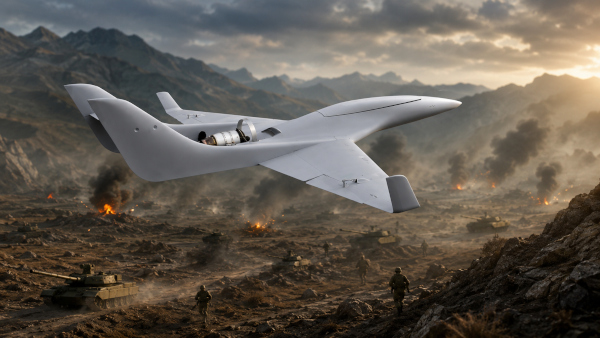
The Indian Army’s drone warfare capability has received a major boost with the delivery of 100 indigenous kamikaze drones from Indian defence company SMPP. The system, named Peacekeeper-Agniveg, represents a new generation of battlefield weapons where speed, precision, autonomy and electronic warfare resistance are becoming central to combat power.
Kamikaze drones, also known as loitering munitions or suicide drones, have changed modern warfare across the world. They combine the eyes of a drone with the destructive effect of a precision munition. A conventional drone observes and returns. A kamikaze drone searches, tracks and strikes the target by destroying itself on impact. This gives commanders a flexible weapon for time-sensitive targets, mobile assets, radar sites, logistics nodes and command positions.
The Peacekeeper-Agniveg delivery is significant because it adds an indigenous long-range strike option to the Indian Army’s tactical and operational toolkit. During user trials, the drone reportedly demonstrated an operational range of around 180 kilometres while operating in heavily jammed and spoofed conditions. This detail is important because future battlefields will be saturated with electronic warfare. A drone that can operate in such an environment gives the Army a stronger chance of maintaining strike capability even when the enemy tries to disrupt navigation, communication and control links.
The system’s reported speed of up to 450 kmph gives it another battlefield advantage. Speed compresses enemy reaction time. Once a target is identified and the drone begins its strike profile, the defending side has a much shorter window to detect, track and neutralise it. This makes the platform useful against targets that may move, hide or shift position quickly.
Peacekeeper-Agniveg is designed to strike high-value targets deep inside enemy territory. Such targets can include command centres, radar installations, logistics hubs, communication nodes, ammunition storage points and critical military infrastructure. These are the targets that shape the tempo of battle. A strike on a radar can open a window for air operations. A strike on a logistics hub can slow an enemy formation. A strike on a command node can create confusion inside the adversary’s decision chain.
This is where kamikaze drones become a force multiplier. They give commanders a precision tool between artillery and missiles. Artillery has mass and volume. Missiles have range and heavy strike value. Loitering munitions bring patience, observation and precision into the same package. They can wait, search, identify and attack with controlled effect. This makes them especially useful in terrain where targets are dispersed, concealed or moving.
For the Indian Army, such drones are valuable across multiple theatres. In mountainous terrain, they can help strike positions across ridgelines and valleys. In desert sectors, they can target mobile columns, logistics vehicles and forward command posts. Along contested borders, they can be used to hold enemy assets at risk without exposing soldiers to direct fire. In high-altitude or difficult terrain, reducing risk to personnel becomes a major operational advantage.
The delivery also reflects the growing maturity of India’s private defence manufacturing ecosystem. SMPP’s ability to complete delivery within a short timeframe shows how Indian companies are becoming active contributors to urgent military requirements. The old model of relying only on imports for advanced battlefield systems is giving way to a more responsive domestic ecosystem where Indian firms design, build and deliver combat technologies suited to Indian conditions.
This shift is especially important in drone warfare. Drones evolve quickly. Lessons from one battlefield can become outdated within months. Armies need rapid upgrades, local production, software changes, payload flexibility and field feedback loops. Indigenous companies can respond faster to such requirements because they work closer to the user and the terrain. This creates a major advantage over slow foreign procurement cycles.
The Peacekeeper-Agniveg also fits into the larger transformation of the Indian Army after recent global and regional lessons. Conflicts in Ukraine, West Asia and the Caucasus have shown that drones are no longer secondary battlefield tools. They are now central to surveillance, targeting, artillery correction, air defence saturation and precision strike. Small, medium and long-range unmanned systems have become essential to both offensive and defensive operations.
India’s defence planners have clearly absorbed these lessons. The induction of indigenous kamikaze drones shows that the Army is building layered unmanned capability. Reconnaissance drones find targets. FPV drones support close tactical strikes. Loitering munitions attack deeper targets. Larger unmanned systems support surveillance and precision delivery. Together, these layers create a more connected and responsive battlefield network.
The ability to operate in jammed and spoofed environments is one of the most important features of the new system. Enemy forces will try to break drone missions through GPS spoofing, communication jamming, signal interference and electronic deception. A drone built for contested electromagnetic conditions has better survivability and mission reliability. In modern warfare, the side that controls the electromagnetic spectrum gains a major advantage.
The name Peacekeeper-Agniveg itself carries a sharp meaning. “Peacekeeper” reflects the deterrent role of strength. “Agniveg” suggests fiery speed. Together, the name captures the logic of modern deterrence: peace is protected through readiness, precision and credible strike capability. A military that can hit high-value targets accurately can prevent escalation by raising the cost of hostile action.
This induction also supports India’s Atmanirbhar Bharat vision in defence. Every indigenous drone system builds domestic knowledge in aerodynamics, propulsion, guidance, control systems, payload integration, materials, sensors, software and battlefield communication. These capabilities matter far beyond one platform. They become building blocks for future unmanned systems, swarm drones, autonomous strike platforms and AI-enabled battlefield tools.
The larger message is clear. The Indian Army is moving towards a future where soldiers, sensors, drones, artillery, missiles and command systems work in a connected kill chain. Peacekeeper-Agniveg adds a new strike layer to this system. It gives field commanders a weapon that can reach deep, strike fast and operate in hostile electronic conditions.
The delivery of 100 indigenous kamikaze drones is therefore more than a procurement update. It is a signal of India’s changing battlefield posture. The Army is building precision, speed and unmanned reach into its combat structure. Indian industry is stepping forward to meet urgent military needs. The future battlefield will reward forces that can see first, decide fast and strike accurately. Peacekeeper-Agniveg is a strong step in that direction.
You may also like
-
India Moves Towards Five-Year Assured Orders for Defence Startups Under New Procurement Reforms
-
Zen Technologies Introduces Indigenous Hyper-Strike Falcon AI-Guided Counter-Drone Interceptor
-
L&T and Germany’s SCHOTTEL Expand Partnership for Controllable Pitch Propeller Systems in Indian Shipbuilding
-
India to Train 60,000 Civil Defence Volunteers Across 12 States and UTs with Indian Army Support
-
Indian Army’s Northern Command Opens 75-Day Defence Technology Internship Programme for Young Innovators
