
Indian researchers have uncovered an important behaviour inside a widely studied catalyst used for green hydrogen production: the catalyst does not simply remain unchanged while the reaction happens. It transforms during the reaction, and that transformation can improve its performance. The finding gives scientists a clearer path for designing next-generation electrocatalysts for efficient and low-cost hydrogen production.
The research focuses on molybdenum carbide, written as Mo₂C, an earth-abundant material studied as a catalyst for the hydrogen evolution reaction. This reaction is a key step in water electrolysis, where electricity is used to split water and release hydrogen. Green hydrogen becomes especially important when the electricity used in this process comes from renewable sources such as solar, wind or hydropower..
The study was led by Dr. Neena S. John and Ph.D. scholar Palash Jyoti Gogoi from the Centre for Nano and Soft Matter Sciences, Bengaluru, an autonomous institute under the Department of Science and Technology. The work was carried out in collaboration with researchers from Kiel University, Germany, and the Indo-Korea Science and Technology Center, Bengaluru.
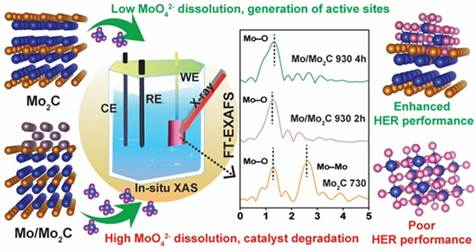
For a long time, catalysts were often imagined as stable helpers that speed up a reaction while keeping their own structure intact. This study shows a more dynamic picture. Under real working conditions, Mo₂C undergoes reconstruction during the hydrogen evolution reaction. Instead of remaining in its original form, it creates oxygen-deficient molybdenum oxide domains, known as MoOₓ, with a local structure close to MoO₂. These newly formed regions become the real active phase that helps generate hydrogen more efficiently.
The research team used advanced tools such as in situ X-ray absorption spectroscopy and in situ Raman spectroscopy to observe how the catalyst changes while the reaction is taking place. This is important because many materials look different before and after a reaction, while their actual working state during the reaction can reveal the real reason behind performance. The team also used theoretical calculations to connect the structural changes with catalytic behaviour.
The key discovery is that controlled reconstruction improves both activity and stability. In simple terms, Mo₂C performs better because it rebuilds its surface into a more useful working form. The study also compared this with Mo/Mo₂C heterostructures, where faster oxidation forms soluble molybdate species and reduces catalytic activity. This comparison shows why controlled transformation supports performance, while uncontrolled oxidation leads to degradation.
This finding matters for India’s clean-energy ambitions because green hydrogen depends heavily on efficient and affordable electrolysis technologies. Precious-metal catalysts can be expensive, so earth-abundant alternatives like molybdenum carbide are attractive for large-scale hydrogen systems. A better understanding of how such catalysts behave under real operating conditions can help researchers design cheaper, longer-lasting and more efficient materials.
The study also changes the way scientists may approach catalyst design. Instead of only searching for a perfect starting material, researchers can now design catalysts that deliberately transform into the most active form during operation. In this approach, the working catalyst is treated as a living, changing surface rather than a fixed material. That shift can influence future research in hydrogen production, water splitting and other clean-energy reactions.
The work has been published in Materials Horizons under the title “Dynamic surface reconstruction governs the hydrogen evolution activity of Mo₂C electrocatalysts in alkaline media.” The paper reports that the active reconstructed Mo₂C@MoO₂₋ₓ surface helps optimise hydrogen adsorption and supports better hydrogen evolution activity in alkaline media.
This discovery gives green hydrogen research a powerful message: transformation can be a strength. A catalyst that rebuilds itself in the right way can become more active, more stable and more useful for future energy systems. For India’s science and technology ecosystem, the study highlights how advanced material research can support the country’s larger journey towards clean fuel, energy security and affordable green hydrogen.
Publication link: https://doi.org/10.1039/D5MH02010G
You may also like
-
India Commissions 51st Doppler Weather Radar at Sambalpur, Plans Around 40 More Under Mission Mausam
-
IIT Bhilai Develops 4D-Printable Hydrogel That Lifts 250 Times Its Weight and Cleans Wastewater
-
IIT Bombay Deploys Matsya 7 and Mini Matsya in Tandem at RoboSub 2026, Secures Two First-Place Honours
-
IIT Guwahati Bacterium Degrades 98.5% of Toxic Textile Dye, Opening Route to Cleaner Industrial Wastewater
-
Bihar’s 700-Year-Old Banyan Becomes World’s Oldest Scientifically Dated Ficus benghalensis
