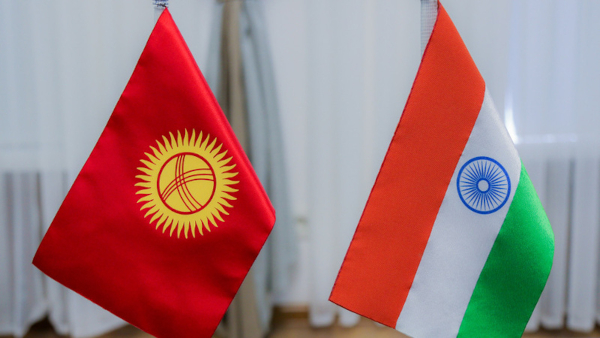
India’s economic outreach to Central Asia gained fresh momentum as Union Minister H.D. Kumaraswamy held bilateral talks in Bishkek with Kyrgyzstan’s Minister of Economy and Commerce, Bakyt Sidikov. The meeting focused on strengthening trade, expanding industrial cooperation, encouraging investment and opening new pathways for manufacturing-linked partnerships between the two countries.
The talks carried importance because India and Kyrgyzstan already share a strategic relationship built on political trust, cultural familiarity and regional cooperation. The latest engagement adds a stronger economic dimension to that relationship. Both sides explored how trade, production, heavy industry, machinery and steel value chains can be expanded in a way that benefits businesses, industries and workers in both countries.
Kyrgyzstan occupies an important place in India’s Central Asia policy. It is located in a region that connects South Asia, Eurasia, China, Russia and West Asia through historic trade routes and modern connectivity ambitions. For India, deeper economic engagement with Kyrgyzstan supports a wider effort to build practical partnerships across Central Asia in trade, technology, energy, minerals, logistics, education and industrial development.
The discussion in Bishkek placed special attention on heavy production sectors. This is significant because India’s industrial growth is now closely tied to its ability to build stronger external markets for engineering goods, machinery, steel products and manufacturing expertise. Kyrgyzstan, with its development needs and regional position, can become a valuable partner for Indian companies looking to expand into Central Asian markets.
Steel value chains formed one of the important areas of discussion. India is one of the world’s major steel producers, and its steel sector is linked to infrastructure, railways, construction, renewable energy, automobiles, defence production and industrial machinery. Cooperation with Kyrgyzstan in this area can create opportunities for supply partnerships, technical exchange, investment and project-based collaboration.
The bilateral trade figure shows both promise and untapped potential. Trade between India and Kyrgyzstan stood at around US$116.88 million in 2024. India’s exports were about US$89.48 million, while imports from Kyrgyzstan were around US$27.40 million. These numbers are modest when compared with the strategic warmth between the two countries, which means there is considerable room for expansion.
India’s exports to Kyrgyzstan include pharmaceuticals, electrical machinery, industrial equipment, apparel, clothing and ceramic products. These sectors match India’s strengths in affordable medicine, engineering goods, consumer products and manufacturing. Kyrgyzstan’s exports to India include precious metals, vegetables, edible roots and mineral fuels, showing scope for a more diversified trade basket in the coming years.
Pharmaceuticals can become one of the strongest pillars of the partnership. Indian medicines are globally known for affordability, scale and reliability. Kyrgyzstan can benefit from India’s pharmaceutical supply strength, while Indian companies can use Central Asian demand to expand their regional healthcare footprint. This can also be linked with medical education, hospital cooperation, telemedicine and public health capacity building.
Industrial cooperation can also support India’s Aatmanirbhar Bharat vision. A self-reliant India is not an isolated India. It is an India that builds domestic capacity and then uses that strength to create trusted international partnerships. When Indian companies enter Central Asian markets with machinery, steel, engineering goods and technology, they convert domestic industrial strength into diplomatic and economic influence.
The meeting also fits into the larger framework of India’s engagement with the Shanghai Cooperation Organisation region. Central Asia is important for energy security, counterterrorism coordination, connectivity, trade diversification and regional stability. Economic cooperation with Kyrgyzstan therefore has both commercial and strategic value.
Investment was another major theme of the talks. Direct investment between India and Kyrgyzstan can grow in sectors such as manufacturing, mining support services, food processing, pharmaceuticals, textiles, education, information technology and renewable energy. Indian firms can look at Kyrgyzstan as a production and distribution base, while Kyrgyz businesses can explore India’s large consumer market and industrial ecosystem.
The presence of India’s Ambassador to Kyrgyzstan in the discussions reflected the institutional seriousness of the engagement. Such meetings help convert broad diplomatic goodwill into specific economic possibilities. They allow both sides to identify obstacles, understand business expectations and create frameworks for future cooperation.
People-to-people links also strengthen the economic relationship. Indian students, professionals and business networks already create a bridge with Central Asian societies. These human connections can support tourism, education, healthcare, entrepreneurship and small business partnerships. A trade relationship becomes stronger when it is supported by familiarity between people.
The latest India-Kyrgyzstan economic outreach shows that New Delhi is treating Central Asia as a serious long-term partner. The region offers markets, resources, strategic depth and historical connection. India brings industrial scale, technology, pharmaceuticals, skilled manpower, manufacturing capacity and a growing global profile.
The Bishkek talks therefore represent more than a routine ministerial meeting. They point toward a wider economic design in which India strengthens its Central Asian partnerships through trade, industry, investment and trust. With focused follow-up, India and Kyrgyzstan can transform their modest trade numbers into a more active and diversified economic partnership.
You may also like
-
India–Mongolia Joint Military Exercise Nomadic Elephant 2026 Begins in Pithoragarh
-
India–Thailand Trade Nears $14 Billion in Seven Months as Economic Ties Broaden
-
Japanese Parliamentary Delegation Visits BEL and Reviews Advanced Defence Systems
-
India and Thailand Move Toward UPI–PromptPay Link and Rupee–Baht Settlement to Deepen Economic Integration
-
India and Canada Push to Accelerate CEPA Negotiations as Economic Engagement Gains Momentum
