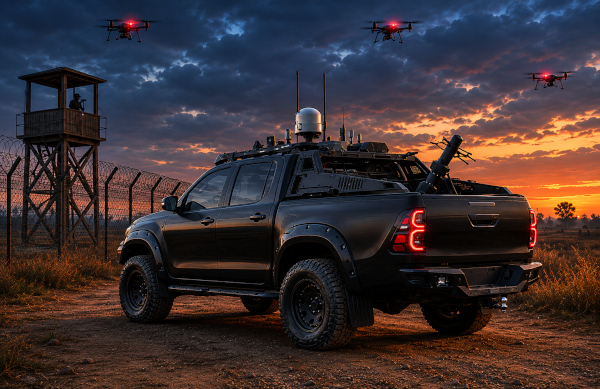
India’s border security challenge has entered a new phase where the threat arrives silently, at low altitude, carrying narcotics, weapons, surveillance payloads, ammunition or explosive components across fields, canals, villages and forward routes. The Indrajaal Ranger enters this battlefield as a mobile counter-drone patrol vehicle built for exactly this changing threat. It is described as India’s first fully mobile, AI-enabled Anti-Drone Patrol Vehicle, a system designed to detect, track, classify and neutralise hostile drones while moving with patrol teams, convoys and field units.
The significance of Ranger lies in its mobility. Traditional counter-drone systems work best around fixed sites such as airports, military bases, ports, refineries or command centres. The border challenge in India is more fluid. Smuggling drones cross at night, shift drop zones, exploit fog, use agricultural belts, hover near canals, and coordinate with local receivers. A static defence grid covers a defined circle. A mobile patrol vehicle creates a moving shield. Ranger is designed to travel with security forces, seal temporary gaps, escort convoys, protect forward operating bases and respond to sudden drone sightings across difficult terrain.
The platform is built on the Toyota Hilux, a rugged 4×4 pickup known for off-road durability. The modified Ranger carries its anti-drone equipment across the roofline and cargo bed, turning a patrol vehicle into a compact counter-UAS command post. The Hilux base gives it a 2.8-litre turbo-diesel engine, around 201 bhp and 500 Nm of torque in the automatic variant, giving the vehicle the strength needed for border tracks, desert roads, rural patrol routes and rapid movement between vulnerable points. The vehicle’s exterior has been militarised with off-road bumpers, electronic winch, auxiliary lamps, flared arches, roof equipment and all-terrain tyres.
The core combat envelope of the Indrajaal Ranger is layered. Its detection and tracking zone extends up to 10 km. Its soft capture capability reaches up to 4 km. Its soft-kill zone works up to 3 km. Its hard-kill response works up to 2 km. This range ladder matters because every drone engagement has a different risk profile. A smuggling drone over farmland can be captured or diverted. A drone carrying explosives near a military convoy may demand instant kinetic destruction. A reconnaissance drone can be jammed, spoofed or taken over before it passes useful imagery to its operator.
At the centre of the system is SkyOS, Indrajaal’s AI-driven command layer. SkyOS fuses sensor inputs, direction-finding data, protocol analysis, navigation disruption tools and interceptor options into a single decision-making system. In military language, Ranger functions as a mobile C5ISRT platform — Command, Control, Communications, Combat, Intelligence, Surveillance, Reconnaissance and Targeting. This means the vehicle does more than spot a drone. It builds a track, classifies the object, estimates intent, maps available response options and triggers the most suitable countermeasure.
The direction finder is one of the most important elements. It identifies the drone’s position and also gives the line of bearing toward the operator or control source. For border security, this changes the mission from simple interception to network disruption. A drone is only the visible part of a smuggling chain. Behind it are handlers, receivers, financiers, route planners and local distribution networks. When a patrol vehicle can help identify the controller’s direction, field forces gain a chance to move beyond the flying object and strike the human network that launched or received it.
The protocol analyser adds another layer. Modern drones communicate through control signals, telemetry feeds and navigation links. A counter-drone platform that can analyse these signals can classify the drone, understand its behaviour and prepare a tailored response. This is crucial because border drones range from off-the-shelf quadcopters to modified multi-copters, swarm-capable platforms and improvised payload carriers. A single radar track gives location. Protocol analysis gives identity, behaviour and vulnerability.
Ranger’s cyber takeover unit is designed for controlled neutralisation. Instead of immediately destroying a drone, the system can attempt to override its control link and guide it to a safe landing. This is valuable in civilian zones, near farms, in villages, near crowds or around sensitive infrastructure where falling debris can create secondary risk. A captured drone also becomes evidence. Its payload, memory, telemetry, flight path and hardware can expose the wider smuggling or surveillance network.
The electronic soft-kill layer uses GNSS spoofing and RF jamming. GNSS spoofing confuses the drone’s navigation system by feeding false positioning cues. RF jamming disrupts the control or communication link between the drone and operator. Together, they can push a hostile drone away from its route, force it to descend, break its mission logic or prevent payload delivery. For narcotics and weapon drops, this is particularly important because the tactical goal is to stop the drone before it reaches the pre-selected drop zone.
The hard-kill layer comes through kinetic options such as the Zombee interceptor drone. This is the final response for hostile drones that continue toward a high-value target, carry dangerous payloads or form part of a swarm. The Zombee interceptor gives Ranger an active pursuit option. It can move into the airspace and physically strike the rogue drone. This turns the vehicle into a mobile air defence node for the low-altitude battlespace.
The operational need is clear from India’s border data. The BSF reported that 255 Pakistan-origin drones had been neutralised in 2025 for smuggling heroin and weapons. Later Punjab Frontier data placed the figure at 272 drones between January and November 2025, along with seizures that included heroin, ICE methamphetamine, opium, RDX or IED material, grenades, weapons, ammunition and magazines. These figures show that drone smuggling has matured from occasional experimentation into an organised logistics system.
The narcotics dimension gives the threat a national security character. Government data showed more than ₹25,000 crore worth of drugs seized in India in 2024, a rise of more than 55% over the ₹16,100 crore seized in 2023. The Narcotics Control Bureau’s 2024 reporting also showed drone-linked narcotics seizures rising from only 3 cases in 2021 to 179 cases in 2024 along the India-Pakistan border, with 163 of those in Punjab and total recovery of about 236 kg. These figures make the western border a combined counter-narcotics, counter-terror and counter-infiltration theatre.
The arms-smuggling angle is equally serious. Recent law-enforcement cases have shown drones being used to move foreign pistols, ammunition and high-grade contraband across the border, after which local networks push them toward cities. This gives hostile intelligence handlers a low-cost pipeline into Indian territory. A drone carrying pistols or IED components can create effects far from the border. Ranger’s importance lies in attacking this chain at the earliest stage — in the air, before the payload reaches a receiver.
The system also fits India’s wider move toward anti-drone deployment along the border. Union Home Minister Amit Shah recently said anti-drone systems would be installed within six months to curb narcotics and weapons smuggling through drones. He also emphasised close coordination between BSF, armed forces, local administration and citizens. Ranger’s mobile design fits this model because drone defence now requires field movement, local intelligence, police coordination and rapid technical response.
Operation Sindoor added another military lesson. Pakistan used missiles, drones, rockets and electronic warfare in a large attack on Indian military and strategic targets in May 2025, while Indian air defence, counter-drone systems and electronic equipment thwarted the attempt. That experience reinforced a central lesson of modern warfare: the low-altitude drone threat has to be handled as part of a layered national air defence architecture. Ranger represents the same logic at tactical level. It gives patrol forces a machine-speed response against small aerial threats that can slip below traditional high-end air defence priorities.
The vehicle’s autonomy and scalability are also important. Ranger is designed for 24×7 threat mitigation, encrypted remote command, manual override, plug-and-operate deployment, interoperability with third-party systems and multi-vehicle mesh networking. Multiple Ranger units can create a moving defensive grid across border roads, canals, ammunition dumps, helipads, logistics hubs, industrial zones and high-risk urban pockets. A single vehicle secures a patrol sector. A network of vehicles can shape a larger counter-drone barrier.
The next stage for India will be integration. Counter-drone patrol vehicles need to connect with BSF posts, Army air defence networks, local police control rooms, civil aviation databases, drone registries and forensic labs. Every intercepted drone should produce intelligence: launch direction, receiver zone, control frequency, navigation path, payload type, serial identity and handler pattern. When the vehicle becomes a sensor, interceptor and intelligence collector, each engagement strengthens the next one.
Indrajaal Ranger is therefore more than a modified pickup with sensors. It is a response to a border war that has moved into the air at low cost and high frequency. It brings AI, cyber takeover, RF disruption, GNSS spoofing, kinetic interceptors and 4×4 mobility into one field-ready package. For India, this is the direction counter-drone warfare must take: mobile, layered, autonomous, networked and indigenous. The drone threat has become fast, cheap and adaptive. India’s answer has to be faster, smarter and present at the exact place where the threat descends.
You may also like
-
Astra Microwave Expands Counter-Drone Capabilities with Layered Detection and Neutralisation Systems
-
MDL Begins Development of Indigenous Lithium-Ion Battery System for Project-75(I) Submarines
-
Tarang Shakti Delegates from 28 Countries Visit HAL and BEL to Explore India’s Defence Manufacturing Ecosystem
-
India’s 114 Rafale Fighter Jet Programme Moves Towards Final Decision with Focus on Indigenous Integration
-
Embraer and Mahindra Identify Nagpur as Potential C-390 Millennium Assembly Hub in India
