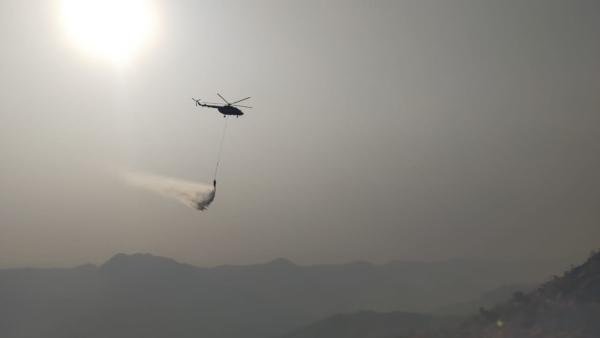
The Indian Air Force carried out intensive aerial firefighting operations in the Kasauli region of Himachal Pradesh after a forest fire was reported on 26 May 2026. A Cheetah helicopter was first launched to assess the ground situation, after which Mi-17 V5 medium-lift helicopters were deployed under the aid-to-civil-authorities framework to support the firefighting effort.
The blaze spread across nearly 10 hectares in the Kasauli Beat area of Solan district, creating a serious threat to nearby residential zones, civil infrastructure and military establishments. The terrain, heat, smoke and hill conditions made the operation demanding, requiring close coordination between the Air Force, state administration, forest officials, the Indian Army and local authorities.
The Mi-17 V5 helicopters used Bambi Buckets to drop water over the affected zone. Water was lifted from Sukhna Lake in Chandigarh, with each sortie carrying roughly 2,000 to 2,500 litres. These repeated sorties helped suppress the flames from the air and gave ground teams valuable support in containing the spread.
Over the course of the mission, the IAF discharged more than 93,000 litres of water on the fire-hit area. The round-the-clock tempo of operations helped prevent the incident from expanding into a larger disaster, especially because the fire had reached a zone where human settlements, infrastructure and defence assets were at risk.
A major operational highlight was the successful use of Night Vision Goggles for night-time Bambi Bucket operations. This was a first for the Indian Air Force in such firefighting missions. Flying with heavy water loads in mountainous terrain during darkness demands precise handling, strong crew coordination and disciplined execution. The operation demonstrated the IAF’s ability to adapt military aviation skills for complex civil emergency missions.
Behind the helicopters, ground crews played an equally important role. Aircraft servicing, refuelling, bucket preparation and rapid turnaround had to continue in difficult weather and operational conditions. Their work allowed the helicopters to maintain a sustained pace through both day and night, making the mission a coordinated air-ground effort rather than a purely aerial response.
The Kasauli operation shows how military aviation has become a vital part of India’s disaster-response architecture. Helicopters that are usually associated with troop movement, logistics and battlefield support can also become powerful tools during forest fires, floods, landslides and other emergencies. In mountainous states such as Himachal Pradesh, where road access can be slow and terrain can restrict ground movement, aerial response often becomes the fastest way to deliver relief and contain danger.
This mission also underlines the value of inter-agency coordination. The Air Force brought aviation capability, the Army and local authorities supported operational coordination, and the forest and civil administration provided ground-level information. Together, they created a rapid response chain that protected lives, infrastructure and strategic assets.
The Kasauli firefighting effort stands as a strong example of the Indian Air Force’s role beyond conventional defence duties. It reflects operational readiness, technical innovation and national service in a real emergency, where speed, courage and coordination helped contain a dangerous forest fire before it could cause wider damage.
You may also like
-
India and Myanmar Prepare for Third Annual Defence Dialogue in Guwahati
-
Five Years After OFB Restructuring, New Defence PSUs Show Stronger Financial Performance
-
Indian Army Builds Six AASHVAST Labs and Expands Drone Training
-
Sagar Defence Broadens Maritime Defence Manufacturing
-
India and South Korea Deepen Defence Industry and Logistics Cooperation at 10th Joint Committee Meeting
