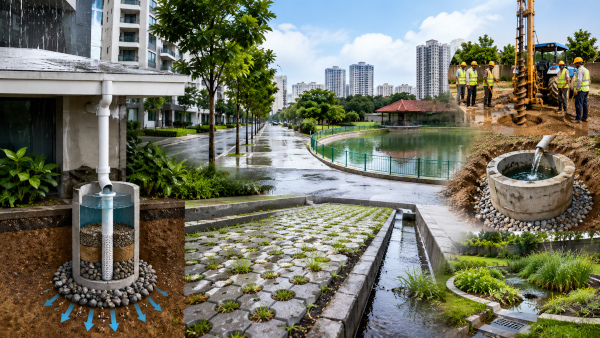
Raipur has emerged as a strong urban model for rainwater harvesting, groundwater recharge and community-led water security under the nationwide Jal Sanchay Jan Bhagidari initiative. The city’s experience shows how scientific planning, public participation, institutional coordination and low-cost engineering can turn seasonal rainfall into a long-term urban asset.
The achievement is significant because Raipur receives nearly 1,200–1,400 mm of annual rainfall, yet it has faced the familiar urban challenge of waterlogging during monsoon and falling groundwater levels through the year. Rapid urbanisation, concrete expansion and excessive groundwater extraction created a situation where valuable rainwater was flowing away through drains while aquifers continued to weaken. Raipur’s campaign directly addressed this contradiction by treating rainwater as a recoverable resource rather than a seasonal nuisance.
Under the leadership of Raipur Municipal Corporation, and with the participation of technical experts, builders, institutions and citizens, the city launched a large-scale rainwater harvesting and groundwater recharge drive. During 2025 alone, nearly 32,000 rainwater harvesting and recharge structures were created across the city. These include recharge wells, percolation pits, injection wells, recharge shafts, rooftop harvesting systems and stormwater recharge structures.
This is where Raipur’s model becomes important for other Indian cities. Urban water resilience cannot depend only on large reservoirs, pipelines and tanker systems. Cities also need thousands of small recharge points spread across neighbourhoods, colonies, campuses, parking areas, roadsides and public spaces. Raipur’s approach creates a distributed water security network where every locality becomes part of the recharge system.
A key strength of the initiative is public-private collaboration. Builders and developers associated with CREDAI integrated rainwater harvesting systems in residential colonies, commercial complexes, institutional campuses and public spaces. Citizens were also encouraged to treat rainwater conservation as a shared civic responsibility. This widened the campaign beyond government engineering departments and turned it into a city-level movement.
Raipur has also used practical technical innovations suited to local conditions. Permeable Eco Blocks are being promoted across footpaths, parking areas and open spaces so that rainwater can seep into the ground instead of rushing into drains. This helps recharge groundwater while also reducing urban waterlogging. In another intervention, tractor-mounted auger drilling technology combined with multilayer filtration and slotted recharge pipes has enabled faster and more cost-effective construction of recharge structures at multiple locations.
The recharge potential of these systems is substantial. PIB notes that recharge wells can replenish up to three lakh litres annually, while injection well systems in groundwater-stressed areas can recharge up to fifteen lakh litres every year. These numbers show why decentralised recharge infrastructure matters. A single structure may look modest, but thousands of such systems across a city can create a large cumulative water security effect.
The city is also moving from project execution to policy reform. Under town and country planning provisions, developers are being encouraged to reserve at least one percent of planned areas for water harvesting and green spaces. Mechanisms for regular maintenance and desilting of recharge systems are also being institutionalised, which is crucial because rainwater harvesting structures need periodic cleaning to remain effective.
Raipur’s larger water resilience strategy includes an integrated Eco Bloc project across the Kharun River, being implemented with an outlay of ₹30 crore under a disaster management initiative. The project aims to conserve rainwater at scale and support the development of a “Sponge City” model. The city is also interconnecting ponds and lakes to improve urban water storage and distribution.
The Sponge City idea is especially relevant for India’s urban future. A conventional concrete-heavy city pushes rainwater away quickly, causing flooding during intense showers and water shortage during dry periods. A sponge city absorbs, stores, filters and reuses water through permeable surfaces, green spaces, ponds, recharge wells and restored water bodies. Raipur’s work shows how this idea can be adapted to Indian conditions using municipal planning, local technology and citizen participation.
The initiative also includes treated wastewater reuse for industrial and infrastructure purposes. This adds a circular water management layer to the city’s strategy. Freshwater should be reserved for drinking and essential domestic use wherever possible, while treated wastewater can support construction, industrial cooling, landscaping and other non-potable needs. Such reuse reduces pressure on groundwater and surface water systems.
Raipur’s campaign reflects a broader shift in water governance. Groundwater conservation is increasingly being treated as a civic mission, not just an engineering problem. Government agencies can create policy, technical design and funding support, but long-term success depends on households, builders, institutions, resident associations, industries and local communities adopting water-saving behaviour.
For India, this model has major relevance. Many growing cities face the same twin problem: heavy rain during monsoon and water stress during summer. The answer lies in capturing rainfall where it falls, slowing runoff, restoring local water bodies, creating recharge systems and using treated wastewater intelligently. Raipur’s 32,000-structure campaign gives a replicable template for other urban bodies.
The larger lesson is simple and powerful: rainwater security begins at the city surface. Every rooftop, footpath, parking area, campus, colony and public space can become part of the recharge grid. When policy support, low-cost technology and public participation come together, rainfall can be transformed from a short-lived monsoon event into a lasting reserve for urban resilience.
Raipur’s rainwater revolution therefore stands as a positive example of practical water governance. It combines municipal leadership, builder participation, citizen awareness, recharge engineering, wastewater reuse and long-term planning. As Indian cities prepare for climate variability, urban flooding and rising demand, Raipur shows that the future of water security may be built through thousands of small structures working together beneath the city’s feet.
Source: PIB
You may also like
-
EON Space Labs and Dhruva Space Advance Indian Space Hardware on Transporter-18 Mission
-
SatLeo Labs’ TAPAS-1 Reaches Orbit, Advancing India’s Private Thermal-Imaging Capability
-
TakeMe2Space’s MOI-1A Reaches Space on Falcon 9 Transporter-18 Mission
-
Bank of Baroda Enters Pension Fund Management After PFRDA Appointment
-
SCI and India’s Push for a Larger Indigenous Maritime Fleet
