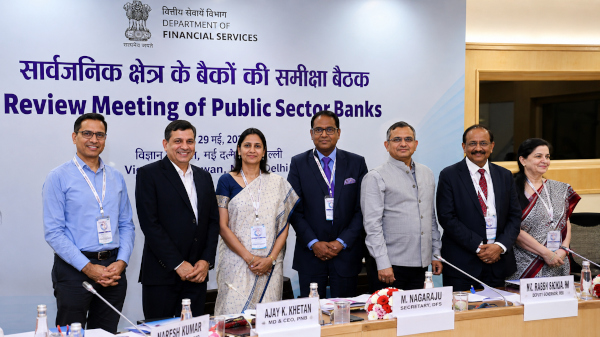
India has taken a citizen-friendly step in financial governance with the launch of the Common Landing Portal for Unclaimed Financial Assets, a unified digital platform designed to help people trace forgotten or unclaimed money lying across the financial system. The portal https://www.unclaimedassetsportal.in, was launched by Shri M. Nagaraju, Secretary, Department of Financial Services, during a review meeting of Public Sector Banks on 29 May 2026.
The new portal brings together access to search facilities for unclaimed bank deposits, insurance claims, shares, dividends and mutual funds. This is important because unclaimed financial assets are often scattered across different institutions and regulators. A person may have an old bank account, a matured fixed deposit, a forgotten insurance claim, unclaimed dividends from shares, or an inactive mutual fund folio. Until now, citizens often had to search across different websites and institutions separately. The new common landing portal gives them a single starting point.
The initiative directly supports the campaign “आपकी पूँजी, आपका अधिकार” — “Your Money, Your Right”, which aims to help citizens identify and reclaim their rightful financial assets. The Department of Financial Services has been running this campaign in coordination with financial sector regulators, banks and other stakeholders to improve awareness, tracing and restitution of unclaimed assets.
The portal is especially useful for families dealing with old financial records. In many households, money becomes unclaimed because account holders move cities, change phone numbers, lose documents, forget old accounts, or pass away without nominees and legal heirs knowing the full financial picture. RBI has noted that unclaimed bank deposits often arise from non-closure of savings or current accounts, non-claiming of matured deposits, and cases where nominees or legal heirs do not come forward after the depositor’s death.
This problem is larger than simple forgetfulness. India’s financial life has become more complex over the last few decades. A single family may have savings accounts in multiple banks, insurance policies from different companies, shares held in old folios, dividends transferred to investor protection systems and mutual fund investments made through different channels. When addresses, bank accounts, phone numbers or nominee details are outdated, legitimate money can remain disconnected from its rightful owner.
The Common Landing Portal addresses this gap by improving discoverability. It acts as a gateway rather than a replacement for every regulator-specific or institution-specific platform. For bank deposits, citizens can search through RBI’s UDGAM portal, where unclaimed deposits transferred to the RBI’s Depositor Education and Awareness Fund can be searched. RBI explains that all unclaimed deposits and accounts forming part of the DEA Fund can be searched through UDGAM.
For shares and dividends, the broader ecosystem includes the Investor Education and Protection Fund Authority, where users can search for unclaimed shares and amounts transferred by companies. The IEPF Authority states that users can do a primary self-search to check amounts and shares transferred to the authority by companies. For mutual funds, AMFI already provides access points for checking unclaimed dividend amounts and has also highlighted service platforms such as MITRA for tracing inactive and unclaimed mutual fund folios.
The new portal’s importance lies in connecting these scattered search journeys into one public-facing access point. A citizen may begin with one portal and then be guided to the relevant system for banks, insurance, shares, dividends or mutual funds. This reduces confusion, improves financial awareness and makes the recovery process less intimidating for ordinary users.
There is also a strong inclusion angle. Unclaimed assets often belong to senior citizens, retired employees, widows, heirs of deceased account holders, small investors and families with incomplete financial records. A single landing portal can help such users avoid repeated visits to banks, registrars, insurers and fund houses just to identify where their money may be lying. For rural and semi-urban citizens, this kind of centralised access can be especially helpful when combined with public sector bank outreach and awareness drives.
The Ministry of Finance has framed the portal as part of a more transparent and citizen-centric financial ecosystem. According to PIB, the initiative is expected to improve public awareness, ease of access to information and trust in the financial system, while contributing to the larger vision of Viksit Bharat 2047 through financial empowerment and inclusion.
This launch also reflects a wider change in Indian financial governance. Earlier, the focus of financial inclusion was mainly on opening bank accounts, expanding digital payments and providing direct benefit transfers. The next stage is about ensuring that citizens can also recover money already belonging to them. That means better nominee awareness, updated KYC details, traceable investments, cleaner records and easier claim processes.
For ordinary citizens, the message is simple: old financial assets should not be written off as lost. Families should periodically check dormant accounts, old fixed deposits, insurance records, dividend statements, shareholdings and mutual fund folios. The new Common Landing Portal gives them a practical starting point for that search. It turns a scattered recovery process into a more organised public service.
In that sense, the portal is more than another government website. It is a financial rights tool. It recognises that people’s money can remain hidden inside institutions because of paperwork gaps, old records or missing communication. By bringing search facilities together, the government is making it easier for citizens to reconnect with their rightful assets and bringing dignity to a process that was often slow, fragmented and confusing.
Source: PIB
You may also like
-
EON Space Labs and Dhruva Space Advance Indian Space Hardware on Transporter-18 Mission
-
SatLeo Labs’ TAPAS-1 Reaches Orbit, Advancing India’s Private Thermal-Imaging Capability
-
TakeMe2Space’s MOI-1A Reaches Space on Falcon 9 Transporter-18 Mission
-
Bank of Baroda Enters Pension Fund Management After PFRDA Appointment
-
PRAHAAR: India’s First National Counter-Terrorism Policy and Strategy
