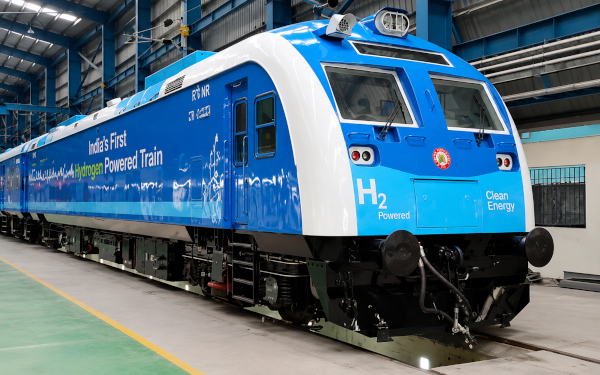
India’s first indigenous hydrogen train marks a major technological step in the country’s railway modernisation journey. It brings together green hydrogen, fuel-cell propulsion, onboard electric traction, local design capability, safety engineering, and route-level hydrogen infrastructure in one integrated railway platform. For Indian Railways, this train is more than a new rolling-stock experiment. It is a working technology demonstrator for the next stage of clean rail mobility.
The project comes at a time when Indian Railways is already moving through one of the world’s largest railway energy transitions. Broad-gauge electrification has advanced at record pace, freight movement is shifting from road to rail, stations and workshops are adopting renewable energy, and the national transporter has set a clear path toward a carbon-light operating future. Hydrogen trains fit into this larger ecosystem as a specialised solution for routes where full overhead electrification involves terrain, heritage, environmental or economic complexity.
The first hydrogen train is planned for the Jind–Sonipat section in Haryana, an 89 km route selected for pilot deployment. The location gives Indian Railways a practical testing corridor with manageable operating conditions, access to supporting infrastructure, and enough route length to study refuelling cycles, traction performance, passenger service behaviour, maintenance planning and safety protocols. A hydrogen train requires much more than a trainset. It needs hydrogen generation, compression, storage, dispensing, onboard containment, fuel-cell control, ventilation, leak detection, power electronics and trained operational crews. Jind therefore becomes a complete hydrogen mobility laboratory on rails.
At the heart of the project is the hydrogen fuel cell. A hydrogen fuel cell produces electricity through an electrochemical reaction between hydrogen and oxygen. Hydrogen reaches the anode side of the fuel cell. Oxygen from air reaches the cathode side. A catalyst separates hydrogen into protons and electrons. The electrons move through an external circuit and create electric current. The protons pass through the membrane and combine with oxygen and electrons on the cathode side, producing water and heat. The train then uses this electricity for traction motors, onboard systems and auxiliary loads.
This makes the hydrogen train an electric train with its own onboard power plant. A conventional electric train draws power from overhead wires. A hydrogen train generates electricity inside the trainset. The fuel cell supplies direct current, which flows through converters, traction inverters and control systems before powering three-phase traction motors. The train behaves like a modern electric multiple unit from the traction side, while its energy source is stored onboard as compressed hydrogen.
The Indian trainset has been developed as a broad-gauge hydrogen-powered platform. Official technical details describe a 10-coach formation with two Driving Power Cars and eight passenger cars. Each Driving Power Car carries a 1,200 kW power system, giving the complete trainset a high-power configuration suited to Indian broad-gauge operations. Recent operational approval details for the pilot service refer to a 10-car trainset powered by a 1,200 kW hydrogen fuel-cell propulsion system and designed for operation at a maximum speed of 75 kmph on the Jind–Sonipat section. These figures show a phased movement from prototype capability to controlled passenger operation.
The Driving Power Car is the most important part of the system. It houses the fuel-cell modules, hydrogen management systems, power electronics, cooling equipment, control cabinets and safety interfaces. In a diesel-electric multiple unit, diesel engines drive alternators that generate electricity for traction. In the hydrogen version, the diesel generator architecture gives way to fuel-cell power packs, hydrogen cylinders, batteries and electronic control systems. The train remains a multiple-unit platform, but its energy chain becomes cleaner, quieter and more digitally controlled.
Hydrogen storage is a major engineering area. Hydrogen has high energy content by mass, yet it has low volumetric density at normal atmospheric pressure. This means it must be compressed and stored in specially designed high-pressure cylinders. These cylinders require strong composite construction, pressure regulation, thermal protection, impact safety and continuous monitoring. Onboard hydrogen systems need valves, regulators, sensors, shut-off devices and pressure relief arrangements. The storage layout must respect railway loading gauge, axle load, crashworthiness, maintenance access and passenger safety requirements.
The refuelling system at Jind forms the second half of the project. Green hydrogen is being produced through electrolysis. In this process, electricity splits water into hydrogen and oxygen. When renewable electricity powers electrolysis, the hydrogen becomes a clean fuel across its production chain. The hydrogen is then dried, purified, compressed, stored and dispensed into the train through a controlled refuelling interface. A railway hydrogen depot must manage pressure, temperature, gas purity, ventilation, earthing, fire safety, emergency shutdown, gas detection and trained handling procedures.
This is where India’s indigenous effort becomes strategically important. The trainset alone is a visible symbol, but the real capability lies in building the entire hydrogen rail ecosystem inside the country. RDSO specifications define technical expectations. Indian Railways supervises system integration. Domestic manufacturing units build the trainset. Energy partners support hydrogen generation and dispensing systems. Safety agencies examine storage and refuelling compliance. A working hydrogen train creates design knowledge, supplier maturity and operating confidence for future routes.
The traction system of a hydrogen train needs careful energy management. Fuel cells work best under steady load. Railway traction demands frequent changes in power because trains accelerate, coast, brake, climb gradients and stop at stations. A battery or energy storage system helps smooth this demand. During acceleration, the fuel cell and battery can supply power together. During cruising, the fuel cell can maintain steady output. During braking, regenerative energy can charge the onboard battery. During station stops, auxiliary loads can run through the managed power system.
This hybrid control philosophy gives the train better efficiency. Batteries support sudden power demand, while fuel cells provide sustained energy. Regenerative braking captures kinetic energy during deceleration and stores it for later use. This is especially useful on routes with frequent stops because every braking cycle becomes an opportunity to recover energy. The onboard energy management software decides when to draw from the fuel cell, when to draw from the battery, when to charge the battery and how to maintain system temperature.
Cooling is another critical engineering function. Fuel cells generate heat during operation. Power electronics also generate heat. Batteries need thermal stability for performance and life. Hydrogen compartments need ventilation and gas monitoring. The train therefore requires a layered thermal management system with coolant circuits, heat exchangers, fans, pumps, sensors and control algorithms. Thermal stability improves reliability, protects expensive components and supports safe operation in Indian climatic conditions.
Safety engineering sits at the centre of hydrogen rail deployment. Hydrogen is light, fast-dispersing and energy-rich. A railway application handles it through design discipline. Storage tanks are built to withstand pressure cycles. Sensors detect leaks quickly. Ventilation prevents gas accumulation. Shut-off valves isolate sections during abnormal conditions. Pressure relief devices protect cylinders during thermal events. Electrical systems follow spark-control and isolation rules. Refuelling stations maintain exclusion zones, gas detection and emergency shutdown systems.
Fire safety and crashworthiness receive special attention because railways carry large passenger loads. The train’s hydrogen equipment must be placed, shielded and monitored to protect passengers and staff. Control systems must identify abnormal temperature, pressure drop, valve failure, sensor alerts and ventilation issues. Crew training becomes part of the safety architecture. Drivers, maintenance teams, station staff and emergency responders need clear procedures for operation, refuelling, isolation and incident response.
The passenger experience can also change. Hydrogen trains generally produce less engine vibration compared with diesel multiple units because the main energy conversion process is electrochemical. Electric traction gives smoother acceleration. The absence of diesel combustion improves local air quality at stations and along the route. The exhaust stream from the fuel-cell process is water vapour and warm air. For passengers, the most visible effect may be a quieter train, cleaner station environment and modern coach experience.
The Jind–Sonipat pilot has deep technical value. It allows engineers to monitor hydrogen consumption per trip, fuel-cell stack behaviour, refuelling time, cylinder pressure patterns, traction response, auxiliary load demand, battery cycling, regenerative braking recovery, depot procedures and maintenance intervals. Data from real Indian conditions will shape future designs. Heat, dust, monsoon humidity, variable passenger load and station patterns all influence system design. A domestic pilot gives Indian engineers operational intelligence that imported specifications alone can never provide.
The project also supports the “Hydrogen for Heritage” vision. Indian Railways has envisaged 35 hydrogen trains for heritage and hill routes. These routes often pass through ecologically sensitive landscapes, tourist regions and historically important corridors. Hydrogen trains can preserve the visual character of such routes while offering clean traction. Hill routes also give engineers a chance to study gradients, braking energy recovery and operating patterns under special terrain conditions. The Jind–Sonipat pilot becomes the foundation before wider heritage deployment.
The economic story will evolve with scale. Early hydrogen trains require higher capital investment because fuel cells, hydrogen storage, refuelling stations and safety systems are specialised assets. Costs improve as production volumes grow, domestic suppliers mature, refuelling stations standardise and fuel-cell modules become common across mobility sectors. India’s wider green hydrogen mission can support this shift by creating demand across railways, ports, trucks, buses, refineries, fertiliser plants and industry. Railways can become one of the anchor customers for a national hydrogen economy.
The National Green Hydrogen Mission gives this railway project a larger industrial context. India aims to build large-scale green hydrogen production capacity, create domestic electrolyser manufacturing, develop supply chains and reduce dependence on imported fossil fuels. A hydrogen train demonstrates demand-side use of green hydrogen in public transport. It also links renewable power, water electrolysis, storage technology, mobility engineering and railway operations in one visible national project.
Indigenous development matters because railway systems require long-term maintainability. Imported technology can start a project, but domestic design knowledge sustains it. Indian Railways operates in varied geography, climate and load conditions. A train that runs in India must suit local maintenance teams, local workshops, Indian standards, Indian track conditions and Indian service expectations. By developing the hydrogen trainset within the national railway ecosystem, India gains control over adaptation, upgrades, component substitution and future fleet expansion.
RDSO’s role is central to this effort. Hydrogen trains combine rolling-stock design, propulsion, gas systems, electrical safety, mechanical integration, braking, fire protection, depot infrastructure and operational standards. RDSO specifications provide the technical language through which manufacturers, operators and safety authorities can work together. A fuel-cell train needs standards for onboard equipment, refuelling, storage, interface control, testing and validation. This standard-setting effort is as important as the train itself.
The hydrogen train also strengthens India’s clean technology manufacturing base. Fuel-cell rail systems require power converters, control software, sensors, high-pressure piping, composite cylinders, battery systems, cooling units, valves, pumps, compressors and electrolyser-linked infrastructure. Each of these components can support domestic industry. A successful rail pilot can help Indian companies gain experience in sectors that will also serve buses, heavy trucks, ports, defence logistics and industrial backup power.
From an energy security perspective, hydrogen rail technology gives India one more tool to reduce liquid fuel demand in transport. Railways already provide a more efficient mode of mass movement than road transport. Hydrogen can deepen that advantage on specialised corridors by replacing diesel traction with locally produced green fuel. When hydrogen is generated from renewable power, the value chain connects Indian sunlight and wind to Indian mobility.
The environmental impact depends on the hydrogen source. A hydrogen train powered by green hydrogen delivers the strongest climate value because renewable electricity drives electrolysis. Tailpipe emissions from the train are limited to water vapour, yet full lifecycle gains depend on clean hydrogen production, efficient compression, reliable storage and high fuel-cell efficiency. This is why the Jind plant based on electrolysis is a significant part of the project. It connects the train to the larger green hydrogen pathway.
The global context also makes India’s project important. Hydrogen trains have already entered service or trial phases in countries such as Germany, Japan, China and the United States. Most early deployments have focused on regional routes, low-carbon mobility experiments and corridors where diesel replacement is attractive. India’s broad-gauge hydrogen train adds a new dimension because it is built for one of the world’s largest railway systems and one of the busiest passenger markets. A successful Indian model can influence hydrogen rail adoption across other large developing countries.
The train’s 10-coach configuration also shows ambition. Many hydrogen train projects globally begin with smaller regional units. India’s approach targets a larger formation suitable for high passenger demand. This requires stronger traction power, more robust thermal management, higher hydrogen storage planning and more careful energy control. It also gives Indian Railways a chance to study hydrogen performance under mass transit conditions rather than a purely symbolic demonstration.
Operational planning will shape success. Hydrogen trains need fixed refuelling windows, trained depot staff, regular inspection of high-pressure systems, stack health monitoring, battery diagnostics and spare-part availability. Maintenance systems will need new skills in electrochemistry, gas handling, sensor calibration and power electronics. Railway workshops that once focused mainly on mechanical and diesel-electric systems will steadily add hydrogen and digital propulsion expertise.
The project also opens the door for future technical upgrades. Fuel-cell stack efficiency can improve. Storage cylinders can become lighter. Batteries can gain higher cycle life. Control software can optimise hydrogen consumption route by route. Refuelling stations can become faster and more modular. Green hydrogen production can link directly with solar and wind assets. Each generation of trainsets can become more efficient, safer and easier to maintain.
For passengers and citizens, the symbolism is powerful. A train has always been one of India’s most familiar public technologies. When a hydrogen train enters service, clean energy becomes visible in everyday life. People see green hydrogen moving through steel tracks, stations and coaches. The national energy transition moves from policy documents into a platform, a timetable and a journey.
India’s indigenous hydrogen train is therefore a milestone in engineering, energy policy and railway modernisation. It combines the practicality of a pilot route with the ambition of a national technology programme. It builds capability in fuel cells, electrolysis, storage, safety and railway integration. It supports green hydrogen demand and gives Indian Railways a new clean-traction option for select corridors.
The long-term promise lies in disciplined scaling. The Jind–Sonipat train will generate operating data. That data will refine design. Refined design will support heritage routes. Heritage deployment will mature suppliers. Mature suppliers will reduce cost. Reduced cost will make hydrogen trains a serious option for more specialised railway applications. This is how a pilot becomes a platform.
India has built the train, prepared the fuel infrastructure and moved the technology toward real service. The next journey belongs to engineers, operators, safety teams and passengers. On the Jind–Sonipat section, hydrogen will move from laboratory promise to railway practice. That journey can become one of the defining stories of India’s green rail future.
Reference:
Press Information Bureau — Manufacturing of India’s First Hydrogen-Powered Train-Set Completed; Green Hydrogen Production Plant Based on Electrolysis Process Being Established at Jind
https://www.pib.gov.in/PressReleasePage.aspx?PRID=2201556
Press Information Bureau — IROAF Invites Bids for Hydrogen Fuel Cell Based Train on Indian Railways Network
https://www.pib.gov.in/PressReleaseIframePage.aspx?PRID=1743631
Press Information Bureau — Indian Railways to Run 35 Hydrogen Trains under “Hydrogen for Heritage”
https://www.pib.gov.in/Pressreleaseshare.aspx?PRID=1896102
Press Information Bureau — Indian Railways: Where Growth Meets Sustainability
https://www.pib.gov.in/PressNoteDetails.aspx?ModuleId=2&NoteId=154552
Press Information Bureau — National Green Hydrogen Mission Targets 5 MMT Green Hydrogen Production by 2030
https://www.pib.gov.in/PressReleaseIframePage.aspx?PRID=1897778
Ministry of New and Renewable Energy — National Green Hydrogen Mission
https://mnre.gov.in/en/national-green-hydrogen-mission/
National Green Hydrogen Mission Portal
https://nghm.mnre.gov.in/overviews.php
U.S. Department of Energy — Fuel Cells
https://www.energy.gov/cmei/fuels/fuel-cells
Alternative Fuels Data Center — How Do Fuel Cell Electric Vehicles Work Using Hydrogen?
https://afdc.energy.gov/vehicles/how-do-fuel-cell-electric-cars-work
Alternative Fuels Data Center — Fuel Cell Electric Vehicles
https://afdc.energy.gov/vehicles/fuel-cell
ScienceDirect — Hydrogen Fuel Cell Electric Trains: Technologies, Current Status and Future Prospects
https://www.sciencedirect.com/science/article/pii/S2666352X24000104
You may also like
-
EON Space Labs and Dhruva Space Advance Indian Space Hardware on Transporter-18 Mission
-
SatLeo Labs’ TAPAS-1 Reaches Orbit, Advancing India’s Private Thermal-Imaging Capability
-
TakeMe2Space’s MOI-1A Reaches Space on Falcon 9 Transporter-18 Mission
-
Bank of Baroda Enters Pension Fund Management After PFRDA Appointment
-
SCI and India’s Push for a Larger Indigenous Maritime Fleet
