War in the Ramayana is often remembered through the thunder of arrows, the roar of Vanara warriors, the fury of Ravana, the courage of Lakshmana, the strength of Hanuman and the calm command of Rama. Yet one of the most sophisticated military lessons in the Yuddha Kanda appears in silence. It arrives before the great assault on Lanka, before the gates are stormed, before the duels begin, and before the city trembles under the weight of battle. It is the lesson of intelligence.
By the time Rama’s army reaches Lanka, the campaign has already achieved something extraordinary. The ocean has been crossed. The bridge has been built. The Vanara host has arrived at the doorstep of Ravana’s island fortress. But reaching Lanka is only the beginning. The real challenge lies ahead: entering a defended city ruled by a king who has placed his strongest commanders at its gates, filled its interior with troops, and prepared for a siege. From outside, Lanka appears as a shining citadel of wealth, pride and military confidence. From a commander’s point of view, it is a closed system. Its true strength lies inside.
This is where Vibhishana becomes more than a political defector. He becomes an intelligence asset of the highest order. He carries memory, access, cultural understanding, command familiarity and insider knowledge. He knows Lanka’s generals, their temperaments, their fighting styles, their loyalties and their place in Ravana’s military structure. He understands the geography of the city and the psychology of its ruler. In modern defence language, Vibhishana brings human intelligence, terrain familiarity and enemy-system knowledge into Rama’s war council.
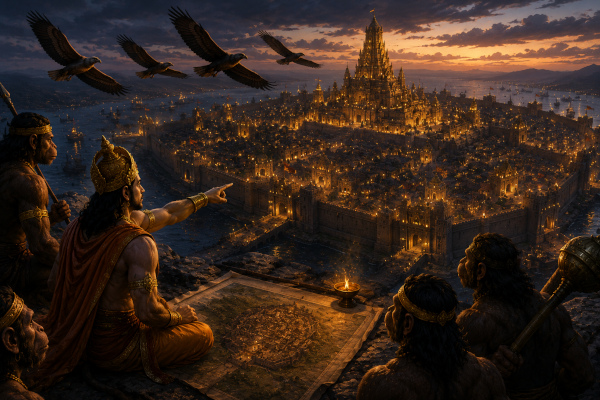
The episode unfolds like a scene from an ancient war room. Rama stands before Lanka, the ocean behind him and Ravana’s golden fortress rising ahead like a challenge carved out of arrogance and power. The Vanara army has reached the enemy’s doorstep, but Lanka is still a mystery from within. Its walls glitter in the distance, its towers watch the sea, its gates are sealed by commanders who know the terrain, and inside the city sits Ravana, surrounded by seasoned warriors, sorcerers, chariots, elephants, cavalry and infantry. A frontal assault based only on courage would turn bravery into waste. At this moment, the war shifts from muscle to mind.
Vibhishana steps forward with the calm confidence of a man who knows Lanka from its courtyards, corridors and command chambers. He understands that Ravana’s city must be read, measured and decoded before it can be broken. So he sends his trusted counsellors — Anala, Panasa, Sampati and Pramati — into Lanka in the form of birds. The image itself is striking: four silent watchers crossing the hostile sky, slipping past ramparts, towers and guards, carrying no banner, drum or weapon of display, only eyes, memory and discipline.
A powerful modern Indian parallel appears in Operation Sindoor. In the Ramayana, Vibhishana’s agents entered Lanka, identified the gates, commanders, troop concentrations and internal reserves, and gave Rama the clarity needed for a sector-wise assault. In May 2025, India followed the same timeless military logic in a modern counter-terror context. After the Pahalgam terror attack, Indian forces launched Operation Sindoor on 7 May 2025, striking terrorist infrastructure in Pakistan and Pakistan-occupied Jammu and Kashmir. PIB described the action as a calibrated response, with nine confirmed terror camps selected through multi-agency intelligence. Another official briefing stated that Indian intelligence had developed an accurate picture of the planners and backers behind the attack. This is the modern form of Vibhishana’s battlefield lesson: before the strike comes the invisible work of identification, verification and target mapping. The weapons may now be precision systems, drones, missiles, surveillance platforms and fused intelligence networks, but the principle remains ancient — the enemy’s hidden structure must first be seen before it can be struck with clarity.
From above, Lanka opens before them like a living military map. They observe the gates, the formations, the troop density and the commanders assigned to each sector. The city that seemed like an impenetrable golden mass from outside begins to reveal its structure. Every gate has a guardian. Every street has movement. Every tower has purpose. The spies watch quietly as the fortress breathes around them. They see where Ravana has placed strength, where he expects attack, where reserves are held, and where the most dangerous warriors wait for battle.
Their report is precise. At the eastern gate, the formidable Prahasta stands in command, guarding the approach with seasoned Rakshasa forces. The east becomes a sector of heavy resistance, watched by one of Ravana’s trusted generals. At the southern gate, Mahaparshva and Mahodara hold the line, two powerful commanders positioned to absorb and crush any breakthrough attempt. At the western gate, the danger deepens: Indrajit, Ravana’s son and master of illusion warfare, waits with heavily armed troops. This is the gate of deception, ambush and sudden destruction. At the northern gate, Ravana himself takes position, turning that sector into the political and psychological centre of the battlefield. Inside the fortress, Virupaksha holds the central reserve, ready to reinforce any gate that begins to weaken.
This is intelligence at its sharpest. The spies return with more than scattered observations. They bring a complete picture of Lanka’s defensive skeleton. They reveal commanders, sectors, troop types and internal reserves. They describe elephants, chariots, cavalry and massive infantry strength inside the city. The information transforms Lanka from a distant fortress into a structured battlespace. Rama’s army now knows that it is facing a layered defence, with strong commanders at the gates and a reserve force positioned at the heart of the city.
The beauty of this moment lies in its military realism. The Ramayana presents war as a contest of vision before it becomes a contest of violence. A great campaign requires reconnaissance before assault, infiltration before breakthrough, observation before command decision, and reporting before deployment. Vibhishana’s counsellors act like ancient intelligence operatives. Their bird-like entry into Lanka resembles aerial reconnaissance in modern warfare, where drones, satellites, surveillance aircraft and high-altitude sensors look down upon enemy territory and convert uncertainty into usable information.
For Rama, the value of the report is immediate. He can now assign commanders according to the strength of each enemy sector. Prahasta at the east demands one kind of response. Indrajit at the west demands another. Ravana at the north becomes the decisive confrontation. Virupaksha in the centre warns Rama that any breach may draw reinforcement from within. The battlefield becomes a grid of threats, priorities and choices. Information creates order.
This is exactly how modern warfare treats intelligence. Before a contemporary army launches a major operation, it studies the enemy’s order of battle. Commanders ask the same questions that Rama’s war council had to answer in Lanka. Who commands each sector? Where are the elite units? Where are the reserves? Which routes are defended? Which areas are watched by artillery, missiles, drones or air defence systems? Which command post controls the battle? Which target, once struck, will disturb the enemy’s entire structure?
Modern armies call this process battlefield preparation. Intelligence teams collect information through satellites, drones, reconnaissance aircraft, electronic intercepts, cyber monitoring, special forces patrols, informants, defectors and open-source analysis. The raw material comes from many directions, but its purpose remains one: to help the commander see the battlefield before committing force. In the Ramayana, Anala, Panasa, Sampati and Pramati play that role with ancient methods. In today’s world, their equivalents fly as UAVs, orbit as satellites, listen as electronic sensors and move quietly as reconnaissance teams.
The bird disguise is especially powerful as a metaphor. A bird sees from above. It crosses boundaries that foot soldiers struggle to cross. It watches movement patterns, gate arrangements, troop concentrations and defensive posture. Modern drones serve the same military instinct. They loiter over hostile territory, study convoys, identify weapon positions, track reserves and feed imagery into command centres. A commander sitting far from the front can watch a battlefield unfold through the eye of a machine. Rama receives that advantage through the eyes of Vibhishana’s agents.
Yet the Ramayana also shows that surveillance alone has limited value. Observation becomes decisive only when it is organised, interpreted and connected to command action. The spies see Lanka, but Vibhishana turns their observations into a battle brief. He names the commanders, identifies the sectors, explains the disposition and presents the threat in a form Rama can use. This is the difference between information and intelligence. Information is what the eye sees. Intelligence is what the mind understands from it.
Modern military headquarters follow the same discipline. A satellite image may show vehicles. A drone may show troop movement. A radio intercept may reveal command activity. A human source may explain morale or intent. Analysts fuse these pieces into a coherent picture. That picture becomes a targeting folder, a movement plan, a deception plan, a strike priority or a defensive adjustment. Vibhishana performs this fusion in the war council. He is both source and analyst, both insider and interpreter.
The Lanka episode also reveals the value of HUMINT — human intelligence. Machines can see, listen and measure, but human sources explain meaning. A drone can see a commander entering a gate; an insider can explain who that commander is, how he fights, what he fears, whom he trusts and how he may respond under pressure. Vibhishana knows Ravana’s system from within. His agents confirm current deployments. Together, they create a complete intelligence picture: identity, location, strength, intent and readiness.
There is another lesson for defenders. Ravana’s fortress is strong, but its arrangement becomes visible. Once an enemy’s defence is mapped, its aura weakens. Walls still stand, gates still hold, warriors still wait, but secrecy begins to collapse. Modern defenders understand this deeply. An air defence battery, command bunker, ammunition depot, armour concentration or missile launcher becomes vulnerable once detected, classified and fed into a strike chain. That is why modern militaries invest heavily in camouflage, concealment, decoys, mobility, electronic discipline, counter-intelligence and deception. The ancient problem remains alive: hide your strength, mislead the watcher, preserve uncertainty.
Indrajit’s placement at the western gate adds a fascinating layer. He is the warrior of illusion, surprise and psychological shock. In modern terms, he represents the sector of hybrid threat — ambush, deception, special weapons, hidden attack and battlefield confusion. Assigning Hanuman to that sector is a brilliant matching of capability to threat. Hanuman has already entered Lanka once, studied the city, survived capture, burned its structures and returned with strategic clarity. Against Indrajit’s dangerous sector, Rama sends a warrior with reconnaissance experience, fearlessness and operational flexibility.
Ravana at the northern gate carries political symbolism. A ruler who takes position at a gate turns that sector into a centre of gravity. The enemy’s morale, prestige and command identity gather around him. For Rama, this becomes the decisive axis. The fight against Ravana is both military and moral. It is the place where battlefield victory and dharmic justice converge. Vibhishana’s intelligence allows Rama to recognise where physical strength and symbolic power meet.
Virupaksha in the centre is equally important. A central reserve is the heartbeat of a fortress defence. It allows the defender to reinforce a threatened sector, counterattack a breach and prevent collapse. The spies’ discovery of Virupaksha’s position gives Rama a crucial warning: entering through one gate may still trigger resistance from the city’s interior. Modern urban warfare follows this same logic. A defending force keeps reserves behind the front line, hidden in depth, ready to move through internal roads, tunnels, buildings or prepared routes. A commander who ignores reserves walks into a trap.
The Ramayana’s intelligence scene also shows disciplined leadership. Vibhishana delivers alarming information: powerful commanders, massive troops, fortified gates and Ravana himself in position. Rama absorbs it calmly. He converts it into assignments. Nila is directed toward Prahasta’s eastern gate. Angada is set against the southern defenders. Hanuman faces the western gate where Indrajit waits. Rama and Lakshmana move toward the northern gate and Ravana. Sugriva, Jambavan and Vibhishana hold the central arrangement. This is command under pressure: hear the report, understand the threat, distribute responsibility and seize initiative.
In modern warfare, this is called tempo. The side that processes information faster acts faster. The side that acts faster shapes the fight. Intelligence gives tempo because it reduces hesitation. Rama’s army gains clarity before Ravana can impose confusion. The assault becomes sector-based, commander-led and threat-aware. The invisible work of spies becomes visible in the structure of the attack.
This episode also fits into a larger pattern in the Ramayana. Hanuman’s journey to Lanka is strategic reconnaissance. He locates Sita, observes Ravana’s court, studies the city and returns with mission-critical information. Vibhishana’s spy network later performs tactical reconnaissance. It studies gate defence, troop deployment and internal reserves. Together, these two episodes show a layered intelligence cycle: first understand the enemy’s political and moral centre, then map his military arrangement. The Ramayana places both forms inside the same campaign.
For modern India, the lesson is deeply relevant. A country facing complex threats across land borders, maritime zones, airspace, cyberspace and information domains requires strong intelligence fusion. Satellites, UAVs, coastal radar chains, electronic warfare systems, maritime patrol aircraft, cyber monitoring, human networks and special reconnaissance all contribute to national security. The purpose is the same one seen at Lanka: see early, understand clearly, decide quickly and act with precision.
The modern battlefield has expanded far beyond walls and gates. A gate today may be a mountain pass, a naval chokepoint, an air defence corridor, a cyber gateway, a logistics hub, a communication node or a satellite-linked command centre. A Prahasta may command armour. An Indrajit may operate drones, electronic deception or long-range precision weapons. A Virupaksha may sit behind the frontline as a mobile reserve. A Ravana may remain inside a hardened command structure, protected by layers of security and propaganda. The names have changed; the logic endures.
The ethical dimension matters as well. Rama’s use of intelligence serves a righteous military objective: the rescue of Sita and the defeat of adharma. The Ramayana distinguishes between cunning used for domination and intelligence used for justice. Vibhishana’s information serves a lawful and moral campaign. Modern democracies also place intelligence within political and ethical frameworks. Intelligence is powerful because it can shape war before war fully begins. Its legitimacy depends on purpose, discipline and accountability.
The cinematic power of the Lanka episode comes from its silence. No massive weapon is fired. No warrior roars. No duel begins. Yet a major part of the battle is already being fought. Four disguised scouts move through the air, study the fortress, return to the war council, and shift the balance of the coming assault. Lanka still stands tall, Ravana still sits proud, and the gates still remain guarded, but the city has lost something crucial — secrecy. Once an enemy’s arrangement is seen, named and understood, the first crack has already opened in the wall.
This is why the episode deserves a central place in any study of ancient Indian military thought. It shows that war is a contest of knowledge as much as strength. Weapons may break gates, but information opens them first. Vibhishana’s bird-spies become the unseen eyes of Rama’s campaign. Their report turns the siege of Lanka from a heroic charge into a planned military operation. The battle ahead will be fought with arrows, maces, mountains and divine weapons, but its foundation is laid here — in observation, infiltration and the disciplined art of knowing the enemy before striking him.
The final lesson is direct and timeless. Armies fight with weapons, but commanders win through information. In Lanka, that information comes through spies in the form of birds. In the modern world, it comes through satellites, drones, reconnaissance aircraft, cyber probes, electronic intelligence, defectors, field sources and special operations teams. Across ages, the principle remains unchanged: before the assault comes the invisible battle for knowledge. Whoever wins that battle begins the war already inside the enemy’s walls.
You may also like
-
ASEAN Diplomats Visit BrahMos Facility as India Showcases Defence Engineering Capabilities
-
India and UAE Agree to Expand Army Cooperation and Desert Cyclone Participation
-
ARKin Labs Showcases Indigenous UAV Avionics for Defence, Agriculture and Enterprise Drones
-
Keralam’s axldrone Showcases Indigenous UAV Platforms and Components in New Delhi
-
India and Myanmar Prepare for Third Annual Defence Dialogue in Guwahati
