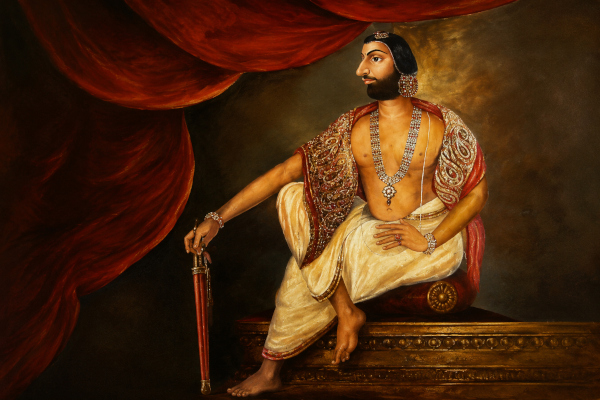
Anizham Thirunal Marthanda Varma stands among the most consequential rulers in Kerala’s history because he did something far greater than win battles. He took a fragmented southern Kerala political landscape, broke the power of feudal lords, defeated a European colonial trading power, built a disciplined army, reorganised revenue and commerce, expanded Venad into Travancore, and then placed the entire kingdom under the spiritual sovereignty of Sri Padmanabha. In Kerala’s political memory, he is not merely a successful king; he is the architect of modern Travancore.
Marthanda Varma ascended the Venad throne in 1729. Britannica notes that he crushed Dutch expansionist designs at the Battle of Kolachel twelve years later and then adopted a European style of martial discipline while expanding Venad into the southern state of Travancore. That single summary captures the scale of his reign: internal consolidation, military modernisation, territorial expansion and state-building.
Before Marthanda Varma, Venad was not yet the strong Travancore remembered in later history. It was a kingdom constrained by aristocratic houses, temple-linked power centres, local chieftains, rival principalities and external commercial forces. Kerala’s coast in the eighteenth century was not just a cultural zone; it was a battlefield of pepper, ports, diplomacy and cannon. European companies were not merely buying spices. They were trying to shape the politics of the Malabar coast through trade monopolies, military alliances and pressure on local rulers.
Marthanda Varma understood this world with unusual clarity. He knew that a king who did not control land, army, revenue, ports and trade would remain a ceremonial ruler trapped inside a feudal web. His first great achievement was therefore internal: he subdued rebellious aristocratic forces and brought royal authority under a centralised structure. This was the foundation on which Travancore rose.
His territorial expansion was systematic. The official city history of Thiruvananthapuram records that modern Travancore begins with Marthanda Varma, who inherited Venad and expanded it by conquering Attingal, Kollam, Kayamkulam, Kottarakara, Kottayam, Changanassery, Meenachil, Poonjar and Ambalapuzha. This was not random conquest. It was strategic unification. By absorbing smaller principalities, he created a larger, more defensible and more economically coherent state stretching across important agrarian and coastal zones.
The defining military event of his reign was the Battle of Colachel in 1741. The Dutch East India Company was then a major European commercial force in the Indian Ocean. Its power depended heavily on spice procurement, coastal influence and political alliances with local powers. Marthanda Varma’s expansion threatened that system. When the Dutch challenged Travancore, the conflict became more than a regional war; it became a contest between an Indian kingdom asserting sovereignty and a European company defending its commercial-political network.
The Travancore State Manual records that the Dutch invaded southern Travancore, advanced after landing at coastal points, and threatened the region between Colachel and Kottar. Marthanda Varma moved quickly to protect Padmanabhapuram, raised additional Nair forces and confronted the Dutch. The manual records the famous battle of Colachel in 1741 and states that the Dutch were completely defeated, retreating to their ships and abandoning their fortifications.
The figures from the Travancore State Manual are striking. After Colachel, the Travancore army captured 24 prisoners, 389 muskets, a few cannon and a large number of swords. This was not merely symbolic. In eighteenth-century warfare, muskets, cannon and trained European personnel were military assets. Marthanda Varma transformed victory into capability. Among the captured Dutch officers were Eustachius De Lannoy and Donadi. Rather than simply treat them as defeated enemies, Marthanda Varma absorbed their expertise into Travancore’s military system. De Lannoy, later remembered as Valiya Kappithan, helped organise and drill Travancore’s army on European lines.
This shows Marthanda Varma’s strategic intelligence. Many rulers could win a battle; fewer could convert enemy skill into state strength. Colachel gave Travancore prestige, weapons, trained personnel and psychological advantage. Peace with the Dutch was finally concluded and ratified in 1748, several years after the battle. By then, Dutch ambitions on the southern Kerala coast had suffered a major blow.
After the wars, Marthanda Varma turned from conquest to consolidation. The Travancore State Manual records that once hostilities ceased and the kingdom’s territory extended towards the limits of Cochin, he directed attention to internal reform. De Lannoy was commissioned to improve the military department, while Ramayyan Dalawa handled revenue administration.
The military reforms were large in scale. De Lannoy became commander-in-chief of the Travancore forces. Fortifications were strengthened at Padmanabhapuram and Udayagiri, stone walls replaced weaker mud defences at important mountain passes, an arsenal was established at Udayagiri for cannon, mortars, weapons, powder and shot, and coastal batteries were erected between Cape Comorin and Poracad. The State Manual states that the army was raised to 50,000 troops, including cavalry, infantry, artillery and irregulars, and was disciplined after the European model.
That figure—50,000 troops—is central to understanding Marthanda Varma’s statecraft. Travancore was no longer merely a traditional coastal kingdom dependent on feudal levies. It was becoming a standing military state with fortifications, arsenals, trained regiments, reserves and supply points. Padmanabhapuram, Thiruvananthapuram and Quilon were made central reserves for men and ammunition. In modern terms, Marthanda Varma was building command depth, logistics and military infrastructure.
Revenue reform was equally important. Under Marthanda Varma’s direction, Ramayyan Dalawa organised a commercial department, established storehouses and depots at Padmanabhapuram, Thiruvananthapuram, Quilon, Mavelikara and Arakkuzha, and stored commodities such as pepper, tobacco, cassia and arecanut purchased at rates fixed by the state. The state also monopolised trade in these goods and regulated their sale. This system gave Travancore stronger control over revenue, exports and strategic commodities, especially pepper, which was the black gold of the Malabar coast.
The land administration reforms were another major achievement. The State Manual records that a survey of the whole state began in 1750–51, that the principle of periodic assessment replaced annual rate-fixing, and that the work was completed in three years. Each landholder received a pattah specifying the tax levied on the property. This is a crucial administrative milestone. A kingdom that surveys land, fixes assessment and issues pattahs is moving from personal rule towards bureaucratic governance.
Marthanda Varma’s rule also reshaped Thiruvananthapuram’s historical destiny. The official city history records that after the dedication of Travancore to Sri Padmanabha, the rulers governed as servants of Sri Padmanabha, or Padmanabhadasas. This was not just a devotional gesture. It was a political-theological transformation of kingship.
The most famous act of Marthanda Varma’s reign was the Thrippadidanam, the dedication of the kingdom to Sri Padmanabha. The NUS Institute of South Asian Studies records that on 17 January 1750, Marthanda Varma surrendered the kingdom of Travancore to Lord Padmanabha Swamy and pledged that he and his descendants would serve as Padmanabha Dasa. The Supreme Court of India’s Padmanabhaswamy Temple judgment also records that the kingdom was surrendered to Sri Padmanabhaswamy and that the rulers thereafter conducted themselves as Padmanabhadasas and agents of the deity.
This act gave Travancore a unique model of sacred sovereignty. The king was not projected as the absolute owner of the kingdom. He was the servant, trustee and agent of the deity. The Supreme Court judgment explains that every ruler of Travancore would call himself Padmanabhadasa, meaning one engaged in the service of Sri Padmanabhaswamy. In political language, Marthanda Varma converted royal power into sacred trusteeship. In cultural language, he made governance an offering.
His legacy therefore rests on four pillars. First, he unified territory and created modern Travancore from Venad. Second, he defeated the Dutch at Colachel and broke a major European colonial design on the southern Kerala coast. Third, he built a disciplined military-administrative state with forts, arsenals, a large army, regulated commerce and land assessment. Fourth, he spiritualised Travancore’s kingship through the dedication to Sri Padmanabha, creating the Padmanabha Dasa tradition that continued through later rulers.
Marthanda Varma’s greatness lies in the combination. A king may be remembered for piety but lack military strength. Another may win battles but fail to build institutions. Another may expand territory but leave no moral architecture behind. Marthanda Varma did all four. He fought like a strategist, governed like a state-builder, negotiated power like a realist and surrendered kingship like a devotee. That is why Kerala remembers him not simply as one more ruler in a royal line, but as the maker of Travancore.
You may also like
-
Rare Stone Features Emerge as Kerala Archaeology Department Restores Megalithic Kudakkals at Karivellur
-
Vidarbha in the Mahabharata: The Ancient Kingdom of Damayanti in Eastern Maharashtra
-
Abhira in the Mahabharata: The Pastoral People of Western India and the Northern Deccan
-
Nasikya in the Mahabharata World: The Ancient Nashik Region on the Upper Godavari
-
Bharukachchha in the Mahabharata: The Ancient Port of Bharuch at the Mouth of the Narmada
