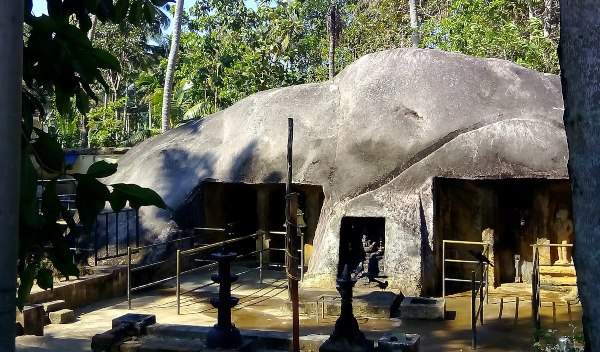
Hidden within the undulating laterite landscapes of southern Kerala, near Vizhinjam in Thiruvananthapuram district, the Kottukal Rock-Cut Cave Temple stands as a quiet testament to an architectural tradition that chose stone as both medium and message. Unlike the towering gopurams of Tamil Nadu or the timber-heavy temple complexes of Kerala, this shrine emerges from the earth itself—excavated, not constructed, shaped by chisels that worked directly into a massive rock face.
The temple is believed to date back to around the 6th to 8th centuries CE, placing it within the early medieval phase of South Indian temple evolution. This period witnessed the spread of rock-cut architecture across peninsular India, influenced by earlier traditions seen in sites like Mahabalipuram and Badami. In Kerala, where climatic conditions favored laterite and wood, such rock-cut monuments remain rare, making Kottukal an important outlier in the region’s architectural history.
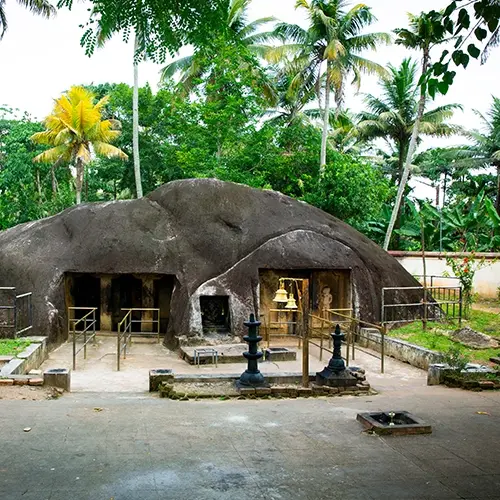
The defining feature of Kottukal is its twin cave sanctum layout, carved into a single large rock. The temple consists of two adjacent cave chambers, each functioning as a shrine. These are not natural caves but man-made excavations, carefully hollowed out with symmetrical planning. The sanctums are modest in scale, yet their proportions reflect a deliberate architectural grammar—simple, functional, and deeply symbolic.
Inside the primary sanctum resides a Shiva Lingam, the aniconic representation of Lord Shiva, which remains the central object of worship. The second chamber is believed to have housed other deities, with later traditions associating it with Ganesha or other forms of Shaiva worship, though the exact original consecration remains a subject of scholarly interpretation. The absence of elaborate iconography suggests an early phase of temple design, where sacred presence took precedence over decorative complexity.
Architecturally, the temple displays minimalist yet precise carving techniques. The walls, pillars, and ceiling are all hewn from the same rock mass, creating a unified structural form. The façade includes simple openings and a slightly recessed entrance, allowing natural light to filter into the sanctum while maintaining a sense of enclosure. The interior surfaces are relatively plain, lacking the ornate sculptures seen in later temples, which points to an austere aesthetic aligned with early Shaiva traditions.
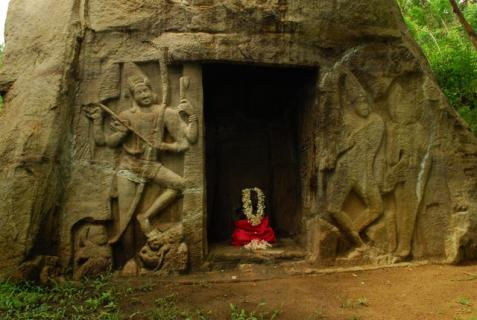
The rock itself, composed of hard laterite and granite-like formations, would have required sustained effort and skilled craftsmanship to excavate. The process involved cutting into the rock horizontally and then expanding inward, ensuring structural stability while achieving the desired internal volume. This method reflects a deep understanding of material behavior, as any miscalculation could compromise the integrity of the entire structure.
Beyond its physical form, Kottukal is enveloped in local legend, which adds a layer of cultural memory to its stone silence. One popular tradition attributes the temple’s creation to the Pandavas from the Mahabharata, who are said to have carved the cave during their exile. Such associations are common across ancient Indian sites, where epic narratives serve to anchor monuments within a broader civilizational story. Another local belief connects the temple to sage Agastya, the revered rishi credited with spreading Vedic culture across southern India. These legends, while not historically verifiable, reflect the temple’s enduring presence in the collective imagination.
The temple’s orientation and layout also suggest a connection to ritual practices and natural elements. The entrance allows controlled light penetration, creating shifting patterns within the sanctum that enhance the spiritual atmosphere. The surrounding landscape—once dense with vegetation and close to ancient trade routes near the coast—would have provided both isolation and accessibility, making it an ideal site for worship and meditation.
Today, the Kottukal Cave Temple is maintained under the care of the Kerala State Department of Archaeology, which recognizes it as a protected monument. Despite its historical significance, the site remains relatively understated compared to more prominent temple complexes, preserving an atmosphere of quiet continuity rather than spectacle.
In a region where temple architecture evolved toward elaborate wooden superstructures and tiled roofs, Kottukal stands apart as a memory of an earlier architectural experiment—a time when devotion was carved directly into stone, and permanence was achieved through subtraction rather than addition. It is a structure that does not rise above the earth but sinks into it, inviting those who enter to step not just into a shrine, but into a fragment of time preserved in rock.
Reference:
https://keralatourism.org/destination/kottukal-cave-temple/365
https://www.kerala.gov.in/kerala-archaeology
https://www.nativeplanet.com/thiruvananthapuram/attractions/kottukal-cave-temple/
https://www.keralatourism.org/kerala-360/kottukal-cave-temple/2056
https://www.indianetzone.com/44/kottukal_rock_cut_cave_temple.htm
https://www.tripadvisor.in/Attraction_Review-g297637-d3912890-Reviews-Kottukal_Cave_Temple-Thiruvananthapuram_Trivandrum_Thiruvananthapuram_District_Ker.html
https://www.sahapedia.org/kottukal-rock-cut-temple-kerala
You may also like
-
Mekala in the Mahabharata: The Ancient Highland Kingdom of Amarkantak and the Maikal Hills
-
Anupa in the Mahabharata: The Ancient Narmada Kingdom of Mahishmati and the Maheshwar Region
-
Sarnath Joins UNESCO World Heritage List as India’s Civilisational Legacy Gains Global Recognition
-
Ancient Bazira-Barikot of Gandhara Gains UNESCO Recognition as 3,000 Years of Urban History Emerge From Swat
-
Vaidisha in the Mahabharata-Era Geography: The Ancient Vidisha Region of Central Madhya Pradesh
