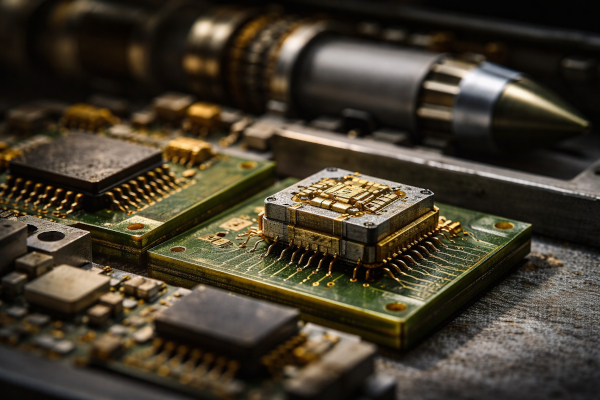
In modern precision weapons, the glamour usually goes to seekers, propulsion, guidance laws, datalinks, and warheads. Yet one of the most consequential technologies sits far deeper in the firing chain, buried inside the fuze and safety architecture: the high-g MEMS switch. DRDO describes its own high-g MEMS non-latch switches as building blocks for Safe and Arm Devices (SAD) in smart missiles and projectile systems, and states that the technology has already been handed over to TBRL, Chandigarh for safe-and-arm applications. That official description is concise, but its significance is immense. A munition can only become intelligent, miniaturized, and combat-ready when its internal safety logic survives launch shock, understands the firing environment, and authorizes initiation only at the correct point in the sequence. High-g MEMS switches are central to that chain of trust.
At the most basic level, a high-g MEMS switch is a micro-electromechanical inertial switch engineered to change electrical state when it experiences acceleration above a defined threshold. In plain terms, it is a tiny mechanical-electrical gate that can sense a violent launch event and respond within microseconds. Reviews of MEMS inertial switches describe them as threshold devices whose on-off state changes when environmental acceleration reaches a preset value. In fuze and S&A applications, that matters because the weapon must distinguish between benign handling loads and the very specific acceleration signature associated with launch, setback, impact, spin, or terminal events. The result is a component that behaves less like an ordinary electronic switch and more like a miniature physical logic element, using mass, springs, beams, contact surfaces, and controlled motion to decide whether the firing train remains interrupted or is allowed to progress toward arming.
The phrase “high-g” is the key to understanding the defence value of the technology. Missile launchers, gun-fired projectiles, mortar rounds, and certain terminal effects environments expose internal components to accelerations far beyond what commercial MEMS sensors typically face. Open technical literature on MEMS S&A devices and fuze arming mechanisms routinely discusses launch and setback environments in the tens of thousands of g, with one MEMS S&A study explicitly analyzing operation under 20,000 g setback acceleration. These switches have to ovecome brief, brutal, mechanically punishing impulse regimes where size, mass distribution, contact reliability, off-axis sensitivity, and shock survivability become decisive. A flashy chip that works in a lab and fails after launch is worthless in a fuze. A high-g MEMS switch has to survive the event, detect it correctly, and preserve timing discipline under the most violent mechanical loads in the weapon.
This is where the connection to Safe and Arm Devices becomes strategically important. A SAD exists to keep the explosive train physically or functionally interrupted during storage, transport, handling, loading, and early launch, then arm only after a validated set of conditions is satisfied. Reviews of MEMS S&A systems describe them as devices that control the transfer of energy through the initiation train of ammunition, integrating blocking, release, and actuation functions within miniature structures. In a modern smart missile or guided projectile, the SAD is the final internal custodian of safety. The weapon may have navigation updates, terminal seekers, programmable fuze modes, and proximity logic, but none of that matters if the internal arm/safe chain is bulky, unreliable, slow, or too fragile to survive launch. High-g inertial switches therefore serve as the fundamental event detectors that tell the S&A mechanism, “the munition has genuinely entered its launch environment; the arming sequence may begin under controlled conditions.”
Technically, these switches can be configured in several ways, but the underlying principle is consistent. A suspended proof mass, beam, spring, slider, or compliant electrode remains separated from a contact surface under normal handling. When acceleration exceeds the design threshold, inertial force drives the moving element into contact or releases a latch, creating a discrete electrical or mechanical event. The challenge lies in making that response precise rather than accidental. Technical surveys emphasize threshold control, response time, off-axis immunity, and structural robustness as the central design problem. Published examples show how redesigned MEMS inertial switches have achieved threshold acceleration around 70 g with 30 microsecond turn-on response in one class of device, while more weapon-oriented designs integrate setback sliders, arming sliders, locking features, pawls, or barrier mechanisms into microscale architectures. In fuze systems, the switch often feeds a larger logic sequence rather than acting alone; it can be the first confirmation layer in a chain that also checks spin, time delay, environmental exposure, or command input before arming is completed.
The reason MEMS matters here is miniaturization with physics discipline. Conventional inertial switches and safing mechanisms can be bulky, heavier, harder to package, and less suited to compact guided ammunition. MEMS allows the switch to be integrated into extremely small volumes while preserving repeatable geometry and enabling mass fabrication techniques. Reviews of MEMS S&A development repeatedly identify miniaturization, integration, and suitability for intelligent munitions as the main reasons the field has advanced so aggressively. That shift matters for smart projectiles and missiles because internal real estate is brutally contested. Guidance electronics, batteries, sensors, actuation channels, thermal protections, explosive trains, and power conditioning all fight for millimeters. A compact high-g MEMS switch gives designers a way to compress the safing logic into a much smaller footprint without surrendering the mechanical authenticity of inertial sensing.
There is also a deep systems engineering advantage in using MEMS switches for launch-event recognition rather than relying only on software or general-purpose accelerometers. A dedicated inertial switch is inherently event-driven. It consumes very little power, can remain dormant for long periods, and can be designed to react only when a sharply defined mechanical threshold is crossed. Technical literature on inertial switches increasingly frames them as efficient event-based devices that wake or authorize downstream subsystems only when the required dynamic condition appears. In defence terms, that means safer dormant storage, better resistance to false wake-up, and clearer sequencing inside the munition. In a missile or projectile, this contributes to a cleaner separation between pre-launch safe status and post-launch controlled arming progression.
The distinction DRDO makes when it calls its technology “non-latch” is also meaningful. In general engineering terms, a latching switch remains in its new state after activation, while a non-latching device returns when the driving condition disappears unless supported by a wider mechanism. In a SAD architecture, that can be advantageous depending on how the inertial switch is used—whether as a transient verifier of launch shock, a timing cue to a subsequent arming stage, or an environmental discriminator working alongside other barriers and locks. The public DRDO description does not disclose the detailed architecture, so it would be unsafe to overstate the exact implementation. Still, the label strongly suggests a design intended to provide a precise acceleration-triggered signal to the larger safe-arm system rather than functioning as the full arm/hold mechanism by itself. That is entirely consistent with modern layered fuze logic, where different microsystems each validate one part of the ballistic environment before the explosive path is fully aligned.
From a defence-industrial perspective, this class of technology is far more important than its tiny size suggests. High-g MEMS switches sit at the intersection of microfabrication, fuze engineering, missile safety, and munition miniaturization. They influence whether India can field more compact guided rounds, more sophisticated programmable fuzes, and safer high-performance projectiles with indigenous internal architectures. They also reduce dependence on imported microscale safing elements in a category where qualification, shock certification, and military reliability are especially sensitive. Because DRDO has already linked the technology to TBRL for S&A applications, the switch can be viewed as part of a broader domestic fuze and warhead ecosystem rather than a laboratory curiosity. It is a classic enabling technology: unseen in parade photographs, yet decisive in determining whether an advanced weapon is merely designed on paper or genuinely manufacturable, certifiable, and deployable.
The battlefield relevance becomes even clearer when viewed through the lens of smart munitions evolution. As projectiles and missiles become more networked, more mode-selectable, and more discriminating in target engagement, the internal firing chain has to become both smarter and safer. That means the arming system must cope with different launch profiles, tighter packaging, higher reliability requirements, and more sophisticated fault containment. Open reviews of MEMS S&A systems emphasize that these devices are becoming indispensable to weapon miniaturization, integration, and intelligence. The logic is straightforward: a future weapon can have exquisite guidance, but it still needs a trustworthy microscopic “permission architecture” that decides when the warhead becomes live. High-g MEMS switches are among the earliest sentinels in that architecture.
In cinematic terms, this is the technology that sits in silence while the missile rests on a rail, while the shell sits in a chamber, while the round is carried through storage depots and transport columns. Then the launch comes—a violent pulse of acceleration, a shock wave of force through metal and explosive, a fraction of a second in which the weapon must recognize that it has truly entered battle. The high-g MEMS switch is one of the first components to understand that moment and execute without flaw.
Reference:
https://drdo.gov.in/drdo/en/industry-partner?page=3
https://www.drdo.gov.in/drdo/en/offerings/products/high-g-mems-switches
https://pmc.ncbi.nlm.nih.gov/articles/PMC8951254/
https://www.sciencedirect.com/science/article/pii/S221491472030026X
https://pmc.ncbi.nlm.nih.gov/articles/PMC8880680/
https://pmc.ncbi.nlm.nih.gov/articles/PMC9331202/
https://pmc.ncbi.nlm.nih.gov/articles/PMC9316114/
https://pmc.ncbi.nlm.nih.gov/articles/PMC10385871/
https://pmc.ncbi.nlm.nih.gov/articles/PMC10303067/
https://pmc.ncbi.nlm.nih.gov/articles/PMC6412507/
https://publications.sto.nato.int/publications/STO%20Educational%20Notes/RTO-EN-AVT-105/EN-AVT-105-03.pdf
https://www.mdpi.com/2072-666X/13/3/359
You may also like
-
Exercise Tarang Shakti 2026 Concludes in Jodhpur, Showcasing India’s Air Power, Indigenous Defence Technology
-
Indian Navy Vice Chief Inspects Japan’s Mogami-Class Stealth Frigate as India-Japan Shipbuilding Cooperation Expands
-
Philippine Marine Wargames Reportedly Show BrahMos Can Penetrate Chinese Destroyer Air Defences
-
Safran Signs 18 Agreements with Indian Aerospace Suppliers, Expanding Make in India Manufacturing Partnerships
-
Indian Army’s Vajra Corps Certifies First Batch of Drone Operators, Strengthens Battlefield Surveillance
