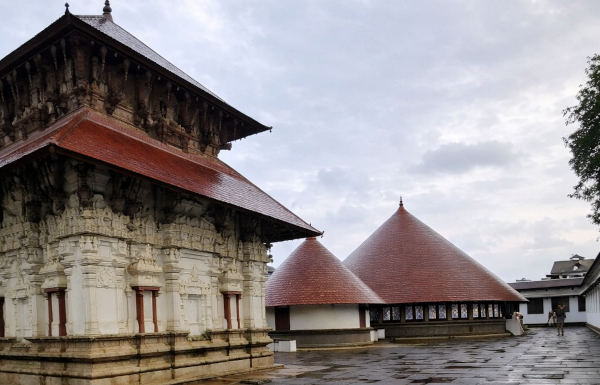
Valiyasala Mahadeva Temple, also known as Kanthalloor Mahadeva Temple, stands in Valiyasalai, Thiruvananthapuram, and is one of the capital region’s most layered sacred sites. Kerala Tourism identifies it as an ancient temple dedicated to Lord Shiva, and local historical memory ties it closely to Kanthalloor Sala, the celebrated centre of learning often described as the “Nalanda of South India.” That association gives the temple a stature larger than that of a city shrine: it is remembered as a place where worship, scholarship, and political history once stood side by side.
The history of the site comes with both strong tradition and some scholarly debate. A 2020 academic study on Kanthalloor Salai says scholars broadly associate the old salai with the Trivandrum urban belt that includes Valiyasala, Chinnasala, Aryasala, Chala and adjoining localities, though alternate theories place the older institution nearer Vizhinjam and suggest that its functions or symbols may have shifted inland after Chola pressure. The same study points to older references and inscriptions linking the Valiyasala Mahadeva temple to Kanthalloor Salai, and notes that the deity was known as Kanthalloor Jwala Mahadevar. Historical consensus, says the salai flourished between the 9th and 12th centuries, taught more than 64 subjects, attracted students from as far as Sri Lanka, and later disappeared in war. The academic paper also preserves a striking institutional memory: around 95 to 96 students are described as being maintained by the university, and roughly 61 streams of knowledge are said to have existed under one roof.
The temple complex itself carries a form and layout that make it stand apart. Temple-history compilations describe it as set within a 4.5-acre compound, widely regarded as more than 1,000 years old, with tradition placing it before 1045 CE and many scholars assigning an earlier origin. The complex is remembered as a Trimurti temple: Shiva is the principal deity, while Brahma and Vishnu have major shrines within the same precinct. The Brahma and Shiva shrines are described as vatta sreekovils, or circular sanctums, while the Vishnu shrine is two-storeyed and noted for granite carvings. Accounts of the temple’s sculptural program mention scenes such as Devasura Yudham and Palazhi Madhanam, along with figures of Krishna, Narada, Narayani, and Lalithambika. The precinct is also said to contain 56 balikkal. These details, together with a 2012 conservation report that singled out the temple for its architectural uniqueness, wood carvings, and mural paintings, explain why the shrine is treated as an important heritage monument as well as a living place of worship.
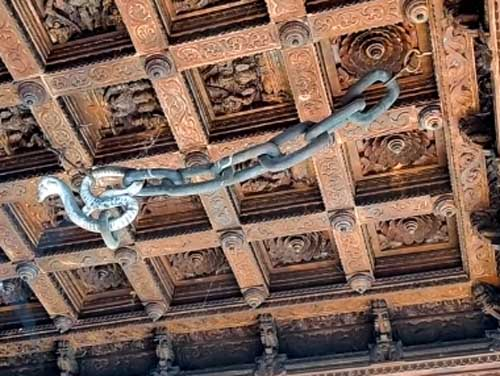
The legends attached to Valiyasala Mahadeva Temple are vivid and unusually dramatic. In temple tradition, the shrine rises out of a devastating conflict involving the Chera, Chola, and Pandya realms. The story says kings and warriors fell in battle in the Kanthalloor region, their queens entered the funeral pyres, and from that blaze emerged a fierce Shivalinga. To pacify this fiery manifestation of Shiva, shrines for Brahma and Vishnu were consecrated beside him, giving the temple its distinctive Trimurti character. Another deeply local legend centres on the temple’s unusual absence of the customary Nandi before Shiva. A temple tradition says Nandi departed in anger over improper worship and settled at Thaliyal, and that during the annual Arattu the deity still halts there ceremonially. Yet another legend speaks of a powerful Siddha who subdued the serpent energy of the region and transformed it into the famous single-stone snake sculpture bound with an iron chain above the Vishnu shrine’s sopana mandapam. These stories belong to sacred memory rather than verifiable political history, yet they are central to how devotees understand the aura of the temple.
One of the reasons the temple remains so resonant in Thiruvananthapuram is that it still lives through ritual, procession, and festival. A festival listing for the shrine describes a 10-day annual festival that concludes with Arattu on the Thiruvathira nakshatra in the Malayalam month of Kumbham. The observances include kodiyettam or flag hoisting at the start, followed later by Gaja Pooja, aanayoottu, pallivetta, and the concluding Arudra Darshanam ritual. In that sense, Valiyasala Mahadeva Temple remains what it has likely been for centuries: a space where memory survives through repeated movement, sound, and worship rather than through stone alone.
The present-day story of the temple also reflects renewed concern for conservation. The Travancore Devaswom Board shrine was shortlisted in 2012 for scientific restoration because of its architectural and artistic value. More recently, media reported that the Thiruvananthapuram corporation first approved a Rs 2.5 crore heritage redevelopment proposal in 2024, and that by 2025 the planned allocation had risen to Rs 10 crore, with work aimed at restoring the sivelipatha, repairing the leaking roof, laying underground cables, and improving the precinct with eco-friendly pathways. That modern effort mirrors the older truth of Valiyasala Mahadeva Temple: it is a shrine where history, legend, architecture, scholarship, and civic memory continue to meet in the middle of a fast-changing capital city
References:
- Kerala Tourism, Government of Kerala. “Valiyasala Mahadeva Temple, Thiruvananthapuram.”
https://www.keralatourism.org/temples/thiruvananthapuram/kanthalloor-valiyasala-mahadeva - G. S. Panicker. “Kanthaloor Salai: Applying Informatics for Survey, Excavation and Conservation of the Sites of Ancient University of South India.” Informatics Studies.
https://www.informaticsstudies.org/index.php/informatics/article/view/630
https://www.ksijmr.com/7.6.1.pdf - OnManorama. “When Thiruvananthapuram housed the Nalanda of the South.”
https://www.onmanorama.com/news/kerala/2019/02/19/when-thiruvananthapuram-housed-nalanda-south.html - Kerala Temples. “Kanthaloor Mahadeva Temple.”
https://keralatemples.info/temple-details/kanthaloor-mahadeva-temple - Hindu Blog. “Valiyasala Mahadeva Temple – Festival – Kanthalloor Mahadeva Temple – Story Of Snake And Missing Nandi.”
https://www.hindu-blog.com/2021/01/valiyasala-mahadeva-temple-festival.html - The New Indian Express. “3 temples under TDB shortlisted for conservation.”
https://www.newindianexpress.com/states/kerala/2010/Nov/08/3-temples-under-tdb-shortlisted-for-conservation-201038.html - The Times of India. “Corp approves 2.5-crore plan for Kanthalloor Temple devpt.”
https://timesofindia.indiatimes.com/city/thiruvananthapuram/corp-approves-2-5-crore-plan-for-kanthalloor-temple-devpt/articleshow/107097531.cms - The Times of India. “Kanthalloor Sree Mahadeva Temple revival to begin soon.”
https://timesofindia.indiatimes.com/city/thiruvananthapuram/kanthalloor-sree-mahadeva-temple-revival-to-begin-soon/articleshow/119314498.cms
You may also like
-
Mekala in the Mahabharata: The Ancient Highland Kingdom of Amarkantak and the Maikal Hills
-
Anupa in the Mahabharata: The Ancient Narmada Kingdom of Mahishmati and the Maheshwar Region
-
Sarnath Joins UNESCO World Heritage List as India’s Civilisational Legacy Gains Global Recognition
-
Ancient Bazira-Barikot of Gandhara Gains UNESCO Recognition as 3,000 Years of Urban History Emerge From Swat
-
Vaidisha in the Mahabharata-Era Geography: The Ancient Vidisha Region of Central Madhya Pradesh
