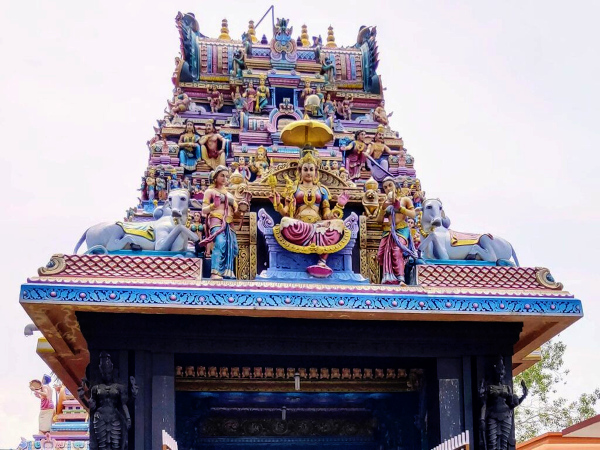
Attukal Bhagavathy Temple in Thiruvananthapuram is one of Kerala’s most revered shrines of the Divine Mother, a temple where devotion, legend, ritual, and public memory have fused into one of the most remarkable sacred traditions in India. Located in Attukal, close to the old core of Thiruvananthapuram and only a short distance from East Fort and the Padmanabhaswamy Temple area, the shrine is dedicated to Goddess Bhagavathy, who is widely identified here with Bhadrakali and also with Kannagi, the heroic woman of the Tamil epic Silappathikaram. Kerala Tourism describes the temple as one of the most important Devi shrines in the state and notes its special connection to women-led worship through the famous Pongala festival.
What gives Attukal its special force is that it is a living center of Shakti worship whose spiritual identity extends far beyond Kerala. The goddess worshipped here is affectionately called Attukalamma, and devotees approach her as a fierce form of the Mother Goddess and as a compassionate protector who grants prosperity, relief, and fulfillment of prayers.
The temple’s own history says about the traditional legend that the deity appeared in the form of a radiant young girl to the head of the Mulluveettil family near the Killi River, crossed the river with his help, disappeared mysteriously, and later instructed him in a dream to consecrate her at a nearby sacred grove marked by signs. That legendary grove became the site of the present shrine. This is temple tradition rather than modern documentary history, but it remains central to how the temple understands its own origin.
The Kannagi connection gives the temple an even deeper literary and cultural dimension. In regional tradition, Attukal Bhagavathy is associated with Kannagi, the heroine of Silappathikaram, who became a symbol of chastity, righteous anger, and divine justice after the destruction of Madurai. Kerala Tourism explicitly notes this Bhadrakali-Kannagi identification, which is one reason the temple occupies such a distinctive place in the sacred geography of the south. Attukal is therefore not just a temple of ritual worship; it is also a shrine where epic memory, Tamil literary tradition, and Kerala goddess worship meet.
Architecturally, the temple reflects the layered visual richness of Kerala shrine culture while also bearing the ornate sculptural intensity associated with South Indian temple art. Kerala Tourism notes its traditional temple form and highlights the richly decorated structure, while the temple’s religious significance often overshadows the fact that it is also a visually striking monument. The sanctum, subsidiary spaces, and decorated gateway together create an atmosphere in which the goddess is encountered not as an abstract theological concept but as a vivid sacred presence. The iconography and ritual setting contribute to the sense that Attukal is simultaneously intimate and monumental: intimate because it is rooted in neighborhood devotion, monumental because its influence radiates across the state and beyond.
The temple is most famous, of course, for the Attukal Pongala, the festival that has made it globally known.It is the defining ritual event through which Attukal becomes, for a day, the center of one of the largest women-led acts of devotion anywhere in the world. The Pongala is the temple’s most prominent festival, celebrated over ten days in the Malayalam month of Kumbham, usually falling in February or March. On the key day, women gather in vast numbers around the temple and across surrounding roads and neighborhoods to prepare Pongala, a ritual offering typically made with rice, jaggery, and coconut in earthen pots over improvised brick hearths.
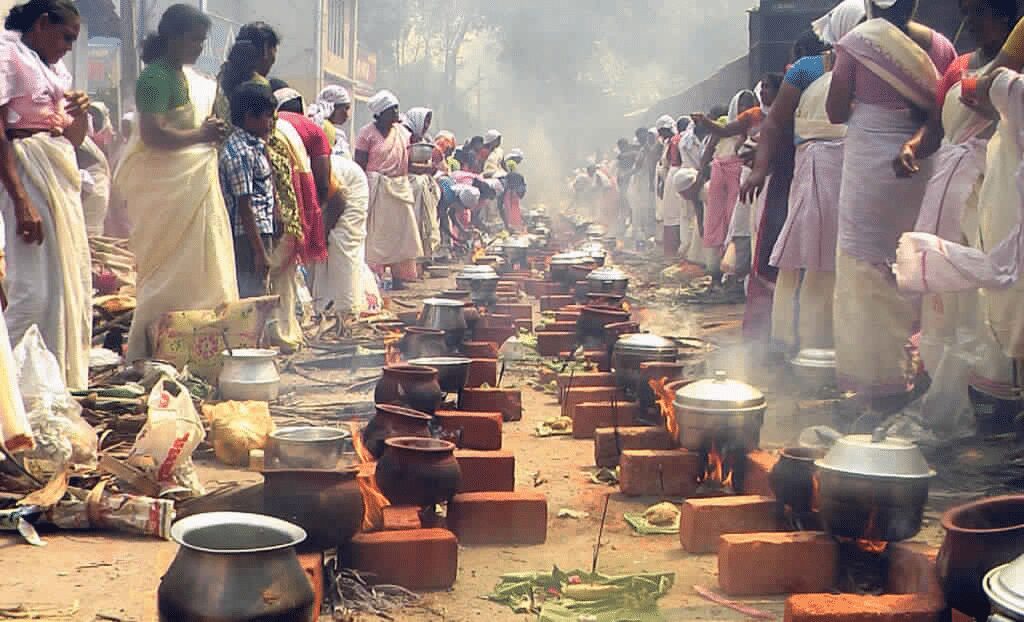
The scale of the festival is extraordinary. Guinness World Records records Attukal Pongala as the largest annual gathering of women, citing 2.5 million women at the 10 March 2009 event organized by the Attukal Bhagavathy Temple Trust. Kerala Tourism likewise describes it as the world’s largest gathering of women for a festival or religious celebration. These claims matter because they are not just publicity language; they reflect the singular character of the event. For a brief time each year, the city itself becomes an extended ritual ground, with hearths spreading for kilometers around the temple. The sacred center is no longer confined to the sanctum. It expands outward into streets, courtyards, terraces, and public spaces, turning urban geography into ritual space.
The ritual logic of Pongala is as powerful as its scale. “Pongala” literally refers to boiling over, and the offering embodies abundance, surrender, and feminine devotion. The temple explains that Pongala is its most important festival and a distinctive religious practice in southern Kerala. The ritual begins when the sacred fire from the temple is used to light the main hearth, after which women light their own hearths in succession and prepare the offering. What might appear to an outsider as mass cooking is, for devotees, a disciplined act of prayer and submission before the goddess. The offering is made in silence, concentration, community, and faith, and the ritual ends with blessings from the temple priests.
One reason the festival is so culturally powerful is that it is fundamentally women-centered. Attukal is often called the “Sabarimala of women,” a phrase that captures its emotional place in popular religious imagination, though that label is more widely seen in secondary descriptions than in official temple or tourism language. What is firmly established is that the Pongala is a ritual performed overwhelmingly by women devotees and that this collective female participation is the very heart of the shrine’s fame. In a religious landscape often narrated through male pilgrimage and priestly authority, Attukal stands apart as a sacred space where women’s collective devotion is not peripheral but central, visible, and defining.
The temple’s annual festival is not limited to the Pongala day alone. Official temple and tourism descriptions note that it is a ten-day observance with a larger sequence of rituals, ceremonies, and devotional performances. Pongala takes place on the ninth day and serves as the climactic moment, but it is framed within a broader ritual calendar that builds spiritual momentum around the goddess. This longer structure helps explain why the event feels less like a single-day spectacle and more like the culmination of a carefully unfolding sacred drama.
There is also something uniquely urban about Attukal’s sacred power. Many major Indian temples are set apart on hills, riverbanks, or ancient ritual landscapes. Attukal, by contrast, sits within a living city, and once a year that city reorganizes itself around the goddess. Roads fill with hearths, households open themselves to pilgrims, state agencies coordinate traffic and safety, and devotion spills across the ordinary layout of civic life. This transformation is one of the reasons the temple has such a hold on public memory in Kerala. It does not merely host a festival; it reshapes the city into a temporary field of sacred fire. This is an inference from the documented scale and spatial spread of Pongala.
, Attukal Bhagavathy Temple endures because it unites tenderness and ferocity, domesticity and grandeur, mythology and mass participation. The goddess is approached as mother, guardian, avenger, and benefactor. It is one of the most compelling examples in India of how a temple can become a living axis of feminine devotion, literary memory, regional identity, and collective spiritual power.
You may also like
-
Mekala in the Mahabharata: The Ancient Highland Kingdom of Amarkantak and the Maikal Hills
-
Anupa in the Mahabharata: The Ancient Narmada Kingdom of Mahishmati and the Maheshwar Region
-
Sarnath Joins UNESCO World Heritage List as India’s Civilisational Legacy Gains Global Recognition
-
Ancient Bazira-Barikot of Gandhara Gains UNESCO Recognition as 3,000 Years of Urban History Emerge From Swat
-
Vaidisha in the Mahabharata-Era Geography: The Ancient Vidisha Region of Central Madhya Pradesh
