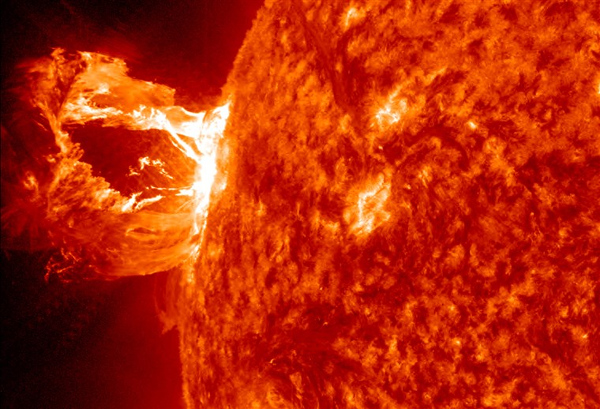
A team of researchers has made progress in solving a long-standing mystery related to the Sun’s outer atmosphere, or corona, in a development that could improve the understanding of space weather and strengthen forecasting capabilities. The study focuses on solar coronal shocks triggered by solar flares and explains why the relative strengths of two types of radio emissions — fundamental and harmonic — vary across different solar radio bursts.
Solar flares and coronal mass ejections can generate shock waves in the Sun’s corona, producing a specific type of radio emission known as Type II solar radio bursts. These bursts, often described as slow-drifting, typically travel at around 1,000 km per second and are detected in the radio wave spectrum. As the shock moves outward from the Sun, the bursts gradually drift from higher to lower radio frequencies.
Scientists usually identify Type II bursts based on parameters such as drift rate, spectral index and other plasma-related characteristics. These bursts generally appear in two components — a fundamental emission, which is the base note, and a harmonic emission, which is the overtone. In theory, the fundamental emission is expected to be stronger. However, observations over time have shown that in some cases the harmonic emission can actually be more intense, raising questions about why this reversal occurs.
To investigate the issue, a team led by astronomers from the Indian Institute of Astrophysics (IIA), an autonomous institution under the Department of Science and Technology, analysed data from CALLISTO instruments located around the world. The researchers traced the origin and characteristics of 58 Type II solar radio bursts, using additional observations from the Gauribidanur Low Frequency Solar Spectrograph (GLOSS) at the Gauribidanur Radio Observatory operated by IIA.
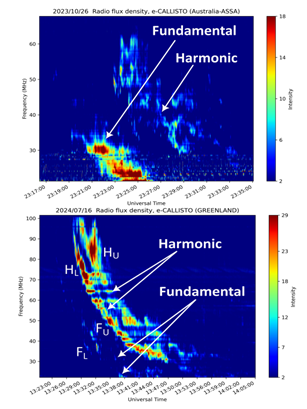
Fig: Top: a Type II burst on 26/10/2023 where the fundamental is stronger than the harmonic, and bottom: a burst on 16/7/2024 where the opposite can be seen.
According to the researchers, the relative strength of the two emissions depends significantly on the location of the active region on the Sun from which the event originates. The study found that bursts arising from active regions located at heliographic longitudes greater than 75 degrees tend to show stronger harmonic emissions, while bursts originating closer to the centre of the solar disk, at less than 75 degrees, are more likely to display stronger fundamental emissions.
The team said this behaviour is linked to refractive effects in the solar corona, as well as the directivity and viewing angle of the solar radio emissions. Because of these factors, fundamental emissions from active regions beyond 75 degrees often do not reach Earth effectively and therefore appear weak or are missing altogether. Harmonic emissions, by contrast, have broader cone angles, allowing them to reach Earth more easily and appear stronger in observations.
Researchers say the findings improve scientific understanding of how solar shocks generate radio waves and how those waves propagate through the Sun’s atmosphere. This is important because solar activity can affect space weather, which in turn can influence satellite communications, navigation systems and other technological infrastructure.
The study’s authors also highlighted the growing importance of large radio astronomy datasets. With CALLISTO and other solar spectrometers around the world continuously gathering vast amounts of observational data, researchers now have new opportunities to investigate unresolved solar phenomena. The team has indicated that machine learning techniques could be used in the future to analyse such datasets more deeply and uncover additional patterns.
The research has been published in the journal Solar Physics. The study was authored by Rishikesh G. Jha, K. Sasikumar Raja, R. Ramesh, and C. Kathiravan from the Indian Institute of Astrophysics, along with Christian Monstein from the Istituto ricerche solari Aldo e Cele Daccò (IRSOL), Università della Svizzera italiana, Locarno, Switzerland.
Source: PIB
You may also like
-
IIT Guwahati Develops Affordable Technology to Remove Arsenic and Fluoride From Drinking Water
-
BITS Pilani Goa Develops Pharmaceutical Bioink for 3D-Printed Skin Scaffolds and Customised Medicines
-
New Smart Technology can Make Diagnosis of Alzheimer’s disease (AD) More Accessible
-
Study Identifies Uniqueness of South Asian Gut Microbiome, Critical for Lifestyle Disease Treatment
-
GENESIS EIR 3.0 Offers Up to ₹10 Lakh to Turn Young Indian Innovators Into DeepTech Entrepreneurs
