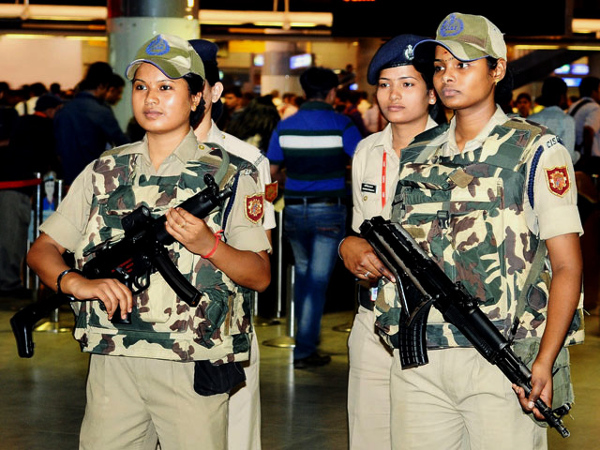
The Central Industrial Security Force has received a major infrastructure push, with the Centre dedicating projects worth ₹136.03 crore to strengthen the force’s administrative, operational, training and welfare capabilities. The package includes the foundation stone for a new CISF Headquarters building in New Delhi and the inauguration of key training and residential facilities in Hyderabad and Tamil Nadu.
Union Minister of State for Home Affairs Bandi Sanjay Kumar laid the foundation stone for the new CISF Headquarters at the CGO Complex in New Delhi. The proposed nine-storey building, being constructed by the Central Public Works Department at an estimated cost of ₹75.78 crore, is expected to become the central command and coordination hub of the force.
The new headquarters will accommodate the office of the Director General, various operational and administrative branches, a modern control room, conference facilities, an auditorium, a library, a gymnasium and other support amenities. Once completed, the building will provide CISF with a modern institutional base suited to its expanding national security role.
Along with the headquarters project, three completed infrastructure facilities were inaugurated. These include the Subordinate Officers’ Mess “Aditya” at the National Industrial Security Academy in Hyderabad, built at a cost of ₹34.22 crore, and the Advanced Training Building “Abhyas”, also at NISA Hyderabad, constructed at a cost of ₹20.53 crore. In Tamil Nadu, the Subordinate Officers’ Quarters at the 4th Reserve Battalion in Amravatipuram, Sivagangai, were inaugurated at a cost of ₹5.50 crore.
These projects are aimed at improving the force’s institutional efficiency, training capacity and living standards for personnel. The National Industrial Security Academy in Hyderabad plays an important role in preparing CISF officers and personnel for specialised security duties across airports, ports, nuclear installations, space establishments, public sector units, metro networks, government buildings and other critical assets.
Addressing the event, Bandi Sanjay Kumar highlighted the government’s focus on the welfare of Central Armed Police Forces personnel and their families. He referred to several recent initiatives, including cashless healthcare under Ayushman CAPF, the Central Armed Police Forces Integrated Management System, transparent housing allotment through the CAPF e-Awas portal, and policies aimed at supporting personnel who suffer disabilities in the line of duty.
The Minister also highlighted welfare measures such as Project MANN, which focuses on mental health support, and financial relief initiatives through the Kendriya Police Kalyan Bhandar network. These steps reflect a wider effort to improve both the professional and personal support systems available to personnel serving in demanding security roles.
CISF Director General Praveer Ranjan said the force is preparing for a fast-changing security environment shaped by hybrid threats, cyber-attacks, digital sabotage, drones and technology-driven risks. He noted that the Ministry of Home Affairs has entrusted CISF with several new responsibilities in recent years, expanding its role beyond traditional industrial security.
One major development is CISF’s designation as a Recognised Security Organisation under the International Ship and Port Facility Security Code. This status allows the force to conduct security audits and assessments of major ports, supporting India’s maritime security framework and the country’s growing Blue Economy.
The CISF is also expanding its role in internal security management, including responsibilities at high-security correctional facilities in Jammu and Kashmir. This reflects the growing trust placed in the force for handling sensitive, high-risk security environments.
A major area of future preparedness is drone and anti-drone security. The Recruit Training Centre at Behror in Rajasthan is being developed as a centre of excellence for drone and counter-drone technology. CISF has also been made the nodal agency for the protection of critical infrastructure from rogue drone threats, a responsibility that has become increasingly important as unmanned aerial systems emerge as a major security challenge.
The force is also strengthening its cyber security capabilities. Specialised teams are being trained in collaboration with leading institutions such as IIT Madras Pravartak, the National Forensic Sciences University in Gandhinagar, and C-DAC. These efforts are expected to enhance CISF’s ability to respond to digital threats targeting critical infrastructure.
Another important announcement highlighted at the event was the approval for raising the first all-women CISF Reserve Battalion at Nuh in Haryana. The battalion will comprise 1,024 personnel and marks a major step in expanding the role of women in India’s internal security architecture. The new battalion will strengthen the force’s operational capacity while also advancing women’s participation in uniformed services.
The ceremony was attended by Union Home Secretary Govind Mohan, Intelligence Bureau Director Tapan Kumar Deka, Member of Parliament Bansuri Swaraj, CISF Director General Praveer Ranjan, senior officers of the Central Armed Police Forces, CPWD officials, SBI representatives and former CISF Directors General.
As part of the event, financial assistance of ₹1 crore under the Personal Accident Insurance Scheme was handed over to the families of deceased CISF personnel. Customised motorised wheelchairs were also presented to differently-abled dependent children of force personnel through a joint initiative of Sanrakshika and the State Bank of India.
The ₹136 crore infrastructure push comes at a significant time for CISF. The force is moving steadily from conventional industrial security duties toward a broader role involving critical infrastructure protection, aviation security, port security, cyber preparedness, drone threat response and high-risk facility management. The new headquarters, upgraded training facilities, welfare measures and the proposed women’s battalion together signal a stronger, more modern and more future-ready CISF.
You may also like
-
Exercise Tarang Shakti 2026 Concludes in Jodhpur, Showcasing India’s Air Power, Indigenous Defence Technology
-
Indian Navy Vice Chief Inspects Japan’s Mogami-Class Stealth Frigate as India-Japan Shipbuilding Cooperation Expands
-
Philippine Marine Wargames Reportedly Show BrahMos Can Penetrate Chinese Destroyer Air Defences
-
Safran Signs 18 Agreements with Indian Aerospace Suppliers, Expanding Make in India Manufacturing Partnerships
-
Indian Army’s Vajra Corps Certifies First Batch of Drone Operators, Strengthens Battlefield Surveillance
