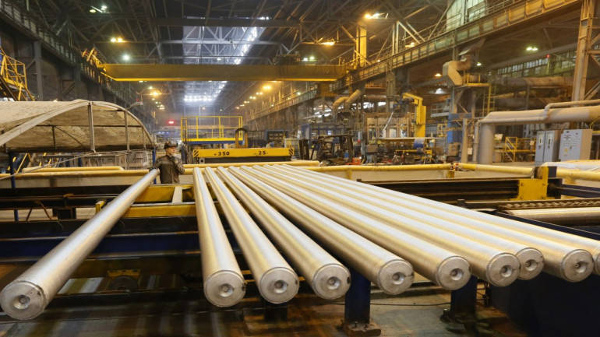
India’s march towards defence self-reliance received another strong boost as Steel Authority of India Limited supplied the complete 5,700 tonnes of special steel used in three newly commissioned Indian Navy vessels — INS Dunagiri, INS Agray and INS Sanshodhak. The contribution highlights the growing role of Indian public sector manufacturing in building the country’s modern maritime strength.
The three naval platforms were commissioned into the Indian Navy on June 21, 2026, during a major ceremony at Syama Prasad Mookerjee Port in Kolkata. INS Dunagiri is an advanced stealth frigate, INS Agray is an anti-submarine warfare shallow water craft, and INS Sanshodhak is a large survey vessel. Together, they represent three important dimensions of naval power — combat capability, underwater threat response and maritime survey operations.
The steel supplied by SAIL includes special quality DMR 249A grade hot-rolled sheets and plates. This is a high-strength defence-grade steel designed for demanding naval applications. The material was manufactured and supplied from SAIL’s major plants at Bokaro, Bhilai and Rourkela, showing the technological depth and production strength of India’s domestic steel sector.
SAIL’s role in these ships is significant because warship construction depends heavily on specialised materials that can withstand challenging marine conditions, structural stress and operational demands. By producing such steel within the country, India reduces dependence on foreign suppliers and strengthens the foundation of indigenous warship building.
The achievement also fits directly into the larger vision of Atmanirbhar Bharat and Make in India. Defence-grade steel is a critical input for naval platforms, and SAIL’s ability to supply it at scale shows how Indian industry is becoming a dependable partner for strategic national programmes.
To meet the rising needs of the defence sector, SAIL has taken steps to enhance the production of DMR grade plates, especially through its Special Plate Plant at Rourkela Steel Plant. This forward-looking expansion supports India’s growing naval construction pipeline and strengthens import substitution in a sensitive defence segment.
SAIL already has a strong record in supplying steel for important naval platforms. Its specialised steel was used in India’s indigenous aircraft carrier INS Vikrant and in Project 17A stealth frigates such as INS Nilgiri, INS Himgiri and INS Udaygiri. The company has also supplied steel for other naval vessels including INS Ajay, INS Nistar and INS Anjadeep.
With INS Dunagiri, INS Agray and INS Sanshodhak joining the fleet, SAIL’s contribution once again shows how India’s industrial base is powering national security. The successful supply of 5,700 tonnes of defence-grade steel is more than an industrial milestone; it is a statement of India’s growing ability to design, build and equip advanced military platforms through domestic capability.
SAIL Chairman and Managing Director Dr. Ashok Kumar Panda said the company remains committed to supporting India’s defence self-reliance. He highlighted that the strengthening of DMR grade plate production, particularly at Rourkela, reflects SAIL’s readiness to meet the future requirements of the armed forces.
The induction of these vessels marks a major moment for India’s maritime preparedness. It also underlines the importance of strong coordination between Indian shipyards, the Navy, public sector manufacturers and the wider defence ecosystem. As India expands its naval presence and maritime responsibilities, indigenous materials such as SAIL’s DMR 249A steel will remain central to building a stronger, self-reliant and future-ready Navy.
You may also like
-
Exercise Tarang Shakti 2026 Concludes in Jodhpur, Showcasing India’s Air Power, Indigenous Defence Technology
-
India’s Economic Warfare Challenge: Strategic Autonomy, Energy Security and the Rise of a Global Power
-
India-US Trade Deal Stalemate: Why Washington’s Tariff Pressure Has Failed to Secure an Agreement
-
US Double Standards in Foreign Policy: 16 Recent Cases Involving India, Russia, China and Global Trade
-
India’s Arctic Energy Ambitions: Russian Oil, LNG and a New Sea Route to Indian Ports
