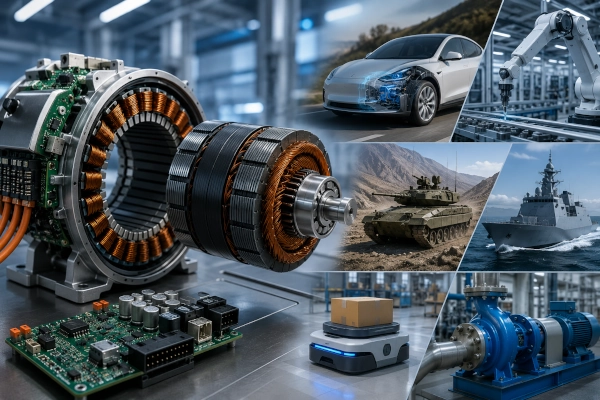
A Bengaluru deep-technology company is attempting to redesign one of electrification’s most important components: the electric motor.
Vimag Labs has announced that it has secured its fifth Indian patent for a software-controlled synchronous motor that produces its rotor magnetic field without permanent magnets. The patented invention, titled “A Robust Rotating Transformer Excited Synchronous Motor and Its Control,” forms the foundation of the company’s Virtual Magnet Synchronous Motor, or VMSM, platform.
The company describes the system as a brushless, slip-ring-free motor capable of delivering performance comparable with permanent-magnet synchronous motors while eliminating their dependence on rare-earth magnets. Vimag says that pilot programmes are under way with two-wheeler and passenger-vehicle manufacturers, with further development planned for commercial vehicles, industrial systems, robotics, cooling equipment and defence applications.
Why Electric Motors Have Become a Strategic Technology
The electric motor is moving from an industrial component to a foundational technology of the global economy. It powers electric vehicles, factory equipment, robotic systems, pumps, compressors, refrigeration units, data-centre cooling systems, mining machinery, drones, ships and an expanding range of military platforms.
Permanent Magnet Synchronous Motors have become popular because they combine high efficiency, compact dimensions, rapid torque response and high power density. Their rotors usually contain powerful neodymium-iron-boron magnets made using rare-earth elements such as neodymium and praseodymium, sometimes supplemented by dysprosium or terbium for improved performance at high temperatures.
This creates a strategic supply-chain concentration. According to the International Energy Agency, China currently accounts for around 60 per cent of global mined production of magnet rare earths, more than 90 per cent of their refining and almost 95 per cent of permanent-magnet production. Demand for magnet rare earths has doubled since 2015 and could grow by more than 30 per cent by 2030 under existing policy settings.
Supply interruptions during 2025 demonstrated how quickly mineral concentration could affect vehicle manufacturers, aerospace companies, industrial motor producers and defence supply chains. Some of China’s wider controls announced in October 2025 were subsequently suspended for one year, although the IEA has warned that the underlying economic-security risk continues.
A commercially viable motor that performs without rare-earth magnets could therefore create value far beyond its environmental credentials. It could reduce exposure to price volatility, export licensing, geopolitical disruption and concentrated foreign processing capacity.
How Vimag’s Virtual Magnet Motor Works
A conventional permanent-magnet motor carries a fixed magnetic field inside its rotor. Vimag’s architecture replaces that fixed field with an electrically generated one.
The rotor contains windings that become electromagnets when supplied with electrical current. Power electronics and control software continuously regulate the rotor field according to the motor’s speed, torque demand, temperature and operating condition.
A rotating transformer transfers excitation power across the stationary and rotating sections of the machine through electromagnetic induction. This contactless arrangement allows the rotor to receive energy without conventional brushes and slip rings, components that can introduce wear, friction, electrical sparking and maintenance requirements.
The result remains a synchronous motor: the rotor turns in synchronisation with the rotating magnetic field produced by the stator. The distinction lies in the source of rotor magnetism. Vimag generates it dynamically through electrical excitation rather than storing it permanently inside rare-earth magnets.
Research into electrically excited synchronous machines has shown that rotary transformers can enable contactless rotor excitation and remove mechanical electrical contacts. Engineering studies also identify challenges involving additional power-electronic components, rotor copper losses, thermal management, packaging and control complexity.
What “Software-Defined” Means in a Motor
Calling the motor software-defined does not mean that software replaces its electromagnetic hardware. The expression refers to the degree to which the motor’s behaviour can be shaped through electronic control.
A permanent magnet produces a largely fixed magnetic field. An electrically excited rotor allows its field strength to be increased, reduced or optimised during operation.
At low speed and high load, the controller can strengthen excitation to produce torque. At higher speed or lighter load, it can adjust the field to reduce unnecessary energy consumption. This ability could help engineers optimise performance across a wider operating map rather than designing around a single fixed magnetic characteristic.
Software control could also support different motor personalities using the same underlying architecture. A delivery vehicle may prioritise low-speed torque and efficiency. A pump may require continuous operation near one speed. A robotic system may emphasise precise response. A defence vehicle may require short bursts of acceleration, low-speed manoeuvrability and controlled power delivery.
This flexibility also creates engineering obligations. The inverter, excitation controller, sensors and embedded software become mission-critical parts of the propulsion system. Automotive versions would require rigorous functional-safety validation, while defence applications would also demand hardened electronics, electromagnetic compatibility and protection against software or cyber compromise.
A Significant Indian Development
Vimag’s work belongs to a wider international effort to reduce dependence on permanent magnets.
BMW already uses current-excited synchronous motors without rare-earth magnets in models including the i4, i5, i7 and iX. BMW states that its fifth-generation drive system achieves up to 93 per cent motor efficiency while avoiding rare earths in the rotor.
Renault began mass-marketing electrically excited synchronous motors more than a decade ago. The company uses wound rotors in several electric vehicles and is developing a new 200-kilowatt motor with Valeo for production from 2027.
The strategic importance of Vimag therefore comes from its specific architecture, contactless excitation system, control platform, Indian intellectual property and potential for local manufacturing. The achievement should be evaluated as an indigenous attempt to build a competitive motor-and-electronics ecosystem rather than as the invention of the first magnet-free motor.
That distinction strengthens the story. It places Vimag within a serious global engineering race while allowing its actual innovation to be assessed on measurable performance.
From Patent to Commercial Production
Vimag Labs was founded by Manish Seth and Dr. Piyush Desai. In January 2026, the company raised $5 million in a funding round led by Accel, with participation from Chakra Growth Fund and Thinkuvate. The capital was intended to support engineering expansion, manufacturing capability and commercialisation of the VMSM platform.
The startup says its technology has reached Technology Readiness Level 7 and is undergoing real-world vehicle testing. It has also begun commercialising parts of its electronics stack and is working with original-equipment manufacturers in India and overseas. These readiness and performance statements currently remain company claims.
Vimag has signed a manufacturing memorandum of understanding with Jendamark India, a company specialising in automated production systems. The partnership is intended to help convert the motor architecture into scalable industrial production.
The company reports five granted patents, ten additional patent applications and 15 trademarks covering motor architecture, power electronics, control software and application-specific systems. Chief Executive Manish Seth has attributed the technology to more than 87,600 engineering hours.
Industrial Uses in Vehicles and Beyond
Vimag’s rare-earth-free motor platform could serve a broad range of electric mobility and industrial applications, beginning with two-wheelers, three-wheelers and passenger vehicles before expanding into delivery vans, buses, trucks, construction equipment, agricultural machinery and mining vehicles. Its proposed 200–600 kW variants could also support industrial pumps, compressors, HVAC systems, cold storage, data centres, robotics, factory automation, port machinery and selected marine systems. Commercial success will depend on achieving a competitive balance of efficiency, torque density, weight, thermal stability, durability, manufacturing cost and lifetime energy savings.
In defence, the technology could support hybrid-electric armoured vehicles, unmanned ground and maritime platforms, naval auxiliary systems, radar drives, launcher mechanisms and ruggedised cooling equipment. Electric propulsion can provide rapid torque, precise low-speed control, silent watch capability, reduced acoustic and thermal signatures and additional onboard power for sensors, communications and electronic warfare systems. A domestically controlled magnet-free motor could also strengthen supply-chain security by reducing dependence on imported permanent magnets, although military adoption would require extensive testing for shock, vibration, corrosion, electromagnetic compatibility and extreme operating conditions.
Rare-Earth Independence Has Direct National-Security Value
Rare-earth magnets are used across aircraft, submarines, unmanned systems, radar equipment and other defence technologies. The US Department of Defense has described secure permanent-magnet supply as an industrial-base priority and has invested in rebuilding domestic mine-to-magnet capability.
India faces a similar strategic question. Expanding domestic mining and magnet production remains valuable, yet a second pathway exists: redesigning certain systems so that they require fewer rare-earth magnets.
A successful VMSM platform could complement India’s mineral-development and recycling programmes. It would offer technological substitution alongside supply diversification.
REFERENCES
- Industrial Products Finder. “Vimag Labs Secures Fifth Patent for VMSM Platform.” July 14, 2026.
https://ipfonline.com/news/detail/autocomponentsaccessories/vimag-labs-secures-fifth-patent-for-vmsm-platform/19049 - ET Auto. “Vimag Labs Secures Patent for Rare Earth-Free Electric Motor Platform.” July 8, 2026.
https://auto.economictimes.indiatimes.com/news/auto-technology/vimag-labs-patents-innovative-rare-earth-free-electric-motor-technology/132257236 - The Economic Times. “Vimag Labs Raises $5 Million in Round Led by Accel.” January 29, 2026.
https://economictimes.indiatimes.com/tech/funding/vimag-labs-raises-5-million-in-round-led-by-accel/articleshow/127715178.cms - Jendamark India. “Volektra and Jendamark Partner for Magnet-Free Motors.”
https://www.linkedin.com/posts/jendamarkindia_jendamark-india-and-volektra-mou-press-release-activity-7344215553479270400-8kF- - International Energy Agency. “Rare Earth Elements: Pathways to Secure and Diversified Supply Chains.” April 8, 2026.
https://www.iea.org/reports/rare-earth-elements - International Energy Agency. “Rare Earth Elements – Executive Summary.” 2026.
https://www.iea.org/reports/rare-earth-elements/executive-summary - International Energy Agency. “New Projects, Partnerships and Policies Are Needed to Address Supply-Chain Risks for Rare Earth Elements.” April 8, 2026.
https://www.iea.org/news/new-projects-partnerships-and-policies-are-needed-to-address-supply-chain-risks-for-rare-earth-elements - BMW Group. “BMW’s Fifth-Generation Electric Drive System Wins 2024 AJAC Best Green Innovation Award.” March 21, 2024.
https://www.press.bmwgroup.com/canada/article/detail/T0440602EN/bmw%E2%80%99s-5th-generation-electric-drive-system-wins-2024-ajac-best-green-innovation-award - BMW Group. “The BMW iX xDrive50: Fifth-Generation eDrive and Sustainability.” March 17, 2021.
https://www.press.bmwgroup.com/usa/article/detail/T0327877EN_US/the-bmw-ix-xdrive50-5th-generation-edrive-and-sustainability - Renault Group. “All About Electric Motors with No Rare Earths.” October 16, 2025.
https://www.renaultgroup.com/en/magazine/energy-and-powertrains/all-about-electric-motors-with-no-rare-earths/ - Renault Group. “Renault Group, Valeo and Valeo Siemens eAutomotive Join Forces to Develop and Manufacture a New-Generation Electric Motor.” February 10, 2022.
https://media.renaultgroup.com/renault-group-valeo-and-valeo-siemens-eautomotive-join-forces-to-develop-and-manufacture-a-new-generation-automotive-electric-motor-in-france/ - Manko, R. et al. “Modelling of the Electrically Excited Synchronous Machine with Contactless Energy Transfer to the Rotor.” Energies, 2022.
https://www.mdpi.com/1996-1073/15/8/2832 - Müller, S. et al. “Inductive Electrically Excited Synchronous Machine for Electric Vehicle Traction.” Energies, 2023.
https://www.mdpi.com/1996-1073/16/4/1657 - Defence Research and Development Organisation. “Alternative Power Plant Technologies for Armoured and Combat Vehicles.”
https://drdo.gov.in/drdo/en/industry-partner?page=46 - United States Department of Defense. “DOD Looks to Establish Mine-to-Magnet Supply Chain for Rare-Earth Materials.” March 11, 2024.
https://www.defense.gov/News/News-Stories/Article/Article/3700059/dod-looks-to-establish-mine-to-magnet-supply-chain-for-rare-earth-materials/ - United States Army. “Army Advancing First Hybrid-Electric Bradley.” February 18, 2022.
https://www.army.mil/article/254124/army_advancing_first_hybrid_electric_bradley - United States Army. “Giving U.S. Soldiers the Advantage of Silence.” April 8, 2024.
https://www.army.mil/article/275128/giving_u_s_soldiers_the_advantage_of_silence - United States Navy. “Amphibious Assault Ship LHD/LHA Information Page.”
https://www.surflant.usff.navy.mil/Organization/Operational-Forces/Amphibious-Ships/Amphibious-Assault-Ship-LHD-LHA-Info-Page/ - United States Navy. “Dry Cargo and Ammunition Ships – T-AKE.”
https://www.navy.mil/Resources/Fact-Files/Display-FactFiles/Article/2211797/dry-cargoammunition-ships-t-ake/
You may also like
-
India’s Economic Warfare Challenge: Strategic Autonomy, Energy Security and the Rise of a Global Power
-
India-US Trade Deal Stalemate: Why Washington’s Tariff Pressure Has Failed to Secure an Agreement
-
US Double Standards in Foreign Policy: 16 Recent Cases Involving India, Russia, China and Global Trade
-
India’s Arctic Energy Ambitions: Russian Oil, LNG and a New Sea Route to Indian Ports
-
India and Russia Explore Joint Icebreaker Construction as Maritime Industrial Cooperation Expands
