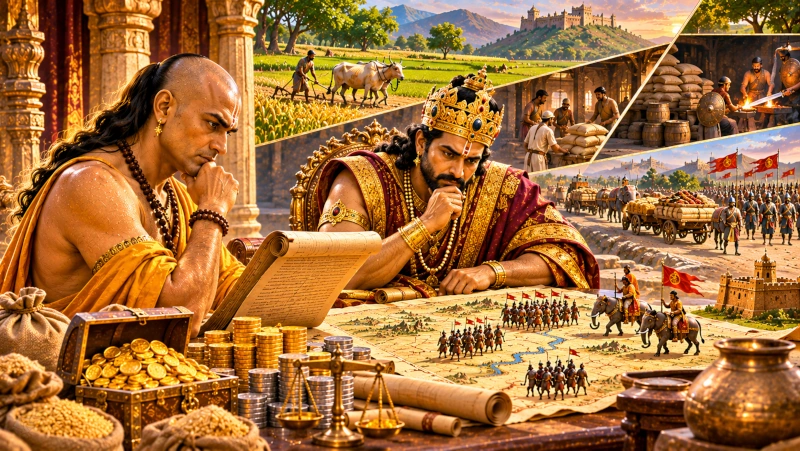
The Architecture of Indian Statecraft | Kauṭilya’s Arthaśāstra | Books II, V, VI, VII, VIII and IX
Introduction: The Economic Foundations of Military Power
Among the most important contributions of Kauṭilya’s Arthaśāstra to political and military thought is its recognition that warfare cannot be separated from the economic foundations of the state. Although military victories are achieved through the deployment of armies, weapons and capable commanders, the ability to raise, equip, supply and maintain those forces depends upon financial resources, productive territory, functioning administrative institutions and an economy capable of sustaining prolonged expenditure.
Kauṭilya examines warfare not merely as a contest of physical strength but as an activity requiring careful economic preparation and the continuous management of resources. The size of an army, the quality of its equipment and the courage of its soldiers are important, but their effectiveness can deteriorate rapidly when the treasury becomes depleted, supplies are interrupted or the productive population can no longer support the demands of military mobilisation.
These principles appear throughout the Arthaśāstra, particularly in Book II, which examines revenue collection and financial administration; Book V, which discusses the replenishment of the treasury and the remuneration of state personnel; Book VIII, which considers the consequences of financial and military weaknesses; and Book IX, which examines the resources, timing and costs associated with military expeditions.
The resulting framework establishes a close relationship between economic prosperity, state finance and military capability. A ruler contemplating war must consider not only whether his forces can defeat an adversary but also whether the kingdom can afford the campaign, sustain its operations and absorb the losses that may follow.
The central strategic principle emerging from Kauṭilya’s treatment is that military strength depends upon economic sustainability. An army that cannot be financed, supplied and maintained may become ineffective even before its battlefield capabilities have been exhausted.
The Arthaśāstra therefore places the treasury, revenue administration, productive territory and military logistics within a common structure of statecraft. Warfare becomes an undertaking whose feasibility must be evaluated through both military and economic calculations.
The Saptāṅga Theory: Why the Treasury and Army Are Interdependent
Kauṭilya’s understanding of military economics begins with the Saptāṅga Theory, which identifies seven fundamental constituents of the state. These are Svāmī, the ruler; Amātya, ministers and administrative officials; Janapada, territory and population; Durga, fortified centres; Kośa, the treasury; Daṇḍa, the army and coercive power; and Mitra, the ally.
The inclusion of Kośa and Daṇḍa as separate constituents is particularly significant. It demonstrates that Kauṭilya distinguishes between the possession of military forces and the financial capability required to support them.
An army represents organised military strength, while the treasury provides resources necessary for its recruitment, remuneration, equipment and maintenance. The relationship between the two is therefore fundamental to the security of the kingdom.
However, Kauṭilya’s framework also connects the treasury and army with the other constituents. Revenue originates from productive territory and economic activity, while administrative officials supervise its collection and distribution. Fortified centres protect essential resources, and allies may influence the military and economic demands placed upon the kingdom.
The strategic significance of this relationship is that defence capability cannot be developed independently of the wider economic and administrative institutions responsible for sustaining it.
A kingdom may possess a large population capable of supplying soldiers, but recruitment alone does not establish a sustainable army. Financial resources must also be available to provide food, equipment, transport and other necessities.
Similarly, a wealthy kingdom may maintain substantial reserves but remain vulnerable if it lacks capable military leadership or an organised system for converting resources into operational strength.
The Saptāṅga framework therefore establishes that economic resources and military capability are distinct but mutually dependent elements of state power.
The enduring principle is that a state’s military strength must be evaluated through the combined condition of its treasury, productive economy, administrative institutions and armed forces rather than through military numbers alone.
Janapada: The Productive Economy as the Foundation of Warfare
Before examining the treasury, it is necessary to understand the economic foundation from which its resources are derived.
In the Saptāṅga framework, Janapada represents the territory and population of the kingdom. Kauṭilya’s treatment encompasses agricultural land, settlements, natural resources, productive activities and the people whose labour generates the wealth necessary to support the state.
Agriculture occupies an important position within this system because it produces food for the population, supplies provisions for military forces and contributes to the revenue available to the treasury.
Commercial activity, mining, manufacturing, animal husbandry and other productive enterprises also contribute to the state’s financial and material resources.
The importance of Janapada becomes particularly clear when considering the requirements of a major military campaign. Soldiers must be fed, transport animals maintained, weapons produced and damaged equipment replaced. These necessities ultimately depend upon the productive capacity of the kingdom.
The central economic lesson is that military power originates in the productive activities of the population. A kingdom cannot sustain prolonged warfare if the economic foundation supporting its army is progressively destroyed.
This relationship creates a strategic responsibility for political leadership.
A ruler who extracts excessive resources from the population or disrupts agricultural production through poorly planned campaigns may weaken the very economy upon which future military operations depend.
Similarly, a military campaign that exposes productive territory to devastation can reduce both immediate supplies and subsequent revenue.
Kauṭilya’s wider framework therefore demonstrates that the preservation of economic activity is closely connected with the long-term maintenance of military power.
The strategic importance of economic resilience lies in the ability of a kingdom to continue producing the resources required for defence even when military operations create extraordinary financial and logistical demands.
Kośa: The Treasury as a Strategic Reserve
The treasury, or Kośa, represents one of the central foundations of Kauṭilya’s conception of state power.
The Arthaśāstra treats the treasury as the financial institution through which the ruler supports government administration, public works, fortifications, military establishments and other responsibilities.
Its importance extends beyond the accumulation of wealth. The treasury must provide resources when circumstances require expenditure that cannot be supported through ordinary revenue alone.
Military emergencies illustrate this requirement particularly clearly. A kingdom facing an invasion may need to mobilise additional soldiers, acquire equipment, repair fortifications and maintain supplies at a time when normal economic activity is under pressure.
The availability of accumulated reserves can therefore determine whether the government possesses sufficient flexibility to respond effectively.
The strategic significance of Kośa lies in its function as a reserve of state capacity, enabling the ruler to maintain essential institutions and military operations when ordinary revenue becomes insufficient.
A treasury containing substantial resources provides greater freedom to prepare for military threats and undertake necessary operations. Conversely, a depleted treasury can restrict strategic choices even when the ruler possesses experienced commanders and capable soldiers.
Kauṭilya also recognises the importance of maintaining financial records and understanding the resources actually available after expenditure.
The distinction between expected revenue and accumulated resources is especially important in military planning. Revenue anticipated in the future cannot always finance an immediate campaign, particularly when collection depends upon harvests, trade or other economic activities that may be disrupted by conflict.
A sustainable military strategy requires an accurate understanding of available reserves rather than reliance upon revenues that have not yet been collected.
Revenue Administration: How the Kingdom Finances Its Military Establishment
Book II of the Arthaśāstra provides a detailed examination of the institutions responsible for generating and managing government revenue.
The discussion identifies several sources of income, including agricultural production, trade, customs duties, state-controlled economic activities, mines, forests, transport facilities and other forms of taxation and public revenue.
Kauṭilya assigns specific responsibilities to officials entrusted with supervising these activities and ensuring that the resulting income reaches the state.
The range of revenue sources is significant because it demonstrates an understanding that the financial strength of the kingdom should not depend upon a single economic activity.
Agricultural revenue may fluctuate according to harvest conditions, while commercial receipts may be affected by changes in trade. Diversified sources of income can reduce the vulnerability of the treasury to difficulties affecting a particular sector.
The central fiscal principle is that reliable military financing requires a functioning revenue system capable of drawing upon the productive resources of the economy while maintaining the administrative capacity to collect and account for those resources.
Kauṭilya’s treatment also reveals the importance of distinguishing regular income from exceptional receipts.
A government may obtain temporary resources through extraordinary levies, fines or other measures, but the maintenance of a permanent military establishment requires continuing financial support.
This creates an important distinction between financing a short campaign and sustaining a military organisation over many years.
A ruler who depends exclusively upon temporary revenue measures may discover that resources become insufficient when military expenditure continues beyond the anticipated period.
The long-term sustainability of military power depends upon predictable revenue streams and disciplined financial management rather than occasional increases in the resources available to the treasury.
Financial Accounting: Why the Ruler Must Know What the State Can Afford
One of the most detailed discussions of financial administration appears in Book II, Chapters 6 and 7, where Kauṭilya examines the collection of revenue and the maintenance of government accounts.
The text requires officials to distinguish among income, expenditure, completed work, unfinished work and the balance remaining after financial obligations have been accounted for.
This approach demonstrates that the effective management of the treasury requires more than the collection of taxes.
Government officials must understand how much revenue has been received, how much has been spent and what resources remain available for future responsibilities.
The distinction becomes especially important when political leadership is contemplating a major military operation.
A campaign may require substantial expenditure before the army reaches enemy territory. Soldiers must be organised, equipment prepared, transport arranged and provisions accumulated.
If the ruler does not possess reliable information concerning the financial condition of the kingdom, the proposed campaign may exceed the resources available to support it.
The strategic significance of financial accounting is that sound military decisions require accurate information concerning revenue, expenditure, outstanding commitments and the actual balance available to the state.
Kauṭilya’s emphasis upon record-keeping also provides a means of identifying administrative inefficiency.
An army may experience shortages because the treasury lacks sufficient resources, but shortages may also result from poor accounting, delayed expenditure or the diversion of funds.
The ability to distinguish between these causes is essential to effective financial management.
The central administrative lesson is that military sustainability depends upon financial transparency within the governing institutions and the capacity to identify how public resources are collected, allocated and expended.
Corruption and Embezzlement: The Hidden Erosion of Military Resources
Book II, Chapter 8 examines the misappropriation of public revenue by government officials.
Kauṭilya identifies numerous ways in which accounts can be manipulated or government resources diverted, including the concealment of receipts, false entries, improper payments and the misrepresentation of the value of goods.
The discussion is significant because it recognises that financial weakness does not always originate in insufficient economic production.
A kingdom may generate substantial revenue while losing resources through corruption, administrative negligence or the misuse of public funds.
Such losses can have direct consequences for military preparedness.
Resources intended for soldiers’ remuneration, equipment, provisions or fortification works may become unavailable when administrative officials divert them for personal benefit.
The strategic danger of corruption lies in its ability to weaken military capability without the enemy having to destroy a single weapon or defeat a single soldier.
Financial mismanagement can also undermine confidence in the institutions responsible for supporting the army.
If soldiers are not paid or essential supplies fail to arrive, the consequences may extend beyond immediate operational difficulties to affect morale, discipline and loyalty.
Kauṭilya therefore treats the detection and prevention of financial misconduct as an important responsibility of government.
Some of the punitive and investigative measures described in the Arthaśāstra differ substantially from modern legal standards. Nevertheless, the underlying administrative concern remains clear.
The effective protection of public revenue is an essential component of national security because the misuse of financial resources can weaken the military institutions that depend upon them.
Military Salaries: Financial Support and the Reliability of Soldiers
The relationship between finance and military effectiveness becomes especially evident in Book V, Chapter 3, which examines remuneration for government personnel.
The Arthaśāstra describes graded payments for different categories of officials, including senior military commanders, officers and personnel associated with the armed forces.
The chapter demonstrates that Kauṭilya regarded remuneration as an organised responsibility of the state rather than a matter left entirely to individual commanders.
The army requires trained personnel whose service can be maintained through a reliable system of support.
Soldiers deprived of sufficient remuneration may become dissatisfied, while commanders lacking the resources necessary to maintain their forces may struggle to preserve discipline.
The central military principle is that the reliability of an army depends partly upon the state’s ability to provide regular material support to the personnel entrusted with its defence.
Kauṭilya’s treatment recognises that the financial requirements of military service extend beyond the immediate cost of raising troops.
A permanent military establishment creates continuing obligations that must be included within the wider financial planning of the kingdom.
These obligations also differ according to the composition of the force. Personnel responsible for elephants, horses, chariots, weapons and other specialised military functions require different forms of support.
The cost of maintaining a military establishment therefore depends upon its organisation and the capabilities it is expected to provide.
A ruler must consider the recurring economic cost of maintaining military readiness, because the expense of an army continues even when it is not actively engaged in battle.
Treasury and Army: Kauṭilya’s Debate on Their Relative Importance
One of the most revealing discussions in the Arthaśāstra occurs in Book VIII, Chapter 1, which examines calamities affecting the constituents of the state.
The text considers the relative seriousness of weaknesses affecting the treasury and the army.
The arguments reveal that both financial resources and military strength are essential, but their relative importance may depend upon the circumstances confronting the kingdom.
Kauṭilya emphasises the role of the treasury in maintaining military forces and recognises that financial weakness can undermine their reliability.
At the same time, the chapter also presents the competing consideration that an army protects the treasury and may prevent the loss of the kingdom’s wealth to an invading adversary.
The discussion is therefore more sophisticated than a simple assertion that money is always more important than soldiers, or that military strength must always take precedence over finance.
The strategic significance of this debate is that the treasury and army protect and sustain one another, making their relative importance dependent upon the immediate threats and requirements facing the state.
A kingdom possessing substantial financial resources but inadequate military protection may lose its treasury to an invading army.
Conversely, a kingdom possessing powerful military forces but insufficient revenue may struggle to maintain those forces over time.
Both situations can threaten political survival.
The wider lesson concerns the need to maintain an appropriate relationship between defence requirements and financial capability.
The sustainability of national power depends upon ensuring that military commitments do not exceed the state’s capacity to finance them, while financial resources remain adequately protected against external threats.
The Logistics of Warfare: Food, Transport and Military Endurance
Kauṭilya’s understanding of warfare includes extensive consideration of the practical requirements of moving and maintaining armed forces.
Book IX examines the circumstances under which a ruler should undertake a military expedition, including the availability of resources, the appropriate season, the geographical conditions and the likely difficulties associated with the campaign.
These considerations reveal that the movement of an army is not simply a matter of issuing orders to advance.
A military force requires provisions, transport, equipment, suitable routes and arrangements for maintaining its effectiveness during the expedition.
The challenge becomes greater as the army moves farther from its base of operations.
Supply routes may become longer, transport requirements may increase and local conditions may affect the availability of food and other necessities.
The central logistical principle is that an army’s operational endurance depends upon the continuous availability of supplies and the ability to move those supplies to the locations where military forces require them.
A ruler may possess sufficient financial resources to equip an army at the beginning of a campaign but still encounter serious difficulties if the system responsible for supplying it cannot function under changing operational conditions.
Kauṭilya’s discussion therefore connects military planning with geography, transport and the timing of operations.
The selection of a campaign route, the condition of the terrain and the availability of supplies can influence whether a military expedition is feasible.
The strategic lesson is that financial resources become effective military capability only when supported by the logistical arrangements necessary to deliver personnel, equipment and provisions throughout the campaign.
The Cost of a Military Expedition: Calculating Losses Before War
Book IX, Chapter 1 provides one of the clearest statements of the economic reasoning underlying Kauṭilya’s military strategy.
Before undertaking an expedition, the ruler is instructed to examine his own strength and that of the adversary, the geographical and seasonal conditions, the timing of mobilisation and the likely consequences of the operation.
The assessment also includes the expected loss of personnel and financial resources, together with the potential gains and dangers associated with the campaign.
This requirement demonstrates that Kauṭilya did not regard the existence of military superiority as sufficient justification for immediate action.
The ruler must determine whether the proposed expedition is likely to produce advantages proportionate to its costs.
The central strategic principle is that the decision to undertake war should be preceded by an assessment of its expected military, financial and political consequences.
A successful military operation may still weaken the kingdom if the resources expended substantially exceed the benefits obtained.
Similarly, the conquest of territory may create additional financial obligations associated with administration, defence and the maintenance of order.
The calculation must therefore extend beyond the expected outcome of the initial battle.
Kauṭilya’s approach recognises that the cost of warfare includes the resources required to prepare for combat, sustain operations and manage the consequences of military action.
A military victory does not automatically constitute strategic success when the economic cost of obtaining and maintaining that victory weakens the long-term capabilities of the state.
The Economic Cost of Time: Why Prolonged Warfare Can Become Dangerous
One of the most important dimensions of military sustainability is the relationship between time and expenditure.
A short campaign may require substantial initial resources but impose fewer continuing obligations than a prolonged conflict.
As operations continue, however, the army must remain supplied, personnel must be supported and damaged or exhausted resources must be replaced.
Military losses may require additional recruitment and training, while extended deployments can increase transport and administrative expenditure.
The economic consequences may also affect the civilian population.
Agricultural workers may be drawn into military service, commercial activity may be disrupted and the productive capacity of affected territories may decline.
The strategic danger of prolonged warfare is that military expenditure can continue increasing while the economic activities responsible for financing that expenditure become progressively weaker.
Kauṭilya’s examination of campaign timing and resource requirements reflects an awareness that military operations must be conducted within the limits imposed by the kingdom’s financial and material capabilities.
The longer an army remains engaged, the greater the importance of dependable supply arrangements and continuing financial support.
The ruler must therefore distinguish between the ability to initiate hostilities and the ability to sustain them until the intended political objective has been achieved.
The enduring military principle is that the capacity to begin a war is not equivalent to the capacity to finance, supply and complete it successfully.
Strategic Restraint: When Peace Becomes Economically Preferable
The economic foundations of Kauṭilya’s military thought are closely connected with his Ṣāḍguṇya framework, which identifies six measures of foreign policy.
These include Sandhi, peace; Vigraha, hostility; Āsana, strategic non-action; Yāna, military expeditions; Saṃśraya, seeking protection; and Dvaidhībhāva, the simultaneous pursuit of peace with one power and hostility towards another.
The measures provide alternatives to immediate warfare, particularly when the balance of capabilities or the expected economic consequences make confrontation disadvantageous.
A ruler may conclude peace to preserve resources, remain inactive while rebuilding military strength or seek external support when the kingdom lacks the means necessary for independent resistance.
These choices demonstrate that military sustainability also depends upon political judgment.
The strategic significance of restraint is that avoiding an economically unsustainable war can preserve the financial and military resources necessary for future security.
Peace may provide opportunities for agricultural production, commercial expansion, treasury replenishment and the improvement of defensive infrastructure.
Similarly, strategic non-action may allow a kingdom to recover from financial difficulties without exposing itself to additional military expenditure.
Kauṭilya’s framework therefore recognises that the preservation of national strength sometimes requires the ruler to delay or avoid confrontation rather than seek immediate military success.
The fundamental diplomatic principle is that peace and military restraint can serve national security when they allow the state to strengthen the economic foundations upon which credible defence capability depends.
Replenishing the Treasury: Extraordinary Revenue and the Limits of Extraction
The Arthaśāstra also examines the problem of replenishing the treasury when ordinary financial resources become insufficient.
Book V, Chapter 2 discusses measures intended to increase state revenue during periods of financial difficulty. These include extraordinary collections, contributions and other forms of resource mobilisation.
The chapter reflects the political environment assumed by Kauṭilya, in which the ruler possesses extensive fiscal authority and may employ coercive methods that differ substantially from modern principles of taxation and public accountability.
Nevertheless, the discussion reveals an important distinction between regular revenue collection and emergency financial mobilisation.
Ordinary revenue must support the continuing responsibilities of government, while extraordinary circumstances may require additional resources to address threats that could not have been anticipated through routine financial planning.
The danger arises when emergency measures place excessive burdens upon productive economic activity.
The central economic principle is that extraordinary revenue mobilisation must be assessed according to its consequences for the productive population, because weakening the economy can reduce the state’s future ability to finance government and defence.
Although Kauṭilya’s historical prescriptions include measures that would not meet contemporary standards of fiscal governance, his wider framework recognises the importance of preserving the resources from which state revenue ultimately arises.
A ruler who obtains immediate financial relief at the expense of long-term production may improve the treasury temporarily while weakening its future revenue base.
The relationship between treasury replenishment and economic sustainability is therefore particularly important during prolonged military crises.
The strategic lesson is that emergency financing must be considered alongside the long-term capacity of the economy to generate resources, rather than evaluated solely according to the immediate revenue obtained.
Military Expansion and the Economic Burden of Conquest
Kauṭilya’s examination of warfare also raises an important question concerning the relationship between territorial conquest and economic benefit.
A successful campaign may bring new territory, productive resources, commercial routes or strategic positions under the ruler’s authority.
However, these gains do not automatically translate into an immediate improvement in the kingdom’s financial position.
Newly acquired territories may require administrative officials, military garrisons, infrastructure repairs and expenditure necessary to establish stable government.
The costs of maintaining control can therefore continue after the original military campaign has concluded.
The Arthaśāstra’s wider discussion of foreign policy, settlement, territorial acquisition and military operations provides a basis for distinguishing between the immediate achievement of conquest and the longer-term resources required to consolidate it.
The strategic significance of this distinction is that the economic value of territorial expansion must be assessed after accounting for the resources required to administer, defend and integrate the acquired territory.
A campaign that secures economically productive territory at limited cost may strengthen the kingdom’s position.
Conversely, an expedition that requires prolonged warfare, extensive garrisons or continuous expenditure may impose burdens that reduce the expected advantages.
The ruler must therefore consider whether conquest will strengthen the existing foundations of the state or create additional obligations that exceed its resources.
The enduring principle is that territorial expansion becomes strategically beneficial only when the resulting political and economic advantages can be sustained without undermining the security and prosperity of the existing kingdom.
The Economic Vulnerability of an Adversary
The relationship between economic strength and military capability also influences Kauṭilya’s assessment of competing kingdoms.
An adversary may possess a substantial army while experiencing financial difficulties that restrict its ability to maintain military operations.
Similarly, a kingdom may control extensive territory but suffer from administrative weakness, disruption of agricultural production or declining revenue.
Such conditions influence the balance of power even before armies meet on the battlefield.
Kauṭilya’s discussions of military expeditions and the relative strength of states therefore extend beyond the visible size of opposing forces.
The ruler must understand the economic and institutional circumstances supporting the enemy’s military establishment.
The central intelligence principle is that assessing an adversary’s military strength requires examining the financial and productive systems that sustain its armed forces.
A financially secure kingdom may possess greater endurance during a prolonged conflict, while an economically weakened state may struggle to replace losses or maintain supplies.
However, economic difficulties alone do not guarantee military defeat. Political determination, defensive advantages, outside assistance and the effectiveness of available forces can also influence the outcome.
Kauṭilya’s framework encourages a comprehensive assessment in which economic resources form one important element of the wider strategic situation.
The strategic lesson is that military capability must be evaluated through both immediate combat strength and the economic capacity required to sustain that strength over time.
Modern Military Parallel: The Allied Economic Mobilisation During the Second World War
A useful modern comparison can be found in the economic mobilisation undertaken by the Allied powers during the Second World War.
The conflict demonstrated the relationship between industrial production, financial resources, logistical organisation and sustained military operations on an unprecedented scale.
The United States expanded the production of military aircraft, ships, vehicles, weapons, ammunition and other equipment after entering the war in December 1941.
American industry became a major source of military supplies for the United States and its allies, while the Lend-Lease programme provided extensive material assistance to countries fighting the Axis powers.
The economic contribution extended beyond finished weapons. Factories, shipyards, transport networks, agricultural production and financial institutions collectively supported the ability to maintain military operations across several theatres.
Britain also mobilised substantial industrial and financial resources, while the Soviet Union relocated important industrial facilities and expanded the production of military equipment under exceptionally difficult wartime conditions.
The conflict demonstrated that battlefield operations depended upon economic systems capable of replacing losses and supplying armed forces over prolonged periods.
The central strategic parallel with Kauṭilya’s framework is that military endurance depends upon the productive, financial and logistical capabilities supporting the armed forces rather than upon battlefield strength alone.
The historical circumstances differ significantly from the political environment examined in the Arthaśāstra. Modern industrial warfare involves technologies, production systems and levels of mobilisation that did not exist in ancient India.
Nevertheless, the underlying relationship between economic resources and military sustainability provides a useful analytical comparison.
The Allied war effort demonstrated how manufacturing capacity, agricultural production, financial mobilisation and transport infrastructure could be coordinated to support major military campaigns.
It also illustrated the importance of allied cooperation in expanding the resources available to individual states.
The enduring military principle is that sustained success in a major conflict requires the ability to organise national resources and convert economic production into operational military capability.
The Modern Relevance of Kauṭilya’s Military Economics
The economic foundations of warfare remain an important subject of modern strategic analysis, although contemporary military and financial systems differ fundamentally from those described in the Arthaśāstra.
Modern armed forces require continuous expenditure on personnel, equipment, training, maintenance, logistics, communications and technological development.
The acquisition of advanced military platforms creates responsibilities extending across their operational lives. Aircraft, naval vessels, armoured vehicles and other complex systems require spare parts, specialised personnel, repairs and periodic modernisation.
Consequently, the financial implications of defence procurement cannot be evaluated solely through the initial acquisition cost.
The modern strategic relevance of Kauṭilya’s framework lies in the recognition that the sustainability of military capability depends upon the resources required to maintain and employ it throughout its operational life.
Economic resilience also influences the ability to respond to unexpected military emergencies.
Governments may need to increase production, replenish equipment, expand logistical capacity or undertake additional expenditure during periods of heightened security concerns.
The availability of financial reserves, industrial capabilities and reliable supply networks can influence the effectiveness of such responses.
At the same time, modern states must balance defence expenditure with other public responsibilities, including infrastructure, education, healthcare and economic development.
The relationship between these priorities is not necessarily one of simple competition. Public investment in infrastructure, scientific research, education and industrial capability may also contribute to national resilience and technological development.
The central strategic lesson is that defence preparedness and economic development must be understood as interconnected responsibilities requiring sustainable financial planning and effective institutional coordination.
The Indian Strategic Perspective: Economic Strength and Defence Self-Reliance
For contemporary India, Kauṭilya’s examination of military economics provides a historically grounded perspective for understanding the relationship between economic development, defence production and national security.
India’s defence capabilities depend upon the availability of trained personnel, modern equipment, reliable supply chains, technological knowledge and the financial resources required to support these institutions.
Domestic manufacturing can contribute to this wider system by developing industrial capabilities, expanding production capacity and strengthening the availability of equipment and components.
Research institutions, defence public-sector undertakings, private manufacturers and specialised technology enterprises contribute to different stages of the defence production ecosystem.
However, manufacturing capability alone does not establish complete military self-reliance.
The sustainability of defence production also depends upon materials, specialised machinery, skilled workers, reliable demand, quality assurance, financial viability and the ability to maintain equipment after delivery.
The strategic significance of indigenous defence manufacturing lies in its potential to connect national industrial development with the long-term requirements of military readiness and equipment sustainability.
A diversified industrial base can provide capabilities relevant to both civilian economic development and national defence.
Similarly, transport infrastructure, communications systems, energy security and technological research contribute to the wider environment within which military institutions operate.
These relationships reflect the central principle underlying Kauṭilya’s treatment of state power: military strength is sustained by the economic and administrative foundations of the kingdom.
The enduring lesson for India’s defence economy is that long-term military capability requires coordination between fiscal resources, industrial production, technological development, logistical infrastructure and the operational requirements of the armed forces.
The Arthaśāstra does not provide a modern defence-industrial policy. Its value lies in offering a historical framework through which the economic foundations of security can be examined.
Strategic Lessons from Kauṭilya’s Economics of Warfare
Kauṭilya’s treatment of treasury management, revenue administration and military expenditure provides several important principles concerning the relationship between economic resources and national security.
The first concerns the economic foundations of military power. The Arthaśāstra connects the army with the treasury and the productive territory from which revenue is generated. A state’s military capabilities can remain effective over time only when supported by an economy capable of producing the resources necessary for their maintenance.
The second concerns financial reserves. Kośa provides resources that can be employed when emergencies require expenditure beyond ordinary revenue. The availability of financial reserves increases strategic flexibility by enabling the state to respond to unexpected threats without depending entirely upon future income.
The third concerns revenue administration. Kauṭilya identifies multiple sources of state income and emphasises the institutions responsible for their collection. Reliable military financing requires a predictable revenue system supported by productive economic activity and competent administration.
The fourth concerns financial accountability. Book II establishes detailed requirements for recording income, expenditure and remaining balances. Sound strategic planning depends upon accurate financial information because military commitments must be matched with resources that are actually available.
The fifth concerns corruption. Kauṭilya recognises that the diversion of public revenue can weaken state institutions. The misuse of financial resources undermines national security by reducing the funds available for military readiness, essential supplies and government operations.
The sixth concerns military remuneration. The Arthaśāstra treats the payment and maintenance of soldiers and military personnel as continuing responsibilities. The reliability and effectiveness of an army depend partly upon the state’s ability to sustain the material support required by its personnel.
The seventh concerns logistics. Kauṭilya examines the importance of geography, timing, supplies and the resources accompanying military expeditions. An army’s operational endurance depends upon its ability to obtain and transport the provisions and equipment necessary to continue fighting.
The eighth concerns the economic cost of war. Book IX requires the ruler to consider the expected loss of personnel and financial resources before undertaking an expedition. Military operations should be evaluated according to their anticipated political benefits and the financial and human costs required to achieve them.
The ninth concerns strategic restraint. The Ṣāḍguṇya framework provides alternatives to immediate military confrontation when the circumstances make war disadvantageous. Peace and deliberate restraint can preserve national strength when military action would impose costs exceeding the advantages likely to be obtained.
The tenth concerns the burden of conquest. Acquiring territory may create new resources but can also require additional expenditure on administration and defence. The strategic value of territorial expansion depends upon whether its benefits can be sustained after accounting for the costs of securing and governing the acquired territory.
Finally, the theory demonstrates the importance of coordinating economic and military institutions. Productive territory supports the treasury, financial resources maintain the army, and military capability protects the economic foundations of the kingdom. The sustainability of national power depends upon the effective interaction of economic production, financial administration, military organisation and political judgment.
Conclusion: Why Economic Sustainability Determines Military Endurance
Kauṭilya’s treatment of military economics in the Arthaśāstra demonstrates that the foundations of warfare extend far beyond the battlefield.
The strength of an army depends upon the productive economy that supplies its resources, the treasury that finances its activities, the administrative institutions that organise expenditure and the logistical systems that maintain its operations.
Although courage, leadership and military equipment remain essential to battlefield effectiveness, none can independently guarantee the successful prosecution of a prolonged campaign.
A ruler may possess formidable armed forces but discover that financial weakness prevents their continued employment. Similarly, a prosperous kingdom may be unable to convert its wealth into military effectiveness when administrative institutions are incompetent or logistical arrangements are inadequate.
Kauṭilya’s framework therefore requires political leadership to examine the economic consequences of military decisions before committing the state to major operations.
The central strategic lesson is that military superiority cannot be sustained through weapons and soldiers alone. It requires a productive economy, reliable revenue, adequate financial reserves and institutions capable of converting those resources into continued military readiness.
The Arthaśāstra also demonstrates that financial management is inseparable from political judgment.
A ruler who undertakes an unnecessary war may exhaust the treasury and weaken the productive population. Conversely, a ruler who preserves resources through prudent diplomacy may strengthen the kingdom’s future ability to defend itself.
The relationship between Kośa and Daṇḍa is therefore one of mutual dependence. The treasury maintains the army, while the army protects the economic and political institutions upon which the treasury depends.
The enduring principle of Kauṭilya’s military economics is that the financial capacity to sustain warfare is as important to strategic planning as the military capability to conduct it.
The significance of this understanding extends beyond the monarchical political environment of classical India.
Modern defence establishments require substantial financial resources, reliable supply networks, technological capabilities and industrial systems capable of maintaining complex military equipment over long periods.
These responsibilities reinforce the importance of examining defence preparedness within the wider economic and administrative structure of the state.
The lasting contribution of the Arthaśāstra is its recognition that economic strength and military power are not separate achievements but interconnected dimensions of national security.
A prosperous treasury without adequate defence may remain vulnerable, while a powerful army without dependable financial support may eventually become ineffective.
The most resilient state is therefore one that possesses the political judgment to balance military requirements with the economic resources necessary to sustain them.
Kauṭilya’s enduring lesson is that winning a battle requires military strength, but sustaining a war requires economic strength, administrative discipline and the foresight to ensure that the resources of the state can support its strategic ambitions.
Within the wider Architecture of Indian Statecraft, the economics of warfare consequently occupies a central position. It connects the productive foundations of Janapada, the financial resources of Kośa, the organised military strength of Daṇḍa and the political judgment of Svāmī.
The strength of a kingdom ultimately lies not merely in how much military power it can assemble, but in how effectively its economic institutions can preserve that power, sustain its operations and protect the prosperity upon which future security depends.
Primary Textual References: Kauṭilya’s Arthaśāstra, Book II, Chapters 5–8, concerning the treasury, revenue collection, financial accounts and the detection of embezzlement; Book V, Chapters 2–3, concerning treasury replenishment and the remuneration of government and military personnel; Book VI, Chapter 1, concerning the seven constituents of the state; Book VII, Chapter 1, concerning the six measures of foreign policy and the relative advantages of peace and war; Book VIII, Chapter 1, concerning calamities affecting the treasury and army; and Book IX, Chapter 1, concerning the assessment of resources, timing, losses and expected gains before undertaking military expeditions.
Scholarly References: R. P. Kangle, The Kauṭilīya Arthaśāstra, Parts II and III; R. Shamasastry, Kautilya’s Arthashastra; and Accounting and Governance in Kautilya’s Arthaśāstra by Shyam Sunder and T. N. Sunder, examining financial administration and accounting practices in the text.
You may also like
-
Bharata at Citrakūṭa: A Constitutional Crisis Resolved Through Dialogue and Dharma
-
Vāmana Overturns Bali’s Conquest: Strategic Diplomacy, Ritual Obligation and Victory Without Conventional Warfare
-
India Reaffirms Its Position on Indus Waters Treaty Amid Pakistani Minister’s Visit
-
India and Portugal Commit to Five-Year Strategic Roadmap for Bilateral Cooperation, 2027–2032
-
India and Canada Conclude Sixth Round of CEPA Negotiations in New Delhi
