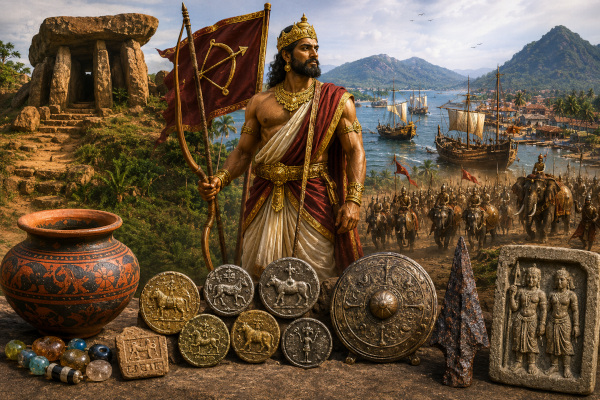
Kudakko Nedum Cheralathan belongs to the difficult but fascinating world of early Chera history, where kings are known less through stone inscriptions and more through Sangam poems, heroic memory, bardic praise and later historical reconstruction. He is usually linked with the early Chera line of ancient Tamilakam, the political-cultural region that included present-day Kerala and parts of western Tamil Nadu. The main historical challenge is that “Kudakko Nedum Cheralathan” is sometimes treated as the same ruler as Imayavaramban Nedum Cheralathan, while some scholars have suggested that he may have belonged to another branch of the Chera house, possibly connected with the Tondi line. Because of this, any detailed account of his life must be written carefully, separating firm literary evidence from later identification and interpretation.
Birth, Parents and Lineage
No surviving Sangam source gives us a clear birth date, birthplace or childhood story for Kudakko Nedum Cheralathan. This is common for most early Chera rulers. The Sangam poems celebrate rulers after they became kings; they rarely preserve the kind of biographical details that later royal inscriptions provide. When Kudakko Nedum Cheralathan is identified with Imayavaramban Nedum Cheralathan, his father is given as Uthiyan Cheralathan, one of the earliest known Chera rulers, and his mother as Nallini, daughter of Veliyan Venman. The Patiṟṟuppattu’s Second Ten is dedicated to Imayavaramban Nedum Cheralathan and names Kumattur Kannanar as the poet who praised him.
In that reconstruction, Kudakko Nedum Cheralathan stands in the direct line of the early western Cheras. His father Uthiyan Cheralathan is remembered in Tamil tradition as a foundational Chera ruler, while Nedum Cheralathan appears as the king who expanded the prestige of the house through warfare, royal generosity and symbolic claims of supremacy. If he is treated separately, as some older reconstructions do, he is linked with another Chera branch and is sometimes connected with Antuvan Cheral Irumporai, showing how fluid and complex early Chera genealogies can be.
Family and Successors
When Kudakko Nedum Cheralathan is identified with Imayavaramban Nedum Cheralathan, his family becomes one of the most important royal households in Sangam-age Chera history. He is connected with sons who later became major figures in Tamil literature and Chera political memory. These include Kalankaykkanni Narmudi Cheral, the celebrated Senguttuvan Chera or Vel Kezhu Kuttuvan, and Adu Kottu Pattu Cheralathan. Senguttuvan in particular became one of the most famous Chera rulers because of his association with the Kannagi-Pattini tradition in the later Tamil epic Silappadikaram.
The Patiṟṟuppattu also preserves the idea of a ruling Chera family whose members held power across different regions and branches. This matters because the Chera kingdom was not necessarily a single centralised state in the modern sense. It appears to have been a network of royal centres, port towns, inland trade routes and collateral branches. Karur or Vanji is strongly associated with the early Cheras in Tamil Nadu’s official district history, while Muchiri/Muziris and Tondi were important western coastal ports linked to Chera power and maritime commerce.
His Titles and Political Identity
The name “Kudakko” is important. It is often understood as a title connected with the western country or Kudanadu, suggesting authority over a western Chera region. “Nedum Cheralathan” itself carries the sense of a great or tall Chera ruler, a name that appears in Sangam tradition as a marker of royal prestige. If identified with Imayavaramban, he also carries the famous title meaning one whose boundary reached the Himalayas. This does not have to be read literally as a verified northern conquest in the modern military sense; in Sangam political language, it was a grand symbolic claim of royal reach, victory and universal fame.
The Patiṟṟuppattu praises him in the language of conquest stretching from the southern seas to the Himalayas and speaks of his bow emblem being associated with the northern mountains. Such imagery shows how Sangam poets framed kingship: a great ruler was not merely a local chief but a world-ordering warrior, giver, protector and patron. The Chera bow was not just a weapon; it was the royal emblem of the dynasty, a symbol of authority, martial identity and legitimacy.
Contributions to Chera Power
Kudakko Nedum Cheralathan’s greatest contribution was the consolidation of Chera prestige during the Sangam age. His reign is remembered for military success, control of important western routes, generosity to poets and the strengthening of Chera identity in Tamil literary memory. The Patiṟṟuppattu says that Imayavaramban Nedum Cheralathan ruled for 58 years, though this number should be treated as part of the poetic-historical tradition rather than a securely dated regnal record.
The poems also describe a ruler who rewarded his poet handsomely. Kumattur Kannanar, who sang the Second Ten in his praise, is said to have received 500 settlements in Umbarkadu and a share of southern revenue for 38 years. This is one of the most striking details about his court culture. It shows that Chera kingship was deeply tied to literary patronage. Poets were not simply entertainers; they were preservers of royal fame, political memory and dynastic legitimacy.
His reign is also linked with prosperity and protection. Sangam poems often contrast the destruction of enemy lands with the flourishing of the king’s own country. In the case of Nedum Cheralathan, the poems present him as a king who could devastate hostile territories but maintain abundance, generosity and order within his realm. This is typical of Sangam royal ethics: the ideal king was fierce in war, open-handed in charity and protective of his people.
Wars and Military Achievements
The military memory of Kudakko Nedum Cheralathan is dominated by three major themes: the defeat of the Kadambu/Kadamba enemy, the victory over Yavanas, and the fatal conflict with a Chola ruler. The Patiṟṟuppattu repeatedly refers to his campaign against the Kadambu enemy and the cutting or destruction of the Kadambu symbol. This may refer to a clan or power on the western coast, possibly connected with maritime or island-based control.
The Yavana episode is one of the most dramatic parts of his legend. In early Tamil literature, “Yavana” usually refers to western foreigners, often Greeks, Romans or Graeco-Roman traders active in Indian Ocean commerce. The literary tradition says that Nedum Cheralathan captured Yavanas, punished them, and later released them after receiving costly ransom such as fine vessels, diamonds and other valuables. This reflects the larger historical background of Indo-Roman trade on the Malabar coast, where Chera ports were deeply connected to overseas commerce.
The most famous war connected specifically with Kudakko Nedum Cheralathan is his battle with the Chola ruler Velpahradakkai Perunar Killi. Older historical reconstruction places this battle at a site called Por, in the Chola country near the Kaveri basin. The account says that both the Chera and the Chola ruler died in the same battle, turning the encounter into one of the great tragic duels of Sangam royal memory.
This death story is important because it preserves the Sangam idea of royal honour. A king could be defeated, but he had to die as a warrior. The account of both kings falling in the same battle allows neither side to appear dishonoured. It is history wrapped in heroic poetry: the battlefield becomes a place where rivalry, prestige and royal mortality meet.
Architecture and Material Culture
There is no securely identified temple, palace, fort or monument that can be directly attributed to Kudakko Nedum Cheralathan. This is not surprising. The early Chera period belongs to the wider Sangam age, where much of the surviving evidence is literary, numismatic, epigraphic and archaeological rather than monumental architecture in the later Chola style. The architectural world of his time would likely have included fortified settlements, ports, wooden or brick structures, assembly spaces, battlefield memorials and early religious establishments, but direct attribution to him would be unsafe.
Karur, associated with Vanji, has produced important archaeological material linked with the early Cheras, including Roman coins, Chera coins and other antiquities. Tamil Nadu’s official Karur district history states that epigraphic, numismatic, archaeological and literary evidence supports Karur’s role as the capital of early Chera kings of the Sangam age. This gives us the material context in which rulers like Kudakko Nedum Cheralathan must be understood: not as builders of surviving stone temples, but as rulers of trade-rich, militarised and culturally active early historic centres.
Literature and Court Culture
Kudakko Nedum Cheralathan’s strongest surviving legacy is literary. The Patiṟṟuppattu, one of the Eight Anthologies of Sangam literature, is central to early Chera history. The Second Ten praises Imayavaramban Nedum Cheralathan and gives us the richest poetic image of his power. It remembers his wars, his generosity, his symbolic northern fame, his treatment of Yavanas and his patronage of poets.
This literary legacy is more than biography. It shows how the Cheras wanted to be remembered. Their kings were not presented merely as local rulers of the western coast. They were shown as protectors of Tamilakam, conquerors of rivals, patrons of learned poets, commanders of elephants and armies, and rulers connected to the maritime wealth of the Arabian Sea. Through poetry, Kudakko Nedum Cheralathan became part of the permanent memory of Tamil civilisation.
Death and Historical Legacy
The tradition surrounding his death is one of the most powerful episodes in early Chera history. Kudakko Nedum Cheralathan is said to have died in battle against the Chola ruler Velpahradakkai Perunar Killi at Por. The Chola king too is said to have died in the same battle. Whether every detail is literal history or poetic heroic memory, the story reflects the intense rivalry between the Cheras and Cholas during the Sangam age.
His legacy rests on three pillars. First, he represents the early Chera attempt to project power across land and sea. Second, he stands as a literary king, remembered because poets preserved his name. Third, he is part of the heroic battlefield tradition of Tamilakam, where rulers were measured by courage, generosity and honour. He may not have left behind a stone temple or a dated inscription in his own name, but he left something equally powerful: a place in the Sangam imagination.
Kudakko Nedum Cheralathan, therefore, should be seen not merely as a king with uncertain dates, but as a bridge between history and heroic memory. He belongs to a time when Kerala and western Tamil Nadu were tied to Roman trade, elephant warfare, bardic courts, port wealth and the political rivalry of the three crowned Tamil dynasties. His life cannot be reconstructed with modern certainty, but his image survives with remarkable force: the Chera king of the west, praised by poets, feared by enemies, generous to bards, and remembered as a ruler who met death in the old warrior’s way—on the battlefield.
You may also like
-
Israel to Honour Indian Pilot Smit Machchhar with Highest Civilian Bravery Award for Saving Flydubai Flight
-
Narendra Modi Completes 25 Years in Government: From Gujarat to the Mission of Viksit Bharat
-
Flydubai FZ1073 Attack: Captain Smit Machchhar’s Calls With Modi and Netanyahu as UAE Probe Names Terror Plot
-
वन्दे मातरम् — Vande Mataram
-
Palakkad Rajas: Guardians of Kerala’s Strategic Eastern Gateway
