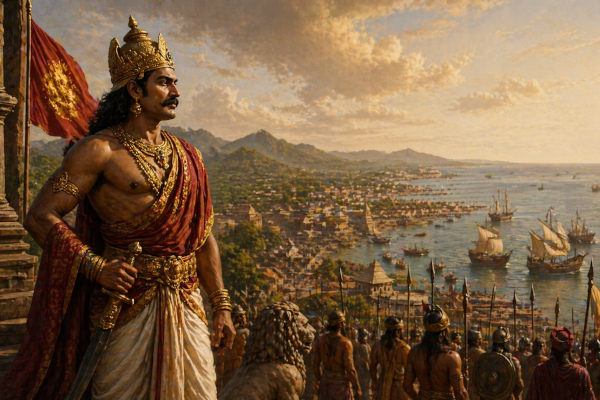
Uthiyan Cheralathan, also called Perum Chottu Uthiyan Cheralathan or Perum-Sorru Udiyan Cheralathan, stands at the misty entrance of Kerala’s recorded royal history. He is remembered as one of the earliest Chera rulers mentioned in Sangam literature, and several historians treat him as the first major Chera king known to Tamil literary tradition. The Kerala State Gazetteer notes that the Chera monarchy is first seen not through a continuous court chronicle, but through early Sangam poems; it also says that the Chera kingdom in the Sangam period covered present-day central Kerala and Kongunadu, with its early roots traced to Kuttanad on the west coast before expanding through the Palakkad gap toward Karur-Vanchi.
Very little is known about Uthiyan’s birth. No surviving Sangam poem gives us his exact birthplace, birth year, parents, childhood or coronation details. This is important because many later retellings try to fill these gaps with confidence, but the historical record does not allow that. What we can say safely is that he belonged to the early Chera house of ancient Tamilakam, the broad cultural region that included Kerala and parts of Tamil Nadu. The Kerala State Gazetteer places him around c. AD 130 and calls him the earliest Chera monarch who “looms large” in Sangam literature, while K. G. Sesha Aiyar’s Chera Kings of the Sangam Period calls him the earliest Chera known to Tamil literature through Purananuru.
His royal name itself carries meaning. Uthiyan or Udiyan appears to be his personal or dynastic name, while Cheralathan marks him as a Chera ruler. He also bore the title Vanavaramban, which has been interpreted as “one whose kingdom is bounded by the sky” or, in another reading, “one whose boundary is the sea.” Sesha Aiyar connects this title with the idea of a wide territory, maritime power and conquests, rather than treating it as a casual ornament.
His most famous title was Perum Chottu or Perum-Sorru, meaning “the great feeder” or “the giver of the great feast.” This comes from a celebrated tradition in Purananuru that he gave abundant food to both sides in the great war of the Mahabharata. The old commentator understood this literally, as though the Chera king fed both the Pandava and Kaurava armies at Kurukshetra. But Sesha Aiyar offers a more cautious interpretation: the poem may refer not to the actual Mahabharata battlefield, but to a grand memorial feeding or ancestral offering connected with the epic heroes from whom the Cheras claimed descent. Either way, the memory that survived is powerful: Uthiyan became the king whose generosity was so vast that literature imagined him feeding armies.
His family is partly known. Uthiyan Cheralathan’s queen was Nallini, described as the daughter of Veliyan Venman. Through her, he became the father of Imayavaramban Nedum Cheralathan, one of the greatest early Chera rulers. Sesha Aiyar states that the second decad of Patirruppattu identifies Uthiyan as the father of Imayavaramban Nedum Cheralathan and says that Uthiyan had married Nallini, daughter of Veliyan Venman. Another important figure, Pal-yanai Sel-Kelu-Kuttuvan, is described as the brother of Imayavaramban, which places him in the same immediate royal family of Uthiyan’s line.
Uthiyan’s reign appears to have laid the foundation for the expansion of the Chera state. The poems do not preserve a neat list of his campaigns, enemies and battle dates, but they present him as a warrior-king who enlarged his kingdom. Sesha Aiyar cites Akananuru to say that Uthiyan “conquered others’ territories and annexed them to his own.” Later, the same historian writes that the work of conquest and annexation began with Uthiyan and was continued by his sons Imayavaramban and Pal-yanai Sel-Kelu-Kuttuvan.
His wars are therefore known more by their political result than by detailed battlefield narrative. Unlike his son Imayavaramban, whose victories over the Kadambas and Yavanas are more clearly remembered, Uthiyan’s military record survives as a broad image: a founder-warrior who pushed the Chera frontier outward, secured the western coast, and created the base from which his descendants could expand northward and eastward. A later study of Uthiyan in Sangam literature also notes that references to his battles occur in Sangam works, including Natrinai, but adds the necessary caution that these songs give only an approximate sketch of his life rather than a precise historical biography.
Uthiyan’s importance was not only military. The Purananuru poem praising him presents his land as prosperous, maritime and connected with foreign trade. In Sesha Aiyar’s translation, the poem speaks of wealth from the sea and merchant vessels arriving at his ports from foreign lands. This is a significant image because the Chera country was one of the great pepper-and-spice zones of the ancient Indian Ocean world. Uthiyan’s Chera realm was not an isolated hill kingdom; it looked outward to the sea, to ships, ports, trade and wealth.
The tradition of his great kitchen also became part of his fame. A later Chera poet, Kottambalattut-tunchiya Makkodai, remembered Uthiyan’s royal kitchen at Kuzhumur or Kulumur. Sesha Aiyar suggested that this place may possibly be connected with the Kumily region near the source of the Periyar, though he also admits that the identification is not certain. Whether the geographical identification is exact or not, the literary meaning is clear: Uthiyan’s kitchen became a symbol of royal abundance. His greatness was remembered through food, hospitality and the kingly duty to feed.
This is why Uthiyan is an unusual kind of early king. Many ancient rulers are remembered only for bloodshed. Uthiyan is remembered for both conquest and generosity. His title Vanavaramban suggests vastness; his title Perum Chottu suggests nourishment. Together, they create the image of a ruler who expanded territory but also fed people, supported poets and presided over a prosperous land. Sesha Aiyar specifically says that if Uthiyan was great in war, he was also great in the arts of peace, with trade flourishing, foreign merchant ships calling at ports, and the king acting as a generous patron of letters.
The question of his death is more complicated. There is a famous story of a Chera king who fought the Chola king Karikala at the Battle of Venni, was wounded in the back, felt dishonoured by that wound, and then performed vadakkiruthal — sitting facing north and fasting to death. This story is sometimes attached in popular retellings to Uthiyan Cheralathan. But the evidence is not secure. Sesha Aiyar explains that the Chera opponent of Karikala at Venni is named in the poems as Perum-Ceralathan, and he argues that this figure was probably Adu-kotpattu Cheralathan, a later Chera ruler, rather than Uthiyan himself.
The death ritual itself is described in powerful terms: the Chera king was struck by an arrow that passed through his body and wounded his back; since a wound on the back was seen as a stain on warrior honour, he sat facing north and courted death by starvation. The act moved others so deeply that some are said to have died along with him. But because the identity of that Chera king is disputed, it is safer to say that Uthiyan Cheralathan’s own death is not clearly recorded in surviving sources. The heroic death at Venni belongs to the Chera historical tradition, but attaching it firmly to Uthiyan would be historically risky.
Uthiyan Cheralathan’s legacy rests on three pillars: he is remembered as the earliest major Chera ruler of Sangam tradition, as the foundational king whose conquests began the rise of the Chera state, and as the Perum Chottu king whose generosity became legendary. He stands between history and epic memory. We do not know his cradle, his childhood or his final hour with certainty. But the poems preserve the outline of a ruler who gave the Cheras their first great literary presence — a king of ports, armies, poets, feasts and expanding frontiers.
Reference:
https://archive.org/details/in.ernet.dli.2015.277483
https://ia801505.us.archive.org/10/items/in.ernet.dli.2015.277483/2015.277483.1097_W_O_text.pdf
https://archive.org/stream/in.ernet.dli.2015.149429/2015.149429.Gazetteer-Of-India-Kerala-State-Gazetteer-Vol-2_djvu.txt
https://www.wisdomlib.org/hinduism/essay/annadatri-carita-study/d/doc1187489.html
https://www.wisdomlib.org/hinduism/essay/annadatri-carita-study/d/doc1187491.html
You may also like
-
Sindhu: The Indus Kingdom of Jayadratha in the Mahabharata
-
Kuninda or Kulinda: The Himalayan Realm of the Mahabharata in Uttarakhand and Himachal Pradesh
-
Durga versus Mahishasura: Weapons, Battlefield Tactics and the Triumph of Shakti
-
Kuluta: The Kullu Valley Kingdom of the Mahabharata
-
Israel to Honour Indian Pilot Smit Machchhar with Highest Civilian Bravery Award for Saving Flydubai Flight
