The Ministry of Agriculture and Farmers Welfare’s latest kharif sowing update shows that India’s 2026 kharif season has gained early momentum, with total sown area reaching 119.90 lakh hectares as of June 19, 2026, compared with 117.95 lakh hectares during the corresponding period in 2025. This marks a net increase of 1.95 lakh hectares, signalling a recovery from the slower pace recorded a week earlier.
Kharif acreage change over 2025
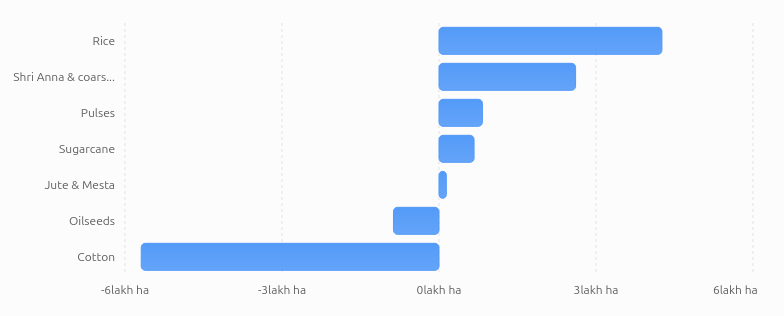
Data: PIB, Ministry of Agriculture & Farmers Welfare. Unit: lakh hectares.
India’s kharif sowing has moved into a stronger phase, helped mainly by a sharp rise in rice acreage, improved sowing under pulses, and a healthy expansion in Shri Anna and coarse cereals. The latest chart places rice acreage at 12.36 lakh hectares, up from 8.09 lakh hectares last year, giving rice alone an increase of 4.26 lakh hectares. This is the single biggest positive contributor in the table.
Pulses have also shown improvement, rising to 7.21 lakh hectares against 6.39 lakh hectares in 2025. Within pulses, moongbean is the strongest performer, rising to 4.08 lakh hectares from 2.86 lakh hectares, while urdbean is lower at 0.62 lakh hectares against 0.98 lakh hectares last year. The data suggests that the pulses basket has improved despite mixed movement across individual crops.
The Shri Anna and coarse cereals category has emerged as another important support point for the season. Area under this group stands at 12.43 lakh hectares, compared with 9.82 lakh hectares last year, a gain of 2.61 lakh hectares. Bajra is the main driver inside this group, rising to 4.05 lakh hectares from 2.14 lakh hectares, while maize has also moved up to 5.69 lakh hectares from 5.34 lakh hectares.
The oilseeds segment presents a more cautious picture. Total oilseed acreage stands at 7.24 lakh hectares, lower than 8.11 lakh hectares last year. The decline is mainly linked to soybean, where sowing has dropped to 1.30 lakh hectares from 2.50 lakh hectares. Groundnut, however, has remained slightly ahead of last year, reaching 5.25 lakh hectares compared with 5.09 lakh hectares.
Cotton is the biggest laggard in the latest update. Cotton sowing has reached 17.13 lakh hectares, compared with 22.82 lakh hectares last year, showing a decline of 5.69 lakh hectares. This is the largest negative movement among all major crop groups in the chart and will need close tracking as sowing progresses across major cotton-growing states.
Sugarcane and jute have remained steady. Sugarcane acreage stands at 57.31 lakh hectares, slightly above last year’s 56.64 lakh hectares, while jute and mesta have reached 6.22 lakh hectares, compared with 6.09 lakh hectares in 2025.
The latest numbers are significant because the previous weekly update, dated June 12, had shown total kharif sowing at 84.60 lakh hectares, lower than 88.04 lakh hectares during the same period last year. Within one week, the season moved from a deficit of 3.44 lakh hectares to a surplus of 1.95 lakh hectares, showing that sowing activity accelerated sharply as the monsoon advanced.
The monsoon remains central to the next phase of the kharif season. IMD’s updated long-range forecast had projected the 2026 southwest monsoon rainfall at 90% of the Long Period Average, with June rainfall expected to be below normal. IMD also indicated favourable conditions for further advance of the southwest monsoon into parts of Maharashtra, Telangana, Odisha, Jharkhand, Bihar and Chhattisgarh around June 23.
Overall, the June 19 chart points to a kharif season that has regained pace after an uneven start. Rice, moongbean, bajra and maize are giving the sowing season a stronger base, while cotton and soybean remain the two areas of concern. The coming weeks will be crucial, as kharif sowing usually expands rapidly with wider monsoon coverage across central, western and northern India. If rainfall distribution improves, the early lead in total acreage could strengthen further; if dry spells persist in key oilseed and cotton belts, the crop mix may remain uneven.
Source: PIB
You may also like
-
Vietnam Expands Business and Investment Links Across India’s Major Economic Hubs
-
India’s GST Collections Rise 14.7% to ₹2.04 Lakh Crore in September
-
SberIndia Lending to Indian Companies Quadruples as India-Russia Trade Finance Expands
-
India Manufacturing PMI Rises to Seven-Month High of 55.1 in September
-
Nothing and Optiemus Announce $100 Million Joint Venture to Expand Smartphone Manufacturing in India
