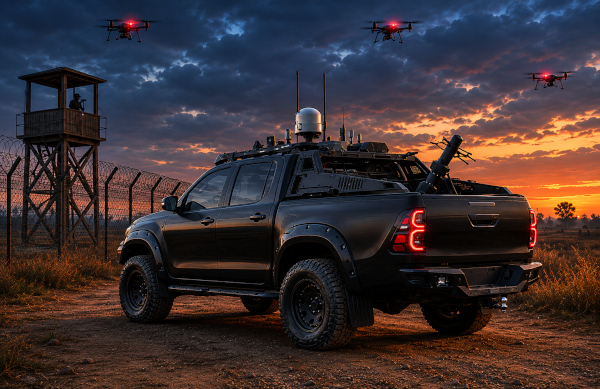
India’s counter-drone architecture is beginning to move beyond fixed protection of military bases and critical infrastructure towards a more mobile concept in which security forces can actively patrol vulnerable low-altitude airspace.
At the centre of this emerging approach is the Indrajaal Ranger, a vehicle-mounted counter-unmanned aircraft system developed by Hyderabad-based Indrajaal Drone Defence. The company describes Ranger as a purpose-built Anti-Drone Patrol Vehicle, or ADPV, capable of detecting, tracking and countering rogue drones while moving through border areas, urban zones and other sensitive corridors.
The concept is strategically important because small drones have changed the nature of threats faced by border forces, military installations and internal-security agencies. A hostile drone does not need to attack a heavily defended airbase. It can cross farmland carrying narcotics, approach a convoy from an unexpected direction, conduct reconnaissance over a military position or appear above a public gathering with little warning.
From Protecting a Point to Patrolling an Area
Traditional counter-UAS systems are frequently positioned around a specific installation such as an airbase, ammunition depot, refinery, airport or command centre. Sensors watch the surrounding airspace, while electronic or kinetic countermeasures respond when a drone enters the protected zone.
That remains essential, but it does not fully address threats that move across large areas.
Indrajaal says Ranger was designed around this problem. The vehicle is intended to accompany convoys, patrol border roads, move through agricultural belts and rapidly reposition to locations where drone activity has been detected. The company lists border infiltration prevention, convoy security, forward operating base protection and rapid-response operations among its intended missions.
This creates a different operational philosophy. Instead of moving a counter-drone system to a location and then operating it as a static site, the vehicle itself becomes a mobile sensing, command and countermeasure platform.
Indrajaal officially unveiled Ranger in Hyderabad on November 26, 2025. The company said it had specifically engineered the platform to perform detection, tracking and neutralisation while moving.
Why India Needs Mobile Counter-Drone Protection
The Ministry of Home Affairs has acknowledged the use of drones for smuggling arms and narcotics across the India-Pakistan border. In an August 2023 parliamentary reply, the government said anti-drone systems had already been deployed in parts of Punjab and confirmed that smugglers were using UAVs to transport prohibited material across the border.
The same government response confirmed that the Anti-Rogue Drone Technology Committee, or ARDTC, operates under the supervision of the Director General of the Border Security Force. Its mandate is to evaluate counter-drone technologies and certify their effectiveness against rogue UAVs.
The threat has since expanded beyond smuggling.
During Operation Sindoor in May 2025, Pakistan used drones alongside missiles, rockets and other long-range weapons during attacks against Indian military targets. The Ministry of Defence later said Indian air-defence, counter-drone and electronic-warfare systems prevented those attacks from damaging vital assets.
The experience reinforced a broader lesson: inexpensive unmanned systems can threaten targets ranging from frontline formations and ammunition facilities to airbases and critical infrastructure.
A counter-drone network must therefore protect not only fixed sites but also the spaces between them.
Ranger Combines Several Ways of Fighting a Drone
A significant feature of Ranger is its layered approach.
Indrajaal says the vehicle combines direction finding, protocol analysis, cyber takeover, GNSS spoofing, RF jamming and kinetic interception under a common command system.
The company states that the system can detect drones at ranges of up to approximately 10 kilometres and employ countermeasures within a combat envelope of around 4 kilometres, although actual performance would depend on the target, environment, electronic conditions and selected countermeasure.
This layered architecture matters because no single counter-drone technique works against every UAV.
Some commercially derived drones rely heavily on radio links between the aircraft and controller. Those communications may be detectable or disruptable.
Other drones can navigate autonomously using pre-programmed routes and may continue flying even when their command link disappears.
A sophisticated counter-UAS system therefore needs several possible responses rather than relying entirely on conventional jamming.
Cyber Takeover Could Preserve the Drone for Investigation
One of Ranger’s advertised capabilities is cyber takeover.
Rather than simply overwhelming a drone with interference, this approach attempts to seize control of a compatible hostile or unauthorised aircraft and direct it towards a controlled landing.
Indrajaal describes its takeover capability as a non-kinetic means of recovering a drone without destroying it.
That can be valuable in internal-security missions because the intercepted aircraft may contain useful evidence.
Investigators could potentially examine its components, stored data, flight information or payload to understand where it came from and how it was being used.
The original material supplied for this article similarly highlights controlled capture as a means of preserving a suspect drone for forensic examination.
However, cyber takeover is not universal. It depends on the target aircraft’s communications protocol, security architecture and level of autonomy. A military UAV designed with encrypted or non-standard communications may require a different response.
Electronic Denial Forms the Second Layer
Ranger also incorporates electronic countermeasures such as RF jamming and GNSS spoofing.
Jamming attempts to interfere with communications or navigation signals used by a drone. Depending on how the aircraft has been programmed, the disruption may cause it to hover, land, return to its launch point or lose its ability to complete the intended mission.
GNSS spoofing takes a different approach by attempting to manipulate the navigation information received by the aircraft.
India has been developing counter-drone requirements around such capabilities for several years. An official BSF technical requirement published through the Ministry of Home Affairs included radar, radio-frequency detection, electro-optical sensors and jamming within a ground-based counter-drone architecture capable of being deployed on a vehicle.
Ranger represents a newer attempt to integrate such technologies into a system designed specifically for routine mobility.
Hard Kill Remains Available When Electronic Measures Are Not Enough
Electronic warfare cannot defeat every threat.
A drone flying autonomously may not require a live control link, while a specially configured aircraft could resist standard jamming techniques.
Indrajaal therefore pairs its electronic capabilities with a kinetic option called Zombee, an interceptor drone intended to physically engage hostile UAVs.
The company describes the interceptor as part of Ranger’s hard-kill layer.
This provides operators with escalation choices. An unknown civilian drone near a restricted area does not necessarily require physical destruction. A cyber takeover or electronic denial may be sufficient.
A weaponised UAV continuing towards a protected target may require a more decisive response.
That layered structure reflects a wider trend in counter-UAS warfare, where operators increasingly combine sensing, electronic warfare and kinetic interception rather than depending on a single weapon.
SkyOS Acts as the Command Layer
The various sensors and countermeasures are brought together through Indrajaal’s proprietary SkyOS platform.
Indrajaal describes SkyOS as an AI-enabled C5ISRT architecture integrating command, control, communications, computers, cyber defence, intelligence, surveillance, reconnaissance and targeting.
For Ranger, the important function is sensor fusion.
A counter-drone operator may receive information simultaneously from RF sensors, direction-finding equipment, electro-optical systems and other detectors. Those inputs need to be correlated quickly enough to determine whether an object is benign, suspicious or hostile.
Indrajaal says its AI architecture supports real-time tracking and threat assessment while maintaining human operational oversight.
In practice, human decision-making remains essential, especially in cities or public areas where legitimate civilian drones may operate close to protected airspace.
₹100-Crore Ministry of Defence Contracts Are Confirmed by the Company
Another important development came in early 2026.
Indrajaal announced that it had secured multiple Ministry of Defence contracts valued at about ₹100 crore for deployment of autonomous counter-drone systems protecting key Indian Army and Indian Navy installations.
The company said the deployments covered both land and maritime environments and involved its multi-layered autonomous counter-drone architecture.
The publicly verifiable announcement is Indrajaal’s ₹100-crore Ministry of Defence contract package, and that announcement refers broadly to autonomous counter-drone systems.
Is India Really the First Country to Conduct Anti-Drone Patrolling?
India is emerging as one of the countries pushing counter-UAS capability beyond static point defence towards purpose-designed mobile patrol operations. The Indrajaal Ranger reflects this shift by taking counter-drone sensors, command systems and neutralisation tools onto a mobile platform that can move with the threat environment rather than remain tied to a fixed installation.
Traditional counter-drone systems are primarily designed to protect defined locations such as airbases, ammunition depots, airports or critical infrastructure. Mobile anti-drone patrol vehicles introduce a different operational concept. They can accompany convoys, patrol vulnerable border sectors, reposition rapidly around public events and provide temporary protection wherever drone activity is expected to emerge.
Several countries already operate vehicle-mounted counter-UAS technologies, but platforms such as Ranger demonstrate how India is moving towards continuous and mobile surveillance of low-altitude airspace. The emphasis is no longer only on defending a protected perimeter. It is increasingly about taking counter-drone capability onto roads, border tracks and operational routes so that the defensive envelope can move with troops, vehicles and security requirements.
This evolution could become increasingly important as inexpensive drones, autonomous UAVs and improvised aerial systems make threats more dispersed and unpredictable. By developing purpose-built mobile counter-UAS platforms, India is helping advance a doctrine in which low-altitude airspace is actively patrolled rather than merely defended from fixed positions.
Borders Could Be the Natural First Operational Environment
The India-Pakistan border presents an obvious use case.
Drone smugglers can exploit large agricultural areas, rivers, canals and sparsely populated terrain. A fixed counter-drone installation protects only the airspace covered by its sensors and effectors.
A mobile vehicle can instead patrol known infiltration routes, respond to intelligence and reposition after a drone sighting.
The government has already acknowledged using vulnerability mapping, surveillance vehicles, command-and-control systems and anti-drone technology along the Punjab border.
A system such as Ranger could complement this architecture rather than replace fixed installations.
The ideal network would combine long-range surveillance, fixed counter-UAS posts, mobile patrol assets and rapid-response teams.
Mobile Counter-Drone Cover Could Protect Military Convoys
Military operations create another requirement that static systems cannot easily satisfy.
A convoy carrying troops, ammunition or high-value equipment may travel for hours through territory without permanent counter-drone coverage.
The proliferation of inexpensive first-person-view drones and small loitering weapons has made moving vehicle columns increasingly vulnerable.
Ranger’s manufacturer specifically lists convoy security as one of its principal missions.
A vehicle travelling with a convoy could potentially provide early warning, electronic countermeasures and an interceptor option while the formation remains on the move.
This could eventually make mobile counter-UAS vehicles a regular element of convoy protection in the same way electronic-warfare and air-defence assets accompany other military formations.
Operation Sindoor Has Made Counter-UAS a Strategic Priority
The strategic environment after Operation Sindoor gives these developments greater urgency.
The Ministry of Defence’s official review of the 2025 conflict said Pakistan employed drones, missiles and other weapons against Indian military targets and highlighted the contribution of Indian counter-drone and electronic-warfare systems to defeating those attacks.
The lesson is that drone defence can no longer be treated as a specialised capability needed only at a few sensitive locations.
Military formations, naval facilities, logistics hubs, ammunition depots, border posts and other critical sites increasingly require layered protection.
Mobile systems can fill the spaces that permanent installations cannot cover.
Government Policy Has Been Moving in the Same Direction
The policy environment is also becoming more supportive of indigenous counter-drone technology.
In March 2025, Union Home Minister Amit Shah told Parliament that India was working towards a comprehensive indigenous anti-drone solution, describing self-reliance in this field as a national-security priority.
The Ministry of Home Affairs had already established ARDTC to evaluate technologies for dealing with rogue drones, while the BSF and other agencies have conducted trials and deployed systems along vulnerable border sectors.
The Indian defence ecosystem is consequently developing several layers of counter-UAS technology, ranging from radars and electronic warfare to interceptor drones and complete command-and-control architectures.
Ranger fits within this wider transformation.
From Anti-Drone Equipment to an Anti-Drone Doctrine
The most significant feature of Ranger may ultimately be doctrinal rather than technological.
India has had vehicle-mounted counter-drone equipment before. What the ADPV concept proposes is to make the vehicle itself a patrolling air-defence asset.
The source material describes this transition as moving from conventional ground patrols towards routine protection of the air immediately above borders, highways and urban spaces.
That distinction could become increasingly important as drones become cheaper and more autonomous.
A static defence system waits for the threat to enter its protected zone.
A patrol system searches for the threat.
If that concept proves operationally effective, mobile counter-UAS vehicles could eventually become part of routine security formations alongside patrol vehicles, electronic-warfare teams and surveillance units.
Indigenous Counter-Drone Manufacturing Is Becoming a Strategic Industry
The development also carries an industrial dimension.
Indrajaal says its counter-UAS architecture is developed in India and has already moved into operational deployments. Its website currently reports more than 15 deployments across different environments, although these company figures do not disclose all customers or configurations.
The ₹100-crore MoD contracts demonstrate that Indian private-sector counter-drone companies are beginning to receive orders at meaningful scale.
That matters because modern counter-UAS technology combines several strategic disciplines: radar, radio-frequency engineering, electro-optics, artificial intelligence, cyber systems, electronic warfare, autonomous interceptors and command-and-control software.
Building those technologies domestically creates capabilities that extend well beyond one anti-drone vehicle.
Ranger Represents a Larger Change in Airspace Security
Indrajaal Ranger should therefore be viewed as more than a modified 4×4 carrying electronic equipment.
Its real importance is the operational idea behind it.
Drone threats are mobile, inexpensive and unpredictable. Counter-drone protection consequently needs the ability to move with the asset being protected and rapidly concentrate wherever an aerial intrusion develops.
India’s official border-security architecture already recognises the drone threat. The Ministry of Home Affairs has established a technology-evaluation mechanism, deployed counter-drone equipment and acknowledged the role of UAVs in cross-border smuggling.
The Armed Forces have simultaneously gained direct experience of large-scale hostile drone operations during Operation Sindoor.
Against that background, Ranger represents a logical next step: taking counter-UAS capability off the fixed perimeter and putting it onto patrol routes, convoys and rapidly changing security environments.
The platform’s final strategic significance will depend on how many systems are actually ordered, where they are deployed and how effectively they perform in operational conditions.
What can already be said with confidence is that India’s counter-drone debate is moving beyond the question of how to defend an installation.
The emerging question is how to continuously control the low-altitude airspace across the spaces between those installations.
That is the domain the Anti-Drone Patrol Vehicle is designed to enter.
Sources
Ministry of Home Affairs / PIB: Government confirmation of the Anti-Rogue Drone Technology Committee, counter-drone deployment along the Punjab border and drone-enabled arms and narcotics smuggling.
Ministry of Home Affairs / BSF: Official technical requirements for vehicle-deployable anti-drone systems and their detection, tracking and neutralisation functions.
Ministry of Defence / PIB: Official 2025 review documenting the use of hostile drones during Operation Sindoor and India’s counter-drone response.
Indrajaal Drone Defence: Official Ranger launch and technical information covering mobility, detection, countermeasures and SkyOS.
Indrajaal Drone Defence: Company announcement confirming multiple Ministry of Defence counter-drone contracts totalling approximately ₹100 crore.
You may also like
-
ICAR Scientists Develop Indigenous Protective Gloves for Cotton Farmers, Sign Commercial Manufacturing Agreement
-
India Moves Towards Five-Year Assured Orders for Defence Startups Under New Procurement Reforms
-
BHEL–Coal India Joint Venture Begins Construction of ₹25,016 Crore Indigenous Coal Gasification Project in Odisha
-
Zen Technologies Introduces Indigenous Hyper-Strike Falcon AI-Guided Counter-Drone Interceptor
-
L&T and Germany’s SCHOTTEL Expand Partnership for Controllable Pitch Propeller Systems in Indian Shipbuilding
