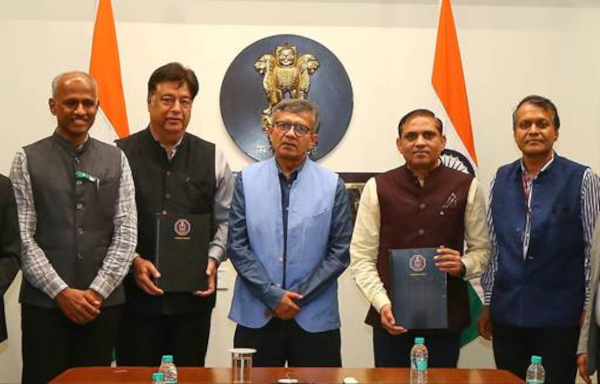
India has taken another important step in strengthening its indigenous electronic warfare capability with the Ministry of Defence signing a ₹449 crore contract for the procurement of 20 Enhanced Capability Global Navigation Satellite System jammers for the Indian Navy. The agreement was signed with Bengaluru-based Accord Software and Systems Private Limited on June 10, 2026, under the Buy Indian, Indigenously Designed, Developed and Manufactured category. The systems will carry a minimum of 75 percent indigenous content, making the contract a significant addition to India’s Aatmanirbhar Bharat defence roadmap.
The new jammers are meant to protect Indian Navy warships in a maritime battlespace where satellite navigation, precision weapons, drones, unmanned platforms and networked sensors are becoming central to modern combat. Global Navigation Satellite Systems are used for positioning, timing, navigation and target coordination. In a high-threat environment, an adversary’s dependence on such signals becomes a point of vulnerability. The ECGNSS jammers are designed to degrade hostile satellite signal acquisition and tracking, while also supporting spoofing or deceptive jamming against enemy receivers.
For the Indian Navy, this capability has clear operational value. Warships operate across wide sea zones, often far from land-based protection. They face threats from aircraft, drones, guided weapons, submarines, surveillance platforms and hostile electronic systems. A naval formation that can interfere with an adversary’s satellite-linked navigation and targeting chain gains an important defensive layer. Such systems help ships operate with greater safety when the enemy depends on satellite signals for direction, timing or weapon guidance.
The deal also carries industrial importance. Accord Software and Systems is a Bengaluru-based technology company with long experience in navigation, avionics, GPS and GNSS-related systems. The company says it provides indigenous GPS/GNSS and communication-technology solutions for defence customers, along with GNSS products for space, industrial and semiconductor applications. This makes the contract part of a larger Indian effort to build domestic depth in specialised defence electronics rather than relying only on imported black-box systems.
The timing of the contract is also significant. Modern warfare has moved deep into the electromagnetic spectrum. A ship today does not only fight with missiles, guns and torpedoes. It also fights by detecting, confusing, denying and manipulating signals. Electronic warfare systems help shape the battlefield before a visible strike takes place. In this context, GNSS jamming is not a standalone equipment purchase; it is part of a broader move toward signal dominance at sea.
For India, the maritime dimension is especially important because the Indian Ocean Region is becoming more contested. Trade routes, energy flows, island territories, chokepoints and undersea infrastructure all require stronger naval protection. The Navy’s ability to operate in a multi-threat environment depends on layered defence, electronic awareness and indigenous technology. The induction of 20 ECGNSS jammers strengthens that architecture by giving ships another tool to counter hostile navigation-linked threats.
The ₹449 crore contract shows a steady shift in Indian defence procurement. Instead of viewing self-reliance only as local assembly, the emphasis is moving toward Indian design, Indian development and Indian manufacturing. With minimum 75 percent indigenous content, the programme supports domestic industry, skilled engineering and long-term technology retention inside the country.
In simple terms, this deal gives the Indian Navy a sharper electronic shield. It strengthens warship survivability, supports maritime security, expands India’s defence-electronics base and reinforces the larger Make in India mission. As naval warfare becomes more digital, satellite-dependent and signal-driven, indigenous ECGNSS jammers will give India a stronger hand in protecting its ships, sailors and strategic interests at sea.
Source: PIB
You may also like
-
India Moves Towards Five-Year Assured Orders for Defence Startups Under New Procurement Reforms
-
Zen Technologies Introduces Indigenous Hyper-Strike Falcon AI-Guided Counter-Drone Interceptor
-
L&T and Germany’s SCHOTTEL Expand Partnership for Controllable Pitch Propeller Systems in Indian Shipbuilding
-
India to Train 60,000 Civil Defence Volunteers Across 12 States and UTs with Indian Army Support
-
Indian Army’s Northern Command Opens 75-Day Defence Technology Internship Programme for Young Innovators
