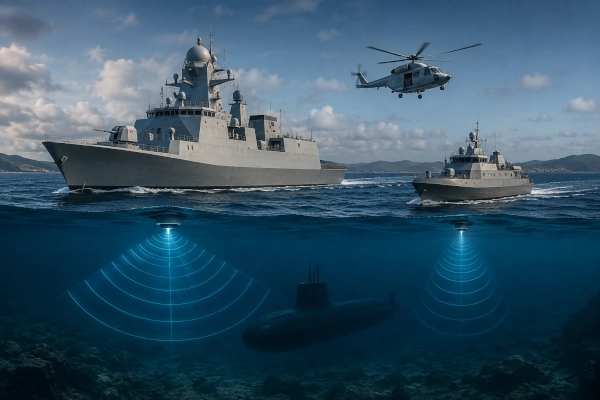
India’s drive towards self-reliance in naval warfare is increasingly extending beneath the surface of the ocean, with indigenous sonar systems developed by the Defence Research and Development Organisation now operating aboard some of the Indian Navy’s newest frontline warships.
DRDO’s August 2026 newsletter has highlighted the deployment of indigenous sonar technologies aboard INS Dunagiri, an advanced stealth guided-missile frigate, and INS Agray, an Anti-Submarine Warfare Shallow Water Craft. Both vessels were commissioned into the Indian Navy in Kolkata on June 21, 2026 and form part of a wider naval modernisation programme in which Indian sensors, weapons, electronics and shipbuilding capabilities are progressively replacing imported systems.
At the heart of this underwater capability is the Naval Physical and Oceanographic Laboratory in Kochi, better known as NPOL. The DRDO laboratory has emerged as one of India’s principal centres for underwater acoustics, sonar engineering and anti-submarine warfare technologies, developing systems capable of detecting, classifying and tracking submarines and other underwater threats.
Sonar performs beneath the sea what radar performs in the air, but the operating environment is considerably more complicated. Radio waves used by conventional radar do not propagate effectively through seawater, forcing naval forces to depend mainly on sound for long-range underwater detection. Sonar systems transmit or receive acoustic energy and analyse the returning signals to determine whether submarines, underwater vehicles or other objects are present.
The challenge becomes especially demanding in the Indian Ocean, where temperature, salinity, depth, seabed characteristics and layers within the water can alter how sound travels. Reflections from the surface and seabed can generate additional acoustic clutter, while commercial shipping and marine activity create substantial background noise. Successful underwater detection therefore depends as much on advanced signal processing and acoustic modelling as it does on powerful transducers.
The sonar fitted aboard INS Dunagiri represents one of the most mature products of this indigenous research ecosystem. The frigate is equipped with the HUMSA-2020, also known as HUMSA-NG Mk II, a fourth-generation shipborne hull-mounted active-cum-passive sonar developed by NPOL and manufactured by Bharat Electronics Limited in Bengaluru.
HUMSA-NG Mk II can operate in both active and passive modes. In active operation, the sonar transmits acoustic energy into the water and analyses echoes returning from underwater objects. Passive operation works differently: instead of transmitting, the system listens for acoustic signatures produced by submarines, propulsion machinery and other underwater activity.
Combining both modes gives a surface warship greater tactical flexibility. Active sonar can provide direct detection information but also reveals that the searching ship is transmitting. Passive sonar enables quieter surveillance by exploiting acoustic emissions generated by other vessels.
The system incorporates conventional and adaptive signal-processing techniques designed to extract useful contacts from complicated underwater noise. Its operator displays can integrate sonar and radar tracks with chart information, while automatic tracking functions allow several underwater contacts to be followed simultaneously. BEL describes HUMSA-NG Mk II as capable of tracking up to eight active and eight passive targets, together with specialised passive-analysis functions for identifying underwater acoustic signatures.
The significance of HUMSA-2020 extends far beyond a single frigate. DRDO says 16 systems have been ordered for Indian naval platforms, covering seven Project 17A frigates, three Talwar-class ships, four additional Talwar platforms, INS Rana and INS Brahmaputra. The system has completed laboratory and shipboard acceptance stages and is already operational aboard naval vessels.
This wider deployment is strategically important because sonar performance improves when a navy develops common indigenous technology across several ship classes. Training, maintenance, software improvements, spare parts and future upgrades can increasingly be handled through a domestic ecosystem instead of depending on separate imported systems with different support chains.
For INS Agray, however, NPOL had to address an entirely different underwater environment. The vessel is an Anti-Submarine Warfare Shallow Water Craft designed specifically for operations closer to India’s coastline, where acoustic conditions can be much more difficult than those encountered in deeper ocean waters.
Shallow seas generate intense acoustic complexity. Sound can repeatedly reflect between the seabed and the sea surface, while reefs, fishing vessels, merchant traffic and coastal activity add substantial noise. A submarine operating in these conditions can exploit the clutter to make detection more difficult.
Large sonar systems designed for major frigates are also unsuitable for smaller shallow-water vessels because of constraints involving space, weight and power consumption. NPOL therefore developed a compact sonar architecture optimised for smaller platforms.
INS Agray carries the Abhay PG Shallow Water Sonar Suite, a compact hull-mounted sonar designed by NPOL specifically for India’s new generation of Anti-Submarine Warfare Shallow Water Craft. DRDO says the system is intended for installation aboard 16 shallow-water vessels being built by Garden Reach Shipbuilders & Engineers and Cochin Shipyard Limited.
The underlying Abhay family is designed for smaller surface vessels and combines active and passive sonar capabilities with advanced signal and information processing. DRDO’s compact hull-mounted sonar architecture provides panoramic active detection, passive surveillance, multiple-target tracking and onboard data recording while fitting within the constraints of smaller naval platforms.
This capability is particularly relevant to India’s coastal defence. Conventional submarines operating in shallow waters can threaten ports, naval bases, shipping approaches and important sea lanes. Small anti-submarine vessels equipped with dedicated sonar therefore provide an important layer of protection around coastal areas where larger destroyers and frigates may not be the ideal platforms for persistent submarine hunting.
The deployment of HUMSA and Abhay also illustrates how India’s sonar programme has evolved from laboratory development into an increasingly mature industrial ecosystem. NPOL remains responsible for core underwater-acoustic research, system design and specialised algorithms, while Indian companies manufacture and integrate the equipment required for fleet deployment.
Bharat Electronics Limited has become particularly important in this process through production of HUMSA-NG Mk II. Other indigenous sonar programmes have similarly involved companies including Larsen & Toubro and Keltron, creating domestic expertise in electro-acoustic transducers, electronics, signal processing, power systems and shipboard integration.
This industrial dimension is critical because a naval sonar is not a single sensor that can simply be installed once and forgotten. Sonar equipment must remain operational for decades while receiving hardware repairs, software modifications, signal-processing improvements and replacement components throughout a warship’s service life.
Domestic design authority gives India much greater control over this lifecycle. Algorithms can be modified as new underwater threats emerge, software can be adapted to Indian Ocean conditions and new processing technologies can be introduced without depending entirely on a foreign original equipment manufacturer.
The growing indigenous sonar ecosystem also has significance for operational secrecy. Underwater-acoustic warfare involves highly sensitive information about frequencies, processing techniques, detection performance and acoustic signatures. Greater domestic control reduces dependence on external suppliers for technologies at the core of anti-submarine warfare.
India’s need for such capability is increasing as the underwater environment of the Indian Ocean becomes more strategically contested. Submarines are among the most difficult military platforms to detect because they can remain submerged for long periods while operating with increasingly quiet propulsion systems.
Modern conventional submarines equipped with air-independent propulsion can remain underwater for extended periods, while nuclear-powered submarines possess enormous endurance and mobility. Improvements in acoustic quieting continually force sonar developers to extract weaker signals from more complicated background noise.
This means underwater detection is effectively a continuous technological competition between increasingly quiet submarines and increasingly sensitive sonar systems.
India’s response extends beyond hull-mounted sonar alone. NPOL has developed a wider family of underwater surveillance and anti-submarine technologies involving variable-depth sonar, towed systems and specialised acoustic processing. The Navy also combines shipborne sonar with maritime patrol aircraft, helicopters, sonobuoys and other sensors to create a layered anti-submarine warfare network.
Future underwater warfare will expand this network further through autonomous systems. Unmanned underwater vehicles can potentially patrol areas that are difficult or dangerous for conventional ships, while distributed sensors and autonomous platforms could work together to detect and track underwater threats.
DRDO is already investing in this next stage. Its Naval Science & Technological Laboratory in Visakhapatnam inaugurated the UDAYAN underwater swarm and mine-countermeasure technology integration facility on June 24, 2026. The centre has been created for the integration, testing and validation of advanced autonomous underwater systems and swarm technologies for future naval warfare.
The combination of NPOL’s acoustic expertise and NSTL’s growing autonomous underwater capabilities points towards a future in which sonar may no longer be confined principally to large crewed warships. Acoustic sensors could increasingly operate across distributed networks involving ships, helicopters, autonomous underwater vehicles and unmanned surface platforms.
India’s naval indigenisation programme is consequently entering a more sophisticated phase. Building the hull of a warship domestically is an important achievement, but genuine strategic autonomy depends increasingly on controlling the sensors and combat systems that determine what the vessel can actually detect and engage.
INS Dunagiri and INS Agray illustrate that distinction. Their Indian-built hulls are visible symbols of domestic shipbuilding, but beneath the waterline their indigenous sonar suites represent an equally important technological achievement.
The two vessels themselves have more than 75% indigenous content, reflecting participation by Indian shipyards and more than 200 domestic MSMEs in the wider construction programme. The presence of Indian-developed sonar means that part of this indigenisation now extends into one of the most technically demanding areas of naval warfare.
For India, this is strategically important because anti-submarine warfare cannot be built around imported hardware alone. Effective underwater surveillance requires sustained research into oceanography, acoustic propagation, transducer materials, signal processing, target classification and platform integration.
NPOL’s work represents decades of accumulated knowledge in precisely these areas. By turning that scientific capability into fleet-standard systems such as HUMSA and Abhay, DRDO is helping transform Indian underwater research into operational naval power.
The August 2026 deployment update therefore tells a larger story than the installation of two sonar systems aboard two ships. It shows the emergence of an Indian underwater-sensor ecosystem in which DRDO laboratories design the core technology, domestic industry manufactures it, Indian shipyards integrate it and the Navy deploys it across increasingly diverse classes of warships.
As India builds a larger blue-water Navy while simultaneously strengthening coastal anti-submarine warfare, indigenous sonar will become one of the foundations of maritime self-reliance. The ability to hear, identify and track what moves beneath the Indian Ocean may ultimately prove as important as the missiles, guns and aircraft carried above its surface.
You may also like
-
India to Seek 35% Increase in Defence Modernisation Budget for FY 2027–28
-
INS Trishul Arrives in UK for Exercise KONKAN 2026 as India and Royal Navy Expand Maritime Cooperation
-
INS Sahyadri Arrives in Russia for Exercise INDRA 2026 to Strengthen India-Russia Naval Cooperation
-
CG Power Strengthens India’s Semiconductor Manufacturing Ecosystem with ₹7,600 Crore Sanand Investment
-
Honeywell Accelerates HTT-40 Engine Deliveries to HAL, Targets 16 Engines by Mid-2027
