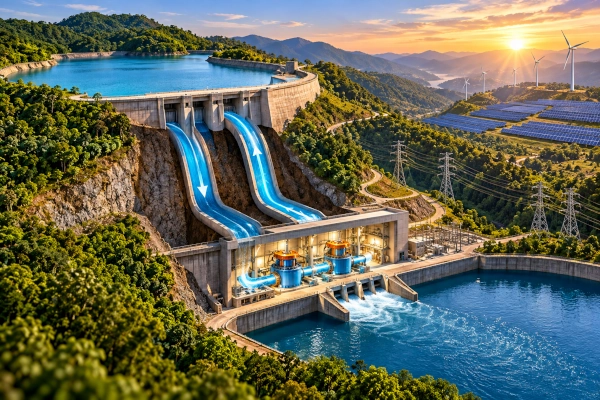
India is rapidly expanding its ability to store electricity using water and gravity, with 7.43 gigawatts (GW) of pumped-storage hydropower capacity operational across ten projects as of August 2026. The development represents an important step towards strengthening the national electricity grid and supporting the country’s transition to renewable energy.
According to a Ministry of Power backgrounder published on 19 October 2026, another 15.87 GW of pumped-storage capacity is under construction or implementation, while 10.40 GW across eight additional projects has received concurrence or undergone appraisal by the Central Electricity Authority (CEA).
Often described as giant water batteries, pumped-storage hydropower projects store energy by moving water between reservoirs at different elevations. They allow electricity generated during periods of surplus supply to be stored and used when demand increases.
India has identified 320 potential pumped-storage projects with a combined capacity of 345.38 GW. The government envisages a substantial expansion of this infrastructure, with cumulative installed capacity projected to reach approximately 105.56 GW by 2035–36.
How Giant Water Batteries Store Electricity
Pumped-storage hydropower uses a relatively simple engineering principle: water stored at a higher elevation contains gravitational potential energy that can later be converted into electricity.
A typical pumped-storage installation consists of two reservoirs located at different elevations, connected through tunnels or pipelines containing reversible pump-turbine equipment.
When electricity generation exceeds immediate demand, power from the grid operates pumps that transfer water from the lower reservoir to the upper reservoir. The elevated water stores energy that can be recovered later.
During periods of increased electricity demand, operators release the stored water through turbines connected to electricity generators. The water flows downhill, turning the turbines and generating electricity before collecting in the lower reservoir.
Once surplus electricity becomes available again, the pumping cycle can resume.
Unlike conventional hydropower plants that primarily generate electricity from naturally flowing water, pumped-storage facilities repeatedly move water between reservoirs to store and recover energy.
The system consumes more electricity during pumping than it generates during discharge because of unavoidable energy losses. Its principal advantage lies in shifting electricity from periods of surplus generation to periods when it is more valuable and urgently required.
This ability makes pumped-storage hydropower particularly useful for electricity systems with increasing solar and wind generation.
India Already Operates 7.43 GW Across Ten Projects
India’s installed pumped-storage capacity has increased significantly in recent years.
According to the Central Electricity Authority, operational capacity stood at approximately 4.745 GW at the end of FY 2024–25. The addition of around 2.68 GW during FY 2025–26 increased the total to approximately 7.425 GW.
By August 2026, the country had 7.43 GW of operational pumped-storage capacity across ten projects, considering facilities with installed capacities above 25 MW.
The expansion reflects growing investment in energy storage infrastructure as India increases its renewable electricity generation capacity.
The Ministry of Power also reported that 11 additional pumped-storage projects, representing 15.87 GW, were under construction or implementation.
A further eight projects with a combined capacity of 10.40 GW had received concurrence or undergone appraisal by the Central Electricity Authority.
Together, these developments demonstrate that pumped-storage hydropower is progressing from an established but relatively limited technology towards a major component of India’s future electricity infrastructure.
Why India Needs Large-Scale Electricity Storage
India’s electricity requirements are increasing as industrial production expands, cities grow and new technologies create additional demand.
Electric vehicles, data centres, manufacturing facilities, railway electrification and modern household appliances are contributing to changing electricity consumption patterns.
At the same time, India is rapidly expanding solar and wind electricity generation.
The Ministry of Power reported that India’s installed non-fossil fuel electricity generation capacity had crossed 300 GW by July 2026. During FY 2025–26, the country added approximately 55.29 GW of non-fossil fuel capacity.
India has established a target of reaching 500 GW of non-fossil fuel electricity generation capacity by 2030.
However, solar power generation depends on sunlight, while wind electricity production varies with weather conditions. Their output does not always coincide with periods of maximum electricity demand.
Solar generation, for example, may be abundant during the afternoon, while household and commercial electricity consumption can remain high after sunset.
Without adequate storage, surplus renewable electricity may need to be curtailed when generation exceeds what the grid can absorb.
Pumped-storage facilities help address this problem by storing energy during surplus periods and releasing it when renewable generation declines or electricity demand increases.
The technology therefore improves the ability of the power system to utilise renewable electricity while maintaining reliable supply.
India Will Require 73.93 GW of Energy Storage by 2031–32
The Central Electricity Authority estimates that India’s electricity system will require approximately 73.93 GW of energy storage capacity by FY 2031–32.
The projected requirement includes 26.69 GW of pumped-storage hydropower and 47.24 GW of battery energy storage systems.
In terms of stored energy, the combined requirement is estimated at 411.4 gigawatt-hours (GWh), comprising approximately 175.18 GWh from pumped storage and 236.22 GWh from battery storage.
These projections reflect the scale of infrastructure required to accommodate larger quantities of renewable electricity.
Pumped-storage hydropower and battery energy storage systems perform complementary functions.
Battery systems can respond rapidly to changes in electricity demand and are suitable for applications such as frequency regulation, short-duration balancing and distributed energy storage.
Pumped-storage projects are particularly valuable for storing and delivering large quantities of electricity over longer operating periods. Their reservoirs, turbines and associated infrastructure can also provide long service lives.
By developing both technologies, India can create a more flexible electricity system capable of responding to changing generation and consumption patterns.
India Identifies 345.38 GW of Pumped-Storage Potential
The Central Electricity Authority has identified 320 potential pumped-storage projects with a combined capacity of 345.38 GW across India.
This includes 62 on-stream projects with an estimated capacity of 56.67 GW and 258 off-stream projects representing 288.71 GW.
The geographical distribution of this potential reflects India’s varied terrain, particularly the availability of suitable elevation differences between potential reservoir locations.
The Western Region accounts for the largest identified potential at 129.72 GW, supported by favourable topographical conditions associated with the Western Ghats and other elevated landscapes.
Maharashtra alone accounts for 67.36 GW, followed by Gujarat with 33.36 GW.
The Southern Region has an estimated potential of 97.76 GW, with Andhra Pradesh, Telangana and Tamil Nadu providing significant opportunities for project development.
Eastern India accounts for 53.41 GW, including 41.53 GW in Odisha. The Northern Region contributes 50.32 GW, while the North Eastern Region has an estimated potential of 14.18 GW.
These figures represent identified technical potential rather than installed capacity or projects that have all received development approval.
The assessment provides a foundation for determining which locations are suitable for future pumped-storage infrastructure.
Western Ghats Offer Major Opportunities for Energy Storage
The Western Ghats play an important role in India’s pumped-storage potential because their elevated terrain creates opportunities to develop reservoirs at different heights.
A greater elevation difference between reservoirs can increase the potential energy stored for a given quantity of water.
The steep gradients associated with the Western Ghats are therefore relevant to pumped-storage development in western and southern India.
Maharashtra’s identified potential of 67.36 GW reflects the significance of these geographical characteristics.
However, project suitability depends on more than elevation differences. Geological stability, reservoir capacity, water availability, transmission access and environmental considerations are essential parts of project assessment.
The Ministry of Power has highlighted the importance of identifying off-stream projects that can reduce impacts on natural rivers and aquatic ecosystems.
Such approaches can help balance the development of energy infrastructure with the protection of ecologically sensitive landscapes.
Three Types of Pumped-Storage Hydropower Projects
Pumped-storage projects are generally classified into three categories according to the relationship between their reservoirs and natural watercourses.
On-stream pumped-storage projects have both reservoirs located on a river, stream or similar natural watercourse. Water moves between these reservoirs during electricity generation and pumping operations.
Off-stream open-loop projects have one reservoir connected to a natural watercourse, while the other is located away from a perennial river or stream. This configuration allows water storage and electricity generation while reducing some forms of direct interaction with natural waterways.
Off-stream closed-loop projects have both reservoirs located away from perennial natural watercourses. Water circulates between the reservoirs through the pumping and generation cycle, although initial filling and replacement of water losses are still required.
The government has emphasised increasing opportunities for off-stream development because suitable configurations can reduce direct impacts on river ecosystems and offer greater flexibility in project planning.
The appropriate design depends on local geography, engineering requirements and environmental conditions.
Government Targets 105.56 GW of Pumped Storage by 2035–36
India has prepared an ambitious development roadmap for pumped-storage hydropower.
According to the CEA’s projections, cumulative capacity could increase from approximately 7.43 GW in FY 2025–26 to 31.80 GW by FY 2029–30.
The roadmap envisages approximately 52.99 GW by FY 2030–31 and 61.79 GW by FY 2031–32.
Further capacity additions are planned through the following years, taking cumulative installed capacity to approximately 105.56 GW by FY 2035–36.
The projected expansion involves the commissioning of approximately 100.81 GW of additional capacity over the roadmap period, including projects already under construction.
These are planning projections and depend on the successful development and commissioning of projects.
The scale of the programme demonstrates the importance being assigned to long-duration energy storage within India’s future electricity infrastructure.
Government Introduces Measures to Accelerate Pumped-Storage Development
The Ministry of Power has introduced several policy and regulatory measures to encourage investment in pumped-storage infrastructure.
In April 2023, the government notified guidelines for promoting pumped-storage project development. These established a framework covering project identification, development processes and institutional coordination.
Additional support has been introduced for essential infrastructure such as roads, bridges, railway sidings, communication facilities and transmission connections associated with eligible projects.
In February 2025, the government notified tariff-based competitive bidding guidelines to provide a standardised framework for procuring pumped-storage capacity and stored electricity.
Projects awarded for construction by 30 June 2028 are eligible for a complete waiver of Inter-State Transmission System charges for 25 years from the commencement of commercial operations.
The Central Electricity Authority has also reduced the timeline for concurrence of detailed project reports from 90 days to 50 days.
Revised appraisal provisions and digital monitoring systems are intended to improve coordination between developers and regulatory authorities.
These measures support the development of a stronger investment environment for pumped-storage infrastructure.
Pumped Storage Creates Opportunities for Indian Engineering Companies
The expansion of pumped-storage hydropower offers opportunities for India’s engineering, construction and electrical equipment industries.
These projects require extensive civil engineering work, including dams, reservoirs, underground tunnels, shafts and powerhouse structures.
They also depend on specialised hydroelectric turbines, reversible pumps, generators, transformers, control systems and high-voltage transmission infrastructure.
Indian companies operating in heavy electrical engineering, construction, tunnelling, hydropower equipment and industrial automation can participate in different stages of project development.
The expansion of pumped-storage infrastructure also creates demand for geological surveys, environmental assessments, project design, specialised construction materials and engineering consultancy services.
A growing domestic market for energy storage infrastructure can support the development of specialised manufacturing capabilities and advanced engineering expertise.
This industrial opportunity aligns with India’s broader emphasis on domestic manufacturing and technological self-reliance.
India Ranks Fourth Globally in Pumped-Storage Capacity
Pumped-storage hydropower remains the world’s most widely deployed form of large-scale electricity storage.
According to the International Renewable Energy Agency, global installed pumped-storage capacity reached approximately 159.8 GW at the end of 2025.
China accounted for nearly 66 GW, followed by Japan with approximately 22 GW and the United States with around 19 GW.
India ranked fourth globally, with approximately 7.18 GW of installed pumped-storage capacity at the end of 2025.
The country’s capacity subsequently increased to 7.43 GW during 2026.
India’s planned expansion would substantially increase its participation in the global pumped-storage industry while strengthening domestic capabilities in long-duration electricity storage.
Water Batteries Can Make India’s Renewable Grid More Reliable
The rapid expansion of solar and wind electricity generation is changing the way electricity systems operate.
Traditional power systems have relied heavily on generators capable of adjusting output in response to consumer demand. Renewable electricity introduces additional variability because generation depends partly on natural conditions.
Energy storage provides a mechanism for managing this variation.
By absorbing surplus electricity and returning it to the grid during periods of greater demand, pumped-storage facilities can improve grid flexibility and reduce the need to curtail renewable generation.
These projects can also provide valuable grid-support services, including frequency regulation and peak-demand management, depending on their design and operating arrangements.
Their ability to supply substantial quantities of electricity over extended periods makes them an important component of long-term power system planning.
The integration of pumped storage with renewable generation and transmission infrastructure will help India make more effective use of its growing clean electricity capacity.
India’s Giant Water Batteries Strengthen the Future of Clean Energy
India’s achievement of 7.43 GW of operational pumped-storage hydropower capacity represents an important milestone in the development of its electricity storage infrastructure.
With 15.87 GW under construction or implementation, another 10.40 GW in the appraisal or concurrence stage, and 345.38 GW of identified potential, the country has established a substantial foundation for future expansion.
The Central Electricity Authority’s roadmap towards approximately 105.56 GW by 2035–36 reflects the growing importance of long-duration storage in India’s energy planning.
Pumped-storage hydropower combines established engineering principles with modern electricity management requirements, providing a practical method for storing surplus renewable energy and delivering it when needed.
As India advances towards 500 GW of non-fossil fuel electricity generation capacity by 2030, its giant water batteries will play an increasingly important role in building a reliable, flexible and technologically advanced national electricity system.
References
- Press Information Bureau, Government of India — Pumped Storage Hydropower: Powering India’s Clean Energy Transition, 19 October 2026.
https://www.pib.gov.in/PressNoteDetails.aspx?ModuleId=3&NoteId=160498&id=160498&lang=1®=6 - Central Electricity Authority, Ministry of Power — Roadmap to 100 GW of Hydro Pumped Storage Projects.
https://cea.nic.in/wp-content/uploads/notification/2026/01/Roadmap_to_100_GW_of_Hydro_Pumped_Storage_Projects-2.pdf - Central Electricity Authority — Pumped Storage Projects in Operation, August 2026.
https://cea.nic.in/wp-content/uploads/pumpedstorage/2026/08/PSP_In_Operation_2.pdf - Central Electricity Authority — Pumped Storage Projects Under Construction, August 2026.
https://cea.nic.in/wp-content/uploads/pumpedstorage/2026/08/PSP_Under_Construction_1.pdf - Central Electricity Authority — Assessment of Pumped Storage Potential in India, August 2026.
https://cea.nic.in/wp-content/uploads/pumpedstorage/2026/08/PSP_Potential_5-2.pdf - Ministry of Power, Government of India — Guidelines to Promote Development of Pumped Storage Projects in India, April 2023.
https://powermin.gov.in/ - International Renewable Energy Agency (IRENA) — Renewable Capacity Statistics 2026.
https://www.irena.org/-/media/Files/IRENA/Agency/Publication/2026/Mar/IRENA_DAT_RE_capacity_statistics_2026.pdf
You may also like
-
India Positions Lakshadweep and Andaman & Nicobar Islands as Major Hubs for Blue Economy Growth
-
Indian Spacetech Startup PierSight’s Varuna 2.0 Satellite Clears Key Structural Qualification Test
-
GAIL Commissions 1.25 Million Tonne PTA Plant in Mangalore, Expanding India’s Petrochemical Manufacturing Capacity
-
Morepen Laboratories Enters US Prescription Generics Market with Desloratadine Launch
-
HSBC Upgrades Indian Equities to Overweight, Citing Resilient Earnings and Attractive Valuations
