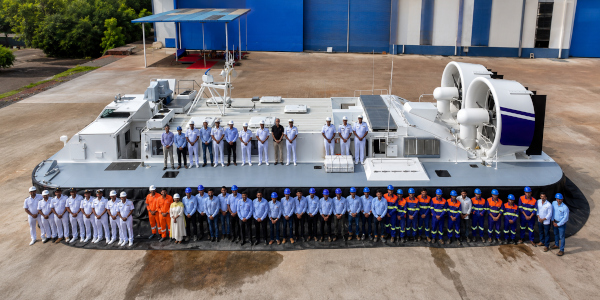
India’s maritime security capabilities received an important push with the induction of the first indigenous Air Cushion Vehicle for the Indian Coast Guard in Goa on 18 June 2026. This is the first of six such vehicles being built by Chowgule & Company Private Limited for the Coast Guard, marking a strong step forward for indigenous shipbuilding and coastal-response capability.
Air Cushion Vehicles, also known as hovercraft, are highly useful platforms for a force like the Indian Coast Guard because they can operate across water, shallow coastal stretches, marshy areas and difficult littoral zones. Their ability to move at speed over mixed terrain gives them a special role in high-speed coastal patrol, reconnaissance, interception, interdiction, search and rescue, and assistance to distressed vessels.
The induction of the first ACV strengthens the Coast Guard’s ability to respond quickly to emerging threats across India’s vast coastline. India’s maritime zones include fishing areas, ports, creeks, estuaries, island territories, shallow waters and busy sea lanes. A hovercraft adds mobility in areas where regular patrol boats face limitations, especially in shallow waters and marshy coastal belts. This makes the platform valuable for surveillance, quick reaction and coastal security operations.
The project also carries strong industrial significance. The Ministry of Defence had signed a contract worth ₹387.44 crore with Chowgule & Company in Goa for six Air Cushion Vehicles for the Indian Coast Guard. The procurement was placed under the Buy (Indian) category, giving the programme a clear Aatmanirbhar Bharat character.
A key feature of the programme is that these ACVs are being manufactured in India for the first time. The project supports India’s maritime industrial base and helps strengthen domestic shipbuilding capability, including the wider ecosystem of ancillary units and MSMEs.
The construction milestone before this induction came in May 2026, when the girder-laying ceremony for the fourth, fifth and sixth ACVs was held at Chowgule Shipyard’s Rassaim Yard in Goa. That update stated that the ACVs were being built with 50 percent indigenous material, showing the gradual deepening of Indian content in the programme.
For the Coast Guard, this induction is part of a broader modernisation drive. The force is responsible for coastal security, maritime law enforcement, search and rescue, anti-smuggling duties, environmental protection, assistance to fishermen and response to distress at sea. Platforms such as ACVs improve the Coast Guard’s ability to respond with speed and flexibility, especially in complex coastal zones where geography itself becomes a tactical challenge.
The strategic value of hovercraft lies in their ability to bridge the gap between sea-based and land-edge operations. In creek areas, river mouths, mangrove stretches and shallow coastal regions, they can provide quick access where larger ships or conventional patrol boats may face operational difficulty. This makes them useful for surveillance, interception and emergency response in India’s sensitive coastal belts.
The induction also highlights Goa’s continuing role in India’s defence shipbuilding map. With Chowgule & Company building these ACVs, the programme adds another private-sector contribution to India’s maritime security ecosystem. It reflects the growing participation of Indian industry in specialised defence platforms that earlier depended heavily on foreign supply chains.
The induction of the first indigenous ACV is therefore more than a platform addition. It is a symbol of India’s growing ability to build specialised maritime systems at home, strengthen the Coast Guard’s operational reach and improve readiness across the country’s dynamic coastal frontier.
Source: PIB
You may also like
-
Astra Microwave Expands Counter-Drone Capabilities with Layered Detection and Neutralisation Systems
-
MDL Begins Development of Indigenous Lithium-Ion Battery System for Project-75(I) Submarines
-
Tarang Shakti Delegates from 28 Countries Visit HAL and BEL to Explore India’s Defence Manufacturing Ecosystem
-
India’s 114 Rafale Fighter Jet Programme Moves Towards Final Decision with Focus on Indigenous Integration
-
Embraer and Mahindra Identify Nagpur as Potential C-390 Millennium Assembly Hub in India
