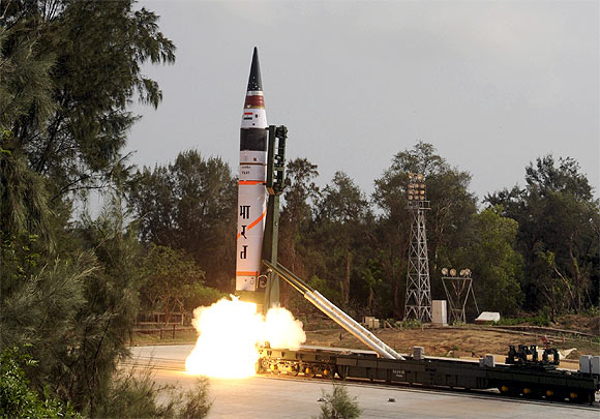
The last launch operations of the Agni-V were carried out and monitored by the Strategic Forces Command (SFC) in the presence of Scientists from Defense Research and Development Organization (DRDO) and other associated officials.
Development of the Agni-V began in 2008. The ICBM features indigenously designed navigation and guidance systems including a ring laser gyroscope based inertial navigation system.
According to Indian military sources, the Agni-V ICBM is a three-stage solid-fueled missile with an approximate range of 5,500-5,800 kilometers. The exact range remains classified, but it is assumed that the missile could have a range from 6,000 to 7,500 kilometers, and can carry a 1,500 kg nuclear warhead. India has reportedly also been working on multiple independently targetable reentry vehicles (MIRV) for the Agni-V in order to ensure a credible second-strike capability.
The Agni-V can be mounted on a launcher vehicle which is known as the Transport-cum-Tilting vehicle-5. It is a 140-ton, 30-metre, 7-axle trailer pulled by a 3-axle Volvo truck according to DRDO, Indian Defence Research and Development Organisation.
Source: AR
Image Courtesy: Money Control
You may also like
-
PRAHAAR: India’s First National Counter-Terrorism Policy and Strategy
-
Takshak Heavyweight Torpedo: How India’s Indigenous Submarine Weapon Compares With the World’s Leading Torpedoes
-
Embraer Builds Dual Aerospace Strategy in India Through C-390 Military and E175 Regional Aircraft Programmes
-
NextLeap Tests Indigenous Jet Engine for Long-Range Stryker Kamikaze UAV
-
Côte d’Ivoire Military Delegation Visits HAL, Shows Interest in India’s Indigenous Aerospace Platforms
