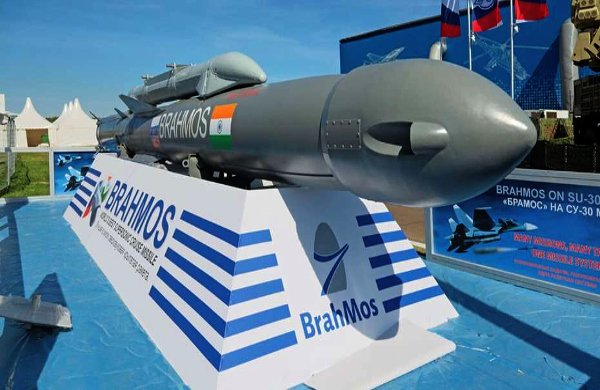
India’s expanding indigenous missile manufacturing ecosystem has generated another significant order for the domestic private sector, with Allen Reinforced Plastics Limited securing a contract worth approximately ₹60.01 crore from BrahMos Aerospace Private Limited for the manufacture of composite components.
The contract was disclosed by Jaykay Enterprises Limited on 25 August 2026. Allen Reinforced Plastics is a step-down subsidiary of Jaykay Enterprises through its defence and aerospace arm. The order is domestic and is valued at approximately ₹60.01 crore including GST. The company has stated that execution will be carried out according to the terms and conditions contained in the order.
Although the financial value itself is significant, the larger importance of the contract lies in the continued expansion of India’s specialised industrial supply chain around the BrahMos supersonic cruise missile programme. Modern missile production depends on far more than propulsion systems, guidance electronics and warheads. It requires a network of specialised manufacturers capable of producing lightweight structures, composite assemblies, precision-machined components and materials engineered to withstand demanding aerodynamic and operational environments.
Allen Reinforced Plastics has been developing precisely this type of manufacturing capability for several decades.
More Than Three Decades in Defence Composites
Allen Reinforced Plastics was incorporated in December 1987 and is engaged in the design, development, manufacture and testing of composite and allied engineering products for defence, aerospace and other engineering applications.
Jaykay Enterprises entered the company in July 2023 through its wholly owned subsidiary JK Defence & Aerospace Limited, initially acquiring a 76.41% stake. A subsequent investment increased JK Defence’s prospective holding to approximately 92.92% following completion of payments associated with additional shares.
Allen therefore represents an established manufacturing operation rather than a recently created defence startup. Company documents state that it has been supplying India’s defence sector for more than three decades and has participated in the indigenous development and production of equipment associated with missiles, rockets, underwater weapons, naval systems, radomes, antennas and aerospace applications.
Among the products publicly identified in company documents are Konkur missile launcher tubes, Pinaka rocket launcher tubes, submarine mine-laying equipment and airframe-related components for BrahMos. Its broader product portfolio covers missile and rocket applications, marine and submarine systems, underwater weapons, radomes, antennas and other specialised structures.
Jaykay Enterprises has separately stated that Allen has supplied critical components associated with programmes including BrahMos, Pinaka and Akash, and has worked with organisations within India’s defence and strategic manufacturing establishment.
That existing history makes the latest ₹60.01-crore order particularly noteworthy because it appears to represent a continuation of an established supplier relationship rather than an initial qualification contract.
Another Major BrahMos Composite Order
The August 2026 contract also follows a considerably larger BrahMos order received by Allen during the previous year.
In September 2025, a BrahMos letter of intent valued at approximately ₹94.45 crore including GST was converted into a definitive order for Allen Reinforced Plastics to manufacture composite parts. The disclosure similarly described it as a domestic contract and did not publicly identify the exact missile components involved.
The new ₹60.01-crore order therefore adds to an already substantial flow of BrahMos-related composite manufacturing work entering the company.
Separately, Jaykay Enterprises itself received another BrahMos Aerospace order in May 2026 worth approximately ₹4.46 crore including GST for the manufacture of PCB Warhead Casing Assemblies. That contract should be distinguished from the latest Allen order, but it demonstrates the wider Jaykay group’s growing engagement with the BrahMos manufacturing ecosystem.
Taken together, these contracts reveal an industrial relationship extending across different manufacturing categories rather than a single isolated procurement.
Why Composites Matter in Missile Manufacturing
Composite materials have become increasingly important in modern aerospace and missile engineering because they can provide combinations of characteristics that are difficult to achieve using conventional metals alone.
Fibre-reinforced polymer structures, for example, can deliver high strength while reducing weight. Composite components can also be engineered for corrosion resistance, dimensional stability and specialised electrical or electromagnetic characteristics. Depending on their formulation and construction, they can be manufactured into complex aerodynamic shapes while reducing the number of individual metallic pieces required in an assembly.
For a high-speed missile, reducing unnecessary structural mass can provide important benefits. Every kilogram saved in the airframe potentially creates greater flexibility for fuel, payload, structural margins or other onboard equipment. At the same time, the structure must tolerate aerodynamic loading, vibration, temperature variations and the stresses generated during storage, transportation and launch.
Different composite systems can consequently find applications in airframes, radomes, launch tubes, fairings, covers, structural housings and other missile or aerospace assemblies.
The latest Jaykay disclosure, however, describes the ₹60.01-crore contract only as being for the “manufacture of composite parts.” It does not identify the exact components, their materials or the BrahMos variant for which they will be produced. Those details should therefore not be inferred from the public announcement.
Manufacturing Capability in Telangana
Allen operates manufacturing facilities at IDA Bollaram and IDA Cherlapally in Telangana. Jaykay Enterprises states that both facilities are certified under the ISO 9001:2015 quality-management framework.
This gives the latest development an additional dimension for India’s emerging defence-manufacturing geography. Hyderabad and the surrounding Telangana industrial belt already host major missile, aerospace and defence-electronics organisations, including Bharat Dynamics, DRDO laboratories and a growing number of specialised private companies.
The development of composite manufacturing capability in the same broader industrial ecosystem creates opportunities for increasingly localised supply chains covering missiles, launchers, propulsion structures, electronics, precision machining and advanced materials.
Jaykay Enterprises itself now describes its manufacturing activities as extending across high-precision manufacturing, CNC machining, additive manufacturing, prototyping and composites, with customers spanning India’s armed forces, ISRO, DRDO, BrahMos Aerospace, HAL, BEL, BHEL and several major private aerospace and defence companies.
BrahMos Is Creating a Wider Industrial Ecosystem
BrahMos represents one of India’s most important examples of a weapon programme generating an increasingly broad domestic manufacturing ecosystem.
While the missile was created through the India-Russia BrahMos Aerospace joint venture, Indian industry today participates across numerous elements of its production chain. Public-sector defence companies, private precision manufacturers, electronics suppliers, materials specialists and smaller component manufacturers have gradually entered different parts of the programme.
This becomes increasingly important as BrahMos production expands to meet requirements of the Indian Army, Indian Navy and Indian Air Force, while export opportunities create an additional production requirement.
The missile family is also evolving. Continued development of different launch configurations and future BrahMos variants will create demand not simply for final missile assembly but for repeatable manufacture of thousands of specialised components meeting aerospace and military quality standards.
Developing several qualified Indian suppliers for these components improves production resilience. It reduces the risk associated with dependence on a limited number of sources and allows manufacturing knowledge to spread through India’s private industrial sector.
For companies such as Allen, repeated orders can also justify investments in tooling, materials processing, quality control and specialised manufacturing equipment that would be difficult to support through one-off development contracts.
From Component Localisation to Production Depth
India’s defence indigenisation programme is increasingly moving into a second phase.
The first phase focused heavily on whether a major platform or weapon could be designed or assembled domestically. The next challenge is deeper: determining how much of the material, component, subsystem, tooling and manufacturing chain supporting that weapon can also be located within India.
A missile may carry an Indian label while still depending on imported bearings, speciality metals, electronic devices, composite materials or precision structures. Genuine industrial depth emerges only when these less-visible layers of the supply chain are progressively localised as well.
Composite manufacturing is particularly important because the technological barrier goes beyond simply producing a moulded component. Reliable aerospace composites require control over fibre orientation, resin systems, curing cycles, dimensional tolerances, bonding techniques, inspection processes and repeatability across large production batches.
A manufacturer that becomes qualified for a demanding missile programme consequently develops expertise that can potentially be applied to UAVs, aircraft, launch vehicles, radomes, naval equipment and other strategic systems.
A ₹60-Crore Order With Wider Significance
Viewed by itself, the ₹60.01-crore BrahMos order is only one contract within India’s much larger defence procurement programme.
Viewed alongside Allen’s earlier ₹94.45-crore BrahMos composite order, its existing experience with missile and rocket structures and the Jaykay group’s separate BrahMos work, however, it points toward something more significant: the emergence of a sustained Indian private-sector manufacturing base around one of the country’s most important missile programmes.
The most important development is therefore not merely that another company has received another defence order. It is that complex missile production is gradually creating a network of Indian companies specialising in niches such as composites, precision structures, electronics, propulsion hardware and warhead-related assemblies.
As BrahMos production expands for domestic requirements and exports, companies occupying these specialised layers of the manufacturing chain could become increasingly important.
Allen Reinforced Plastics’ latest contract provides another indication that India’s defence indigenisation effort is progressing beyond final assembly and toward the deeper industrial capabilities needed to manufacture sophisticated weapon systems repeatedly, reliably and at scale.
You may also like
-
Indian Navy Vice Chief Inspects Japan’s Mogami-Class Stealth Frigate as India-Japan Shipbuilding Cooperation Expands
-
India and Russia Explore Joint Icebreaker Construction as Maritime Industrial Cooperation Expands
-
Philippine Marine Wargames Reportedly Show BrahMos Can Penetrate Chinese Destroyer Air Defences
-
Safran Signs 18 Agreements with Indian Aerospace Suppliers, Expanding Make in India Manufacturing Partnerships
-
Indian Army’s Vajra Corps Certifies First Batch of Drone Operators, Strengthens Battlefield Surveillance
