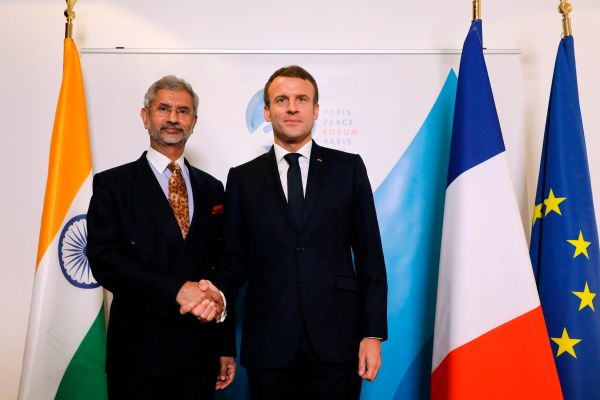
NEW DELHI: India on Tuesday stated that while it is excited about opportunities from cyber space in the backdrop of Digital India program it is concerned about the threats from the cyberspace including from unimpeded growth of terrorism related activities, including extremist propaganda; terror financing; illicit trafficking and radicalization. India suggested a global regulation, so that cyberspace remains open, safe and secure.
“Four years ago, we launched the “Digital India”, the world’s largest, digital technology driven transformation programme. The central notion is that Digital infrastructure should be available as a utility to all citizens…We are excited about the opportunities, but also concerned about the threats from the cyberspace,” Foreign Minister S Jaishankar said in his intervention at Paris Peace Forum on Tuesday.
“There are actors, both state and non state, whose actions present a clear threat to our national, regional and global security. One example is unimpeded growth of terrorism related activities, including extremist propaganda; terror financing; illicit trafficking and radicalization in the cyberspace,” Jaishankar pointed out.
“India’s support to the Christchurch call to eliminate Terrorist and Violent Extremist Content Online manifest our commitment to work with like-minded countries to ensure that the entire digital space serves to advance our societies and economies, without endangering our safety and security. Getting the balance right between the Laissez Faire approach and Authoritarian approach.”
“In our view, the tool kit to advance opportunities and respond to challenges in the cyberspace would need to recognize a clear role of each stakeholder, and would need to include: (i) Flowing from the principle of state sovereignty, a clear role and responsibility for the States/governments to strengthen their respective national cyber security ecosystems; (ii) States must protect the data privacy and ensure data security for its citizens; (iii) Maintaining their openness at the same time; (iv) Coordinated action by nations (bilaterally or multilaterally) to prevent the forces of terrorism and extremism from building presence in the digital domain. For the specific security threats, including cyber attacks on critical infrastructures, countries should consider entering into arrangements for speedy action and mitigation. (v) Give space to varied forms of cultural expressions and multiple societal narratives,” the Foreign Minister suggested.
“In conclusion, we need to arrive at a global understanding if not a global regulation, in order that the cyberspace remains open, safe and secure and for that multilateralism is more essential than ever before.”
Source: ET
Image Courtesy: Daily World
You may also like
-
India, Russia and the Ukraine Conflict: Putin Highlights Modi’s Continued Push for Dialogue and a Negotiated Settlement
-
India and France Discuss Aerospace Manufacturing, UPI Integration and India-EU FTA
-
Côte d’Ivoire Military Delegation Visits HAL, Shows Interest in India’s Indigenous Aerospace Platforms
-
India and Netherlands Move to Deepen Agricultural Cooperation in Seeds, Horticulture and Innovation
-
Tarang Shakti Delegates from 28 Countries Visit HAL and BEL to Explore India’s Defence Manufacturing Ecosystem
