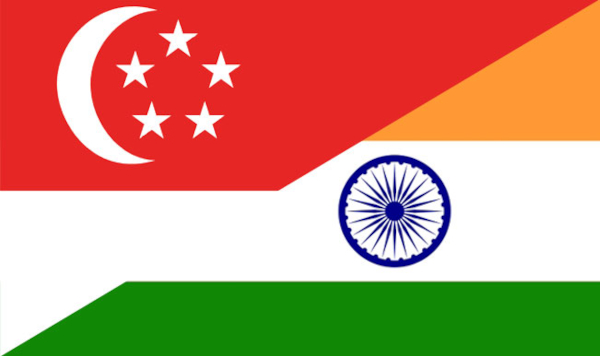
India and Singapore have moved to deepen their Comprehensive Strategic Partnership as senior ministers and business leaders from the two countries gathered in Singapore for the fourth India-Singapore Ministerial Roundtable (ISMR), with technology, manufacturing, investment, connectivity and skills emerging as major areas of cooperation.
The Indian delegation included Finance and Corporate Affairs Minister Nirmala Sitharaman, External Affairs Minister Dr S. Jaishankar, Commerce and Industry Minister Piyush Goyal, and Minister of State for Commerce and Industry and Electronics and Information Technology Jitin Prasada. The fourth ISMR was held in Singapore on August 20, continuing a high-level institutional mechanism established in 2022 to identify new areas of cooperation between the two countries.
The meeting came amid steadily expanding political and economic engagement between India and Singapore. The relationship was elevated to a Comprehensive Strategic Partnership in September 2024, while the two governments subsequently developed a broader roadmap covering economic cooperation, digitalisation, sustainability, connectivity, healthcare, skills, defence and security, and people-to-people exchanges.
Jaishankar-Balakrishnan Meeting Sets Diplomatic Tone
External Affairs Minister S. Jaishankar began his Singapore engagements with a meeting with his counterpart, Foreign Minister Vivian Balakrishnan, on August 19.
The two ministers held detailed discussions on taking the Comprehensive Strategic Partnership forward. Their meeting provided the diplomatic backdrop for the ministerial roundtable and underlined the wider strategic dimension of a relationship that increasingly extends beyond conventional trade ties.
Jaishankar and Balakrishnan also jointly laid the foundation stone for the new Chancery complex of the High Commission of India in Singapore. Jaishankar said the new complex would represent the emerging phase of the bilateral partnership while strengthening services available to the Indian community in Singapore.
Singapore has long occupied an important place in India’s engagement with Southeast Asia. The relationship combines strong commercial links with cooperation in technology, finance, maritime connectivity, defence, education and an extensive people-to-people relationship.
Six Pillars Form the Core of the Partnership
The ISMR has evolved into an important mechanism through which different ministries can pursue interconnected projects rather than dealing with individual sectors separately.
The framework currently centres on six major pillars:
- advanced manufacturing
- connectivity
- digitalisation
- healthcare and medicine
- skills development
- sustainability
The third ISMR, held in New Delhi in August 2025, had already produced discussions on semiconductor and MRO skills, sustainable industrial parks, cross-border data flows, capital markets and infrastructure financing.
The fourth meeting carried this agenda further.
According to News on AIR’s post-meeting report, ministers discussed cooperation in digital technology, Digital Public Infrastructure, semiconductor supply chains, artificial-intelligence governance and cybersecurity. They also examined ways to expand cooperation in advanced manufacturing, fintech, healthcare, sustainability and digital skills.
These areas reflect a noticeable shift in India-Singapore relations towards industries that are likely to shape the next generation of economic growth.
Semiconductors, AI and Digital Infrastructure Move Up the Agenda
Technology has become one of the strongest new components of the partnership.
India is developing a domestic semiconductor ecosystem while Singapore already possesses a significant electronics and semiconductor manufacturing base. Cooperation in semiconductor supply chains, advanced manufacturing and specialised workforce development therefore offers opportunities for both countries.
Digital connectivity is another established area of collaboration. India’s UPI and Singapore’s PayNow have already been linked for cross-border person-to-person payments, demonstrating how financial technology cooperation can translate into practical services. The broader ISMR discussions are now moving into areas including Digital Public Infrastructure, AI and governance of emerging technologies.
Cybersecurity has also entered the ministerial dialogue, reflecting the growing importance of protecting interconnected digital economies.
Piyush Goyal Brings Major Indian Business Delegation
The government-to-government discussions were accompanied by a substantial commercial push.
Commerce and Industry Minister Piyush Goyal travelled to Singapore for a three-day visit from August 19, accompanied by around 70 senior Indian business leaders from diverse sectors. The delegation was intended to strengthen commercial partnerships and connect Indian companies more directly with Singapore’s business, investment and technology ecosystem.
Goyal’s programme included participation in the fourth ISMR as well as the India-Singapore Business Roundtable, which provides private-sector leaders with a channel to contribute ideas to the broader bilateral economic agenda.
His programme also included government-to-business engagements with representatives of organisations including the Global Finance and Technology Network, YPO Global and the Milken Institute, as well as engagement with Singapore’s senior leadership.
The presence of around 70 Indian business leaders gives the latest round of engagement a particularly strong commercial dimension. Instead of restricting the relationship to diplomatic discussions, New Delhi and Singapore are increasingly attempting to connect government policy with investment, technology partnerships and direct business collaboration.
Singapore’s Role in India’s Economic Engagement with ASEAN
Singapore holds an unusual position in India’s external economic strategy. Despite its comparatively small geographic size, it acts as a major financial centre, logistics hub and gateway to Southeast Asian markets.
The ISMR consequently allows India to engage Singapore not merely as a bilateral trading partner, but also as a source of capital, technology, specialised expertise and connections with wider Asian and global markets.
For Singapore, India’s rapidly expanding economy offers opportunities across manufacturing, infrastructure, digital services, healthcare, renewable energy, financial technology and consumer markets.
The complementarities have encouraged both governments to gradually expand their partnership from traditional trade and investment into fields such as semiconductors, green energy, digital payments, artificial intelligence, advanced manufacturing and skills training.
From Strategic Partnership to Implementation
The significance of the fourth ISMR lies partly in the institutional continuity it has created.
The first ISMR was held in New Delhi in September 2022, followed by the second in Singapore in August 2024 and the third in New Delhi in August 2025. The fourth round returned to Singapore in August 2026.
That regular cycle enables ministers to review projects, identify bottlenecks and introduce new areas of cooperation rather than relying solely on occasional bilateral summits.
The latest round also shows how quickly the agenda has expanded. Discussions that initially concentrated heavily on digitalisation, sustainability and skills now encompass AI governance, cybersecurity, semiconductor supply-chain resilience, advanced manufacturing and Digital Public Infrastructure.
For India, the partnership offers access to one of Asia’s leading centres for finance, technology, logistics and investment. For Singapore, India’s expanding industrial and digital economy provides both a large market and a growing base for manufacturing and innovation.
The combination of ministerial engagement, Jaishankar’s diplomatic discussions, Sitharaman’s participation in the institutional dialogue and Goyal’s large accompanying business delegation therefore gives the fourth ISMR a broader significance. It represents an attempt to translate the India-Singapore Comprehensive Strategic Partnership from a diplomatic framework into practical cooperation across investment, technology, manufacturing, finance and human capital.
You may also like
-
ICAR Scientists Develop Indigenous Protective Gloves for Cotton Farmers, Sign Commercial Manufacturing Agreement
-
India and Italy Hold First Maritime Security Dialogue in Rome, Strengthen Strategic Maritime Cooperation
-
BHEL–Coal India Joint Venture Begins Construction of ₹25,016 Crore Indigenous Coal Gasification Project in Odisha
-
India and Azerbaijan Agree to Strengthen Security, Trade, Energy and Economic Cooperation
-
PM Modi to Inaugurate RBI’s Tier IV Data Centre and Cybersecurity Training Institute in Bhubaneswar
