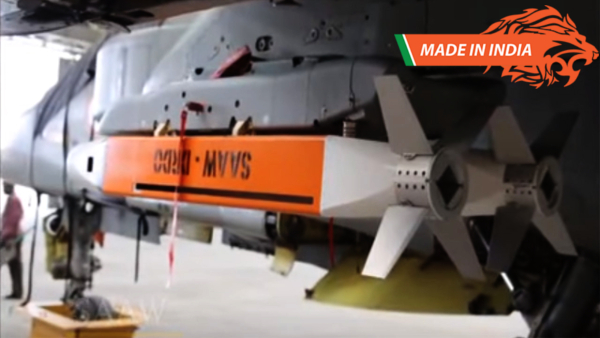
India has placed a major production order for the indigenous Smart Anti Airfield Weapon, strengthening the Indian Air Force’s ability to strike hostile airfield infrastructure from stand-off ranges without requiring the launch aircraft to approach the immediate target area.
The Ministry of Defence signed a ₹810.79-crore contract with Bharat Dynamics Limited on September 23, 2026, for the procurement of 160 Satellite Smart Anti Airfield Weapons, or SAT-SAAW, together with associated equipment. The contract was signed in New Delhi in the presence of Defence Secretary Rajesh Kumar Singh.
The procurement has been placed under the Buy (Indian – Indigenously Designed, Developed and Manufactured) category, making the programme another significant transition of a DRDO-developed weapon from development into series acquisition for the armed forces.
A Precision Weapon Designed to Attack Airfields
SAT-SAAW is an air-to-ground precision-guided glide weapon developed specifically for attacking critical infrastructure associated with enemy airfields. Unlike a conventional free-fall bomb, the weapon can be released at considerable distance from its target and glide towards the designated impact point using its guidance system.
Its stand-off capability allows the launching aircraft to release the weapon without having to fly directly over a heavily defended airfield. This is particularly important because operational airbases are normally protected by layered surface-to-air missile systems, anti-aircraft weapons, electronic warfare systems and combat air patrols.
The principal purpose of the weapon is to disable infrastructure required for sustained air operations. Depending upon mission planning and the selected aim point, anti-airfield weapons can be employed against runways, taxiways, hardened installations and other critical facilities whose loss can restrict an adversary’s ability to generate combat sorties.
Jaguar, Su-30MKI and Hawk Can Carry the Weapon
According to the Ministry of Defence, SAT-SAAW can be launched from aircraft including the Jaguar, Su-30MKI and Hawk.
This gives the weapon considerable flexibility within the IAF inventory. The Jaguar remains an important deep-strike aircraft, while the Su-30MKI provides the combination of range, payload and multirole capability required for long-distance precision-strike missions. Integration with the Hawk further demonstrates the adaptability of the weapon across different aircraft types.
A glide weapon also differs fundamentally from a powered air-to-surface missile. Instead of relying on a rocket or jet propulsion system throughout its flight, it converts the altitude and velocity provided by the launching aircraft into forward glide range. This can reduce complexity and cost while still providing substantial stand-off capability.
Satellite Guidance Marks an Important Evolution
The designation SAT-SAAW reflects the satellite-guided configuration of the Smart Anti Airfield Weapon.
Satellite-assisted navigation provides the weapon with the ability to attack predetermined coordinates with precision. For fixed targets such as airfield infrastructure, accurate coordinate-based guidance is particularly valuable because the target’s location can be established during mission planning before the aircraft enters the operational area.
The weapon therefore gives strike aircraft the ability to release precision ordnance from a safer distance and subsequently manoeuvre away rather than continuing towards the target for a conventional bombing pass.
60 Per Cent Indigenous Content
The Ministry of Defence has stated that the SAT-SAAW being procured will have an indigenous content of 60 per cent.
The programme also includes further indigenisation of important subsystems, including the Initial Measurement Unit, Long Impact Delay Fuse and Twin Store Carrier. Developing these components domestically is important because a weapon’s strategic independence depends not merely on assembling the final system in India but also on establishing domestic control over its guidance, fuzing, carriage and other critical technologies.
Bharat Dynamics Limited will serve as the production agency for the weapons ordered by the IAF, bringing another indigenous precision-strike system into India’s defence manufacturing pipeline.
Twin Store Carrier Expands Aircraft Load Options
The inclusion of a Twin Store Carrier among the systems being indigenised is also operationally significant.
A twin-store arrangement allows two compatible weapons to be carried using a common carriage configuration, potentially increasing the number of precision weapons an aircraft can take on a strike mission while making more efficient use of available weapon stations.
For an anti-airfield mission, the ability to release several precision weapons against separate aim points can be particularly valuable. Airfields are distributed targets consisting of multiple runways, taxiways, shelters and support facilities rather than a single structure.
Long Impact Delay Fuse for Hardened Targets
The Long Impact Delay Fuse being indigenised provides another indication of the weapon’s intended role.
An impact-delay fuze allows a weapon to penetrate a target surface or structure before detonation rather than exploding immediately upon contact. Such fuzing can increase effectiveness against reinforced surfaces and hardened infrastructure.
For anti-airfield operations, this capability can be useful against targets where simply detonating a warhead above the surface may not produce the required level of structural damage.
Deliveries Scheduled Across 2027-29
The 160 weapons and their associated equipment are scheduled for delivery across 2027-28 and 2028-29.
The production contract therefore establishes a defined pathway for the weapon to enter the IAF’s operational inventory in significant numbers.
Once inducted, SAT-SAAW will add another indigenous precision-strike option to the IAF’s expanding stand-off weapons inventory. Its combination of precision guidance, glide range and specialised anti-airfield role is intended to allow Indian aircraft to attack critical fixed infrastructure while reducing their exposure to enemy air defences.
From DRDO Development to Series Procurement
The ₹810.79-crore contract is significant not simply because of the number of weapons ordered, but because it represents the progression of an indigenous precision weapon from DRDO development into production and operational deployment.
India’s defence-industrial strategy increasingly depends on completing this transition successfully. Indigenous weapons acquire their real military and industrial value when technologies developed by research laboratories move into sustained manufacturing, enter service in meaningful quantities and generate production expertise across domestic suppliers.
With 160 SAT-SAAWs now contracted for the Indian Air Force and further indigenisation planned for important subsystems, the programme represents another step towards establishing a broader domestic ecosystem for precision-guided air-launched weapons.
References
Press Information Bureau, Ministry of Defence — “Major boost to ‘Aatmanirbhar Bharat’: MoD signs Rs 811 crore contract with BDL for 160 Satellite Smart Anti Airfield Weapons for IAF,” 23 September 2026.
Ministry of Defence, Government of India — Smart Anti Airfield Weapon procurement and contract announcement.
Defence Research and Development Organisation — Smart Anti Airfield Weapon development programme.
Bharat Dynamics Limited — Indigenous guided weapons and production programmes.
You may also like
-
PTC Industries Secures Safran Order to Manufacture Titanium Components for LEAP Aircraft Engines
-
India and ASEAN Strengthen Defence Cooperation for a Secure and Stable Indo-Pacific
-
Indian Navy Completes Historic First Command of Combined Task Force 154, Training Personnel from 39 Nations
-
ideaForge Secures ₹151 Crore Government Support to Develop YETI Heavy-Lift Autonomous Logistics Drone
-
JSR Dynamics Advances Indigenous Jet-Powered Weapons and Guided Rockets
