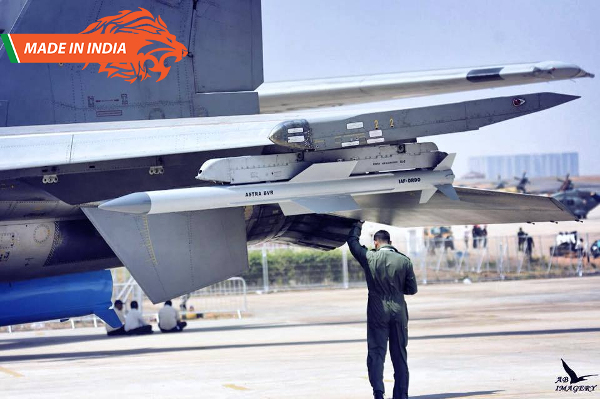
India is preparing for a major expansion of indigenous air-to-air missile manufacturing as the government opens DRDO-developed conventional missile technologies to qualified Indian defence companies. The move creates a pathway for private industry to participate much more deeply in the production of the Astra family of beyond-visual-range air-to-air missiles, including the operational Astra Mk1 and the longer-range Astra Mk2 now moving towards large-scale induction.
The policy shift was approved by Defence Minister Rajnath Singh on August 25, 2026. Under the new framework, technologies associated with conventional missile systems developed by the Defence Research and Development Organisation can be transferred to qualified Indian defence manufacturers for production, subject to the applicable certification, qualification and regulatory requirements. The broader objective is to expand India’s missile-manufacturing capacity, reduce dependence on a limited number of production agencies and build an industrial base capable of meeting increasingly large domestic and export requirements.
For the Astra programme, the timing is particularly significant. Astra Mk1 is already in series production and operationally relevant to the Indian Air Force, while Astra Mk2 is intended to provide a substantially greater engagement range. At the same time, India’s requirement for indigenous beyond-visual-range air-to-air missiles is expanding as more fighter aircraft are expected to be equipped with domestically developed weapons.
Government Opens DRDO Missile Production to Wider Industry
The Ministry of Defence described the August 25 decision as an important step towards greater self-reliance in defence manufacturing. Instead of relying primarily on a small number of traditional production agencies, DRDO-developed conventional missile technologies can now be transferred to a wider pool of capable Indian manufacturers.
The change is intended to allow DRDO to concentrate increasingly on research, development and next-generation systems while industrial partners assume a larger role in series manufacture. Such an approach can help reduce production bottlenecks and create additional manufacturing capacity at a time when India’s armed forces are seeking larger inventories of precision-guided weapons.
The policy is also expected to provide opportunities to established private defence companies, smaller specialised suppliers and MSMEs that already manufacture missile components, propulsion systems, electronics, structures, seekers and other sub-systems.
Astra Mk2 Could Become One of the First Major Programmes
Even before the wider policy was formally approved, Indian defence reporting had indicated that Astra Mk2 was likely to become one of the first major missile programmes opened to wider private-sector production.
Reports in July 2026 said the government was preparing to invite Indian companies to participate in Astra Mk2 manufacturing as part of a larger effort to increase national missile-production capacity. Companies including Tata Group, Bharat Forge, Adani Defence, ICOMM and Mahindra have been mentioned in reporting as possible contenders, although the final manufacturers will depend on qualification, competitive procurement and government selection.
The importance of the move lies in the extent of industrial responsibility involved. Private Indian companies have long supplied components and sub-systems to DRDO missile programmes. The new policy creates a pathway for qualified companies to assume responsibility for complete missile manufacture under formal Transfer of Technology arrangements.
Astra Mk1 Established India’s Indigenous BVR Capability
The Astra programme was developed to reduce India’s dependence on imported beyond-visual-range air-to-air missiles. Astra Mk1 became the first major indigenous Indian missile in this category and was developed jointly by DRDO and the Indian Air Force.
The Ministry of Defence has officially described Astra Mk1 as a beyond-visual-range air-to-air missile with a range of more than 100 kilometres. It incorporates modern navigation and guidance systems and uses an active radio-frequency seeker during the terminal phase to detect and engage its target.
The missile has been integrated with the Su-30MKI, while integration with other Indian combat aircraft has been pursued progressively. The Indian Navy has also planned Astra integration with the MiG-29K carrier-borne fighter.
The programme is already supported by a broad domestic industrial ecosystem. More than 50 public and private-sector companies contributed to different aspects of Astra development and production, demonstrating that the missile has long relied on a distributed Indian supply chain even before the latest decision to widen complete-system manufacturing.
Bharat Dynamics Established the Initial Astra Production Base
Large-scale production of Astra Mk1 began through state-owned Bharat Dynamics Limited. In May 2022, the Ministry of Defence signed a contract worth approximately ₹2,971 crore with BDL for Astra Mk1 missiles and associated equipment for the Indian Air Force and Indian Navy.
DRDO transferred the relevant production technology to Bharat Dynamics, allowing the missile to enter series manufacture. That arrangement established the first major industrial production line for India’s indigenous BVR air-to-air missile.
Opening Astra production to additional companies therefore does not represent the beginning of manufacturing from scratch. Instead, it represents the next phase of the programme, in which India seeks to expand beyond a production architecture dominated by one major manufacturer and build a broader national missile-manufacturing network.
Indigenous RF Seeker Strengthens Astra’s Technology Base
Another important milestone came in July 2025 when DRDO and the Indian Air Force successfully tested Astra equipped with an indigenously developed radio-frequency seeker.
Two missiles were launched from a Su-30MKI against high-speed unmanned aerial targets under different engagement conditions. According to the Ministry of Defence, both targets were destroyed with high accuracy.
The indigenous seeker is one of the most important technological achievements within the Astra programme because the terminal seeker is among the most sophisticated components of a modern active-radar-guided air-to-air missile.
Greater domestic control over the seeker, navigation system, guidance architecture, propulsion and missile structure reduces dependence on foreign suppliers and makes it easier to scale production, improve the weapon over time and potentially support exports.
Astra Mk2 Extends the Engagement Envelope
Astra Mk2 represents the next major stage in India’s air-to-air missile programme. The system is intended to allow Indian fighters to engage hostile aircraft from significantly greater stand-off distances than Astra Mk1.
On December 29, 2025, the Defence Acquisition Council granted Acceptance of Necessity for Astra Mk2 as part of a wider package of military acquisitions. The Ministry of Defence stated that the missile’s enhanced range would allow Indian fighters to neutralise enemy aircraft from greater stand-off distances.
The government has not publicly released a definitive maximum operational range for Astra Mk2. Defence reporting has generally placed the weapon in approximately the 180 to 200 kilometre class or beyond, but such figures remain reported estimates rather than officially declared specifications.
What is clear is that Astra Mk2 is intended to provide a substantially larger engagement envelope than Mk1 and will therefore become an important component of India’s future air-combat capability.
India’s Requirement Could Run Into Hundreds of Missiles
The decision to expand manufacturing capacity is closely linked to the scale of India’s future requirement.
Astra is not intended to remain limited to a small number of Su-30MKI squadrons. The objective is to create an indigenous BVR missile family capable of equipping a much larger section of India’s combat-aircraft fleet.
As integration expands across additional fighters, the number of missiles required for operational squadrons, training, war reserves, replacement stocks and sustained combat operations will increase significantly.
A combat aircraft fleet requires far more missiles than the number carried during a single sortie. Adequate inventories must account for squadron reserves, repeated wartime missions, training firings, maintenance cycles and replenishment after expenditure.
The resulting demand could therefore extend into many hundreds of missiles over successive procurement cycles.
Reports of 500-Plus Missile Production Opportunities
A defence report published on August 28, 2026 added another dimension to the industrial story. IDRW, citing unnamed industry sources, reported that companies taking up Astra Mk1 and Mk2 technology transfer could receive production opportunities involving more than 500 missiles, along with prospects for repeat orders and participation in export programmes.
The figure has not, however, been officially confirmed by the Ministry of Defence or DRDO. It should therefore be treated as source-based industry reporting rather than a formally announced government procurement commitment.
Even so, the suggestion of production volumes in the hundreds is consistent with the broader direction of the Astra programme. India’s fighter fleet, future integration plans and the need for war reserves all point towards requirements far beyond the initial batches ordered during the early stages of Astra induction.
Missile Production Requires Significant Industrial Investment
Manufacturing a sophisticated air-to-air missile requires considerably more than a conventional assembly line. Companies must establish specialised facilities for propulsion systems, precision structures, guidance electronics, seekers, energetic materials, environmental testing and quality assurance.
Missiles must remain reliable after long periods in storage and then function under extreme acceleration, vibration, temperature and aerodynamic stress. Each production batch therefore requires strict component traceability, inspection and testing.
For private manufacturers, entering such a sector can require substantial upfront investment before the first production order is completed. This is why visibility over long-term procurement volumes is particularly important.
A company is far more likely to build dedicated missile-manufacturing infrastructure if it expects sustained orders rather than a small one-time production batch.
Multiple Manufacturers Could Improve Production Resilience
Opening Astra production to additional companies could eventually create more than one manufacturing source for the missile family.
This would allow India to increase annual production rates, reduce delivery timelines and distribute production risk across several facilities. If one production line were disrupted by supply-chain problems or technical issues, another could continue manufacturing.
Multiple qualified producers could also introduce greater competition and encourage investment in modern manufacturing processes.
Most importantly, greater industrial depth would improve India’s ability to replenish missile inventories rapidly during or after a high-intensity conflict.
Recent wars have demonstrated that sophisticated precision-guided weapons can be consumed at rates far higher than peacetime assumptions. The ability to manufacture large numbers of missiles quickly is therefore becoming an increasingly important element of national military readiness.
Operation Sindoor Reinforced the Value of BVR Weapons
Recent operational experience has further strengthened the importance of modern air-to-air missiles.
Operation Sindoor in May 2025 highlighted the role of long-range sensors, airborne warning aircraft, electronic warfare systems, integrated air defence and beyond-visual-range weapons in contemporary air combat.
Modern fighter engagements can begin well before opposing aircraft become visible to one another. The side with the stronger combination of radar, networking, electronic warfare and long-range missiles can potentially engage from greater distance while keeping its aircraft outside the adversary’s preferred firing envelope.
Astra Mk2 is intended to strengthen this component of India’s air-combat architecture by providing a domestically controlled long-range BVR weapon that can be upgraded over time without complete dependence on foreign suppliers.
Astra’s Export Potential Is Increasing
The export dimension is becoming increasingly important as India’s indigenous missile industry matures.
Astra is no longer being viewed solely as a domestic air-to-air weapon. India has actively promoted indigenous missile systems abroad as part of a wider expansion in defence exports.
Indonesia has emerged as one of the most important prospective markets for Indian missile systems, with Astra featuring in bilateral defence discussions alongside BrahMos.
Indonesia operates Russian-origin Su-27 and Su-30 fighters, making Astra potentially relevant because the missile was originally developed around integration with India’s Su-30MKI fleet.
Any successful export would represent a major milestone for India’s defence industry because it would take an indigenous air-to-air missile into a foreign combat-aircraft ecosystem.
Export Access Would Still Require Government Approval
The opening of Astra technology to Indian private manufacturers does not mean that companies receiving the technology would be free to sell the missile independently to overseas customers.
DRDO technologies remain subject to licensing conditions, and defence exports continue to require approvals under India’s export-control framework.
Private manufacturers could nevertheless participate in authorised export programmes if selected as production partners.
This means export access could still become commercially significant for Indian industry, even though overseas sales would remain subject to sovereign approval by the Government of India.
Astra Could Follow the Path Created by BrahMos and Pinaka
India’s missile-export ecosystem has already begun expanding through programmes such as BrahMos and Pinaka.
BrahMos has established India as an exporter of advanced supersonic cruise missiles, while Pinaka has demonstrated that Indian rocket artillery can also secure overseas customers.
Astra opens another category altogether. A successful air-to-air missile export would integrate an Indian weapon directly into a foreign combat-aircraft fleet.
Such programmes can create long-term relationships involving missile replenishment, integration support, training, maintenance, upgrades and additional batches.
If Astra secures sustained overseas demand, the result could be a much larger and more stable production base than would be possible through domestic orders alone.
DRDO Is Moving Towards Industry-Led Series Production
The Astra development reflects a broader transformation in DRDO’s relationship with Indian industry.
Under its Development-cum-Production Partner model, DRDO increasingly brings private and public companies into projects before large-scale production begins.
This allows industry to acquire manufacturing knowledge earlier and transition more quickly from development to series production once a weapon is cleared.
The August 2026 policy extends this philosophy across the conventional missile sector.
DRDO can focus increasingly on new technologies and future missile generations while qualified companies expand responsibility for serial manufacture.
This separation between development and production is similar to the model followed in several mature defence-industrial economies.
India Is Building Production Depth, Not Merely Indigenous Designs
The strategic importance of the new policy lies in the difference between owning a missile design and possessing the capacity to manufacture large numbers of missiles.
India already has an increasingly broad range of indigenous missile systems. The next challenge is producing them at the scale required by modern warfare.
A programme dependent on only one or two specialised production facilities can face severe bottlenecks when domestic requirements expand or when export orders arrive simultaneously.
By spreading missile-manufacturing knowledge, testing infrastructure and skilled personnel across a wider industrial ecosystem, India can create production depth rather than simply additional nominal capacity.
This becomes especially important during wartime, when missiles can be consumed far more rapidly than they can be replaced through conventional peacetime procurement cycles.
Astra Mk1 and Mk2 Could Become the Model for the New System
The Astra family is particularly well suited to becoming an early example of this wider industry-led production model.
Astra Mk1 is already mature, operationally relevant and in series manufacture. Its technology has undergone extensive testing, and its supply chain is relatively well established.
Astra Mk2 represents the next generation of the same capability and is moving towards major procurement.
Opening both versions to wider industrial participation would allow Indian companies to enter missile production through an established weapon while simultaneously building expertise applicable to more advanced systems.
The knowledge gained in propulsion, guidance, seekers, precision manufacturing and quality control can later support production of other DRDO-developed missile systems.
Bharat Dynamics Will Continue to Play an Important Role
The decision to involve private industry should not be interpreted as a move away from India’s defence public-sector manufacturers.
Bharat Dynamics remains one of the country’s most experienced guided-weapon producers and has accumulated decades of expertise in missile assembly, integration and testing.
The emerging model is more likely to involve public and private manufacturers operating simultaneously, with contracts awarded according to capability, qualification, production capacity and competitive procurement.
Such an arrangement can preserve the expertise already available within established public-sector manufacturers while significantly expanding India’s total national production capacity.
Astra Is Part of a Much Larger Missile-Industrial Opening
The August 2026 decision extends beyond Astra.
The government has opened the broader portfolio of DRDO-developed conventional missile technologies to qualified Indian industry.
This creates a pathway for greater private-sector involvement across air-defence missiles, anti-armour weapons, anti-radiation missiles, tactical strike systems and other guided weapons.
Astra is therefore significant not only because of its own operational importance, but because it could become one of the first major examples of how India’s future missile-production ecosystem will function.
From Import Substitution to Large-Scale Indigenous Production
The Astra programme illustrates how India’s defence-industrial ambitions have evolved.
The first objective was to reduce dependence on imported BVR air-to-air missiles.
The second was to establish a fully indigenous missile and domestic production line.
India is now entering a third stage in which the emphasis is shifting towards large-scale manufacture through multiple industrial partners and the creation of sufficient capacity to support both domestic and overseas demand.
This change could improve production economics, sustain manufacturing lines for longer periods and give private companies stronger incentives to invest in advanced missile-production infrastructure.
The 500-Plus Missile Figure Remains Unconfirmed, but Demand Is Clearly Rising
The reported possibility of production opportunities exceeding 500 missiles has attracted considerable attention because it would make Astra one of India’s largest guided-weapon manufacturing programmes.
For now, however, no official government announcement confirms such a specific guaranteed quantity for private manufacturers.
The wider picture is nevertheless clear.
Astra Mk1 is already in production. Astra Mk2 has received procurement approval. DRDO’s conventional missile technologies have been opened to qualified Indian industry. Private manufacturers are expected to compete for production opportunities, and India is simultaneously seeking overseas markets for its indigenous missile systems.
Together, these developments point towards production volumes significantly larger than those associated with the initial phase of Astra induction.
A New Phase for India’s Indigenous Air-to-Air Missile Programme
India’s decision to widen Astra production represents much more than another defence procurement reform.
It signals that the indigenous air-to-air missile programme has matured to the point where the central challenge is no longer simply developing the weapon, but manufacturing it at scale.
Astra Mk1 established India’s indigenous modern BVR capability. Astra Mk2 is intended to extend that capability to considerably greater engagement ranges.
The next requirement is to ensure that India’s fighter squadrons have enough missiles to sustain high-intensity operations while maintaining adequate training stocks, operational reserves and future replenishment capacity.
Exports could increase that requirement further.
By allowing qualified private companies to manufacture DRDO-developed missiles, India is attempting to create the industrial depth needed to support both domestic and international demand.
For Indian defence manufacturers, Astra could therefore become one of the most important opportunities created by the new missile Transfer of Technology policy.
For the armed forces, the larger significance lies in the creation of a national production ecosystem capable of manufacturing sophisticated indigenous air-to-air missiles in substantial numbers and sustaining that capability over the long term.
References
Press Information Bureau, Ministry of Defence. “Raksha Mantri approves Transfer of Technology of DRDO-developed missile systems to Indian defence industry to bolster indigenous manufacturing.” August 25, 2026.
https://www.pib.gov.in/PressReleasePage.aspx?PRID=2303014
Press Information Bureau, Ministry of Defence. Astra Mk1 production contract and Transfer of Technology to Bharat Dynamics Limited. May 31, 2022.
https://www.pib.gov.in/PressReleasePage.aspx?PRID=1829750
Press Information Bureau, Ministry of Defence. “DRDO & IAF conduct successful flight-test of Astra Beyond Visual Range Air-to-Air missile with indigenous Radio Frequency Seeker from Su-30 Mk-I.” July 11, 2025.
https://www.pib.gov.in/PressReleasePage.aspx?PRID=2144118
Press Information Bureau, Ministry of Defence. “DAC clears proposals worth Rs 79,000 crore to enhance the capabilities of the Armed Forces,” including Acceptance of Necessity for Astra Mk-II. December 29, 2025.
https://www.pib.gov.in/PressReleasePage.aspx?PRID=2209422
The Indian Express. “India approves transfer of missile technology to defence industry.” August 25, 2026.
https://indianexpress.com/article/india/rajnath-singh-approves-drdo-brahmos-conventional-missile-technology-transfer-private-industry-10849237/
Hindustan Times. “Centre set to open missile sector to private Indian firms.” July 2026.
https://www.hindustantimes.com/india-news/centre-set-to-open-missile-sector-to-pvt-indian-firms-drdo-pralay-missile-astra-mark-2-rafale-101783816207283.html
You may also like
-
Project Seabird Expands at Karwar as Indian Navy Inaugurates New Infrastructure with Over 90% Indigenous Content
-
DRDO Seeks Semi-Autonomous Guided Installation Vehicle and Specialised Pod Storage System
-
JISA Softech Unveils Indigenous QuLens-CryptoBind Quantum-Safe Cybersecurity Platform at Pragati Q-Foundry 2026
-
Sensorise Launches Made-in-India Wega M1 4G Module for EVs, Smart Meters and Industrial IoT
-
Nayan Technologies Selected by JSW MG Motor to Advance AI-Based Road Monitoring and Smart Mobility
