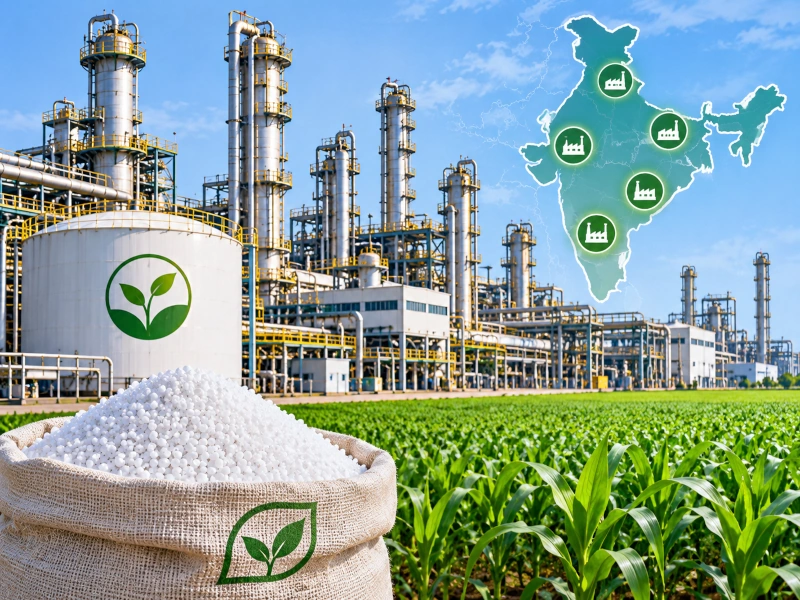
The Government of India on 25 November 2026 approved six brownfield gas-based urea projects involving an estimated investment of ₹54,000 crore. The projects, approved under the New Investment Policy framework, are intended to expand domestic fertiliser manufacturing capacity and reduce India’s dependence on imported urea. The initiative represents an important step towards strengthening agricultural input security and achieving greater self-reliance in fertiliser production.
Expanding Domestic Urea Manufacturing Capacity
The approved projects focus on brownfield development, involving the expansion of manufacturing capabilities at existing industrial locations. This approach enables fertiliser manufacturers to utilise established infrastructure, utilities, technical expertise and industrial supply networks. The proposed investments are expected to strengthen domestic production capacity while supporting the modernisation of India’s fertiliser manufacturing ecosystem.
Natural gas serves as a principal feedstock in conventional urea manufacturing, providing the hydrogen required for ammonia production. The development of gas-based manufacturing facilities will require reliable feedstock arrangements, advanced process technologies and efficient industrial infrastructure. These requirements create opportunities for associated engineering, natural gas distribution and industrial equipment manufacturing enterprises.
Reducing Dependence on Fertiliser Imports
Urea remains one of the most important nitrogenous fertilisers used in Indian agriculture, supporting the cultivation of rice, wheat, maize and numerous other crops. Although India possesses substantial domestic manufacturing capacity, imports continue to supplement production in meeting agricultural demand. Expanding indigenous manufacturing capabilities is therefore important for reducing exposure to international supply disruptions and fluctuations in global fertiliser prices.
The proposed investments could strengthen India’s ability to meet a greater proportion of its agricultural requirements through domestic production. A more resilient manufacturing ecosystem would also support long-term fertiliser availability, particularly during major agricultural seasons when demand increases significantly.
Strengthening India’s Fertiliser Manufacturing Ecosystem
The proposed ₹54,000 crore investment has implications extending beyond fertiliser production. Large-scale industrial expansion can generate demand for engineering services, process equipment, industrial automation, specialised machinery and infrastructure development. The projects could also create employment opportunities during construction, commissioning and subsequent plant operations.
India’s fertiliser industry encompasses public sector enterprises, cooperative organisations and private manufacturers, supported by an extensive network of agricultural distribution facilities. Expanding production capacity through brownfield investments could strengthen this interconnected industrial ecosystem while encouraging greater domestic value addition. The scale of the proposed investment also highlights the importance of fertiliser manufacturing within India’s broader industrial development strategy.
Supporting Agricultural Productivity and Food Security
Reliable access to fertilisers is an important component of agricultural productivity and national food security. Domestic production capacity helps strengthen supply resilience while supporting the distribution of agricultural inputs across different regions and cropping seasons. The proposed projects are therefore relevant not only to industrial manufacturing but also to the long-term requirements of India’s farming community.
However, increased fertiliser availability must be complemented by balanced nutrient management, soil testing and efficient application practices. Combining domestic manufacturing expansion with responsible fertiliser utilisation can help improve agricultural productivity while protecting long-term soil health and environmental sustainability.
Advancing Self-Reliance in Fertiliser Production
The approval of six gas-based urea projects represents another step towards strengthening India’s domestic capabilities in a strategically important agricultural input sector. The actual benefits will materialise progressively as the approved projects advance through development, construction, commissioning and commercial production. Their successful implementation could contribute to reducing import dependence, strengthening agricultural supply chains and expanding domestic industrial capabilities.
By integrating fertiliser manufacturing expansion with agricultural security and industrial development, India can build a more resilient foundation for its farming economy. The proposed ₹54,000 crore investment reflects the importance of domestic manufacturing in supporting long-term agricultural requirements and advancing the objectives of Atmanirbhar Bharat.
Reference
Press Information Bureau (PIB), Government of India — Government approval of six brownfield gas-based urea projects under the New Investment Policy, 25 November 2026, Release ID: 2341442.
You may also like
-
India Tracks ₹38.11 Lakh Crore Infrastructure Investment Pipeline
-
Suzlon Energy Lays Foundation Stone for 1 GW AI-Enabled Wind Turbine Blade Factory in Tamil Nadu
-
Avore Electric Reports 90 Per Cent Domestic Component Sourcing for Electric Motorcycles
-
Indian Nuclear Startup SUK-M Secures Funding to Develop Indigenous Thorium Microreactor
-
Jupiter Wagons Partners South Korea’s Woojin to Manufacture Metro Trains and Propulsion Systems in India
