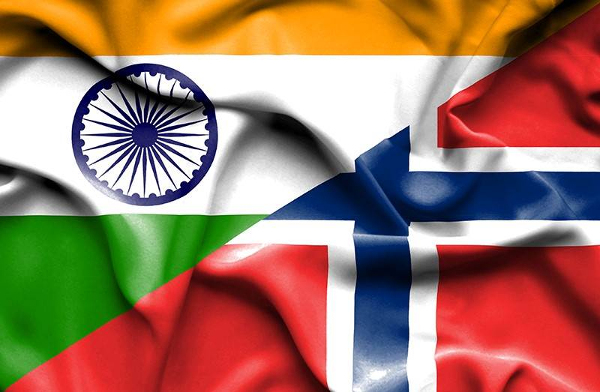
India and Norway have decided to give their bilateral relationship a stronger strategic and sustainability-focused direction, with Prime Minister Narendra Modi and Norwegian Prime Minister Jonas Gahr Støre agreeing in Oslo to elevate the partnership to a Green Strategic Partnership. The decision came during bilateral talks held on May 18, 2026, as part of Prime Minister Modi’s official visit to Norway, which also forms part of his wider Europe outreach.
Prime Minister Modi was received at Oslo Airport by Prime Minister Støre, a gesture described by the Indian side as symbolic of the warmth in India-Norway ties. The visit is significant because it marks Prime Minister Modi’s first visit to Norway and the first prime ministerial visit from India to the country in 43 years.
The talks covered a wide range of issues, including trade, investment, climate action, energy transition, blue economy, ocean governance, research, higher education, Arctic and polar cooperation, space, and talent mobility. The Green Strategic Partnership gives a formal direction to the growing convergence between India’s development priorities and Norway’s strengths in clean technology, maritime systems, offshore energy, sustainability and innovation.
A major focus of the meeting was economic cooperation under the India-EFTA Trade and Economic Partnership Agreement. Both leaders underlined the aim of doubling the value of current India-Norway trade by 2030 and encouraged businesses to build sectoral partnerships that support the TEPA-linked target of USD 100 billion in investments and the creation of one million jobs in India. Prime Minister Modi also welcomed greater participation by Norwegian enterprises in India’s growth story.
The blue economy emerged as one of the most important pillars of the discussion. India and Norway agreed to deepen cooperation in areas such as marine ecosystem protection, shipbuilding, green shipping, tunnelling and infrastructure, fisheries, aquaculture, seafarer training and ocean governance. The two sides also reaffirmed the principles of the United Nations Convention on the Law of the Sea and welcomed Norway joining the Indo-Pacific Oceans Initiative.
Technology and innovation formed another strong component of the dialogue. The leaders identified opportunities in space, artificial intelligence, robotics, cyber security and digital public goods. They also agreed to establish a Joint Working Group on Digitalization to drive cooperation in digital transition. Prime Minister Modi suggested the creation of a Start-up Innovation Hub and a Green Innovation Hackathon between the two countries, while also inviting Norway to participate in Bharat Innovates 2026, to be held in France in June 2026.
On climate and clean energy, the two countries agreed to strengthen collaboration in niche technologies such as carbon capture, utilisation and storage, offshore wind and clean energy investment in India. This fits naturally with Norway’s experience in offshore energy and India’s push for large-scale renewable energy, green industrialisation and sustainable growth.
The leaders also discussed expanding cooperation in Arctic and polar research, with both sides agreeing to work on responsible practices, polar logistics and scientific collaboration. Higher education was another important area, with India and Norway agreeing to explore joint degree programmes, mutual recognition of qualifications, and greater mobility for students and faculty.
Strategic and security issues also featured in the talks. Both leaders condemned terrorism, including cross-border terrorism, and called for coordinated global action against the threat. Norway reiterated its support for India’s permanent membership in a reformed United Nations Security Council, while both sides also noted the potential for defence cooperation and defence industrial collaboration.
The Oslo meeting shows that India-Norway relations are moving beyond a narrow bilateral framework into a wider partnership built around green growth, maritime cooperation, digital transition, research, polar science and strategic convergence. With TEPA creating a stronger economic foundation and both countries seeking sustainable industrial growth, the new Green Strategic Partnership could become one of India’s most important clean-technology bridges with Northern Europe.
You may also like
-
ASEAN Diplomats Visit BrahMos Facility as India Showcases Defence Engineering Capabilities
-
India and UAE Agree to Expand Army Cooperation and Desert Cyclone Participation
-
India and Myanmar Prepare for Third Annual Defence Dialogue in Guwahati
-
India and South Korea Deepen Defence Industry and Logistics Cooperation at 10th Joint Committee Meeting
-
India and US Review Defence, Energy and Critical Technology Cooperation
