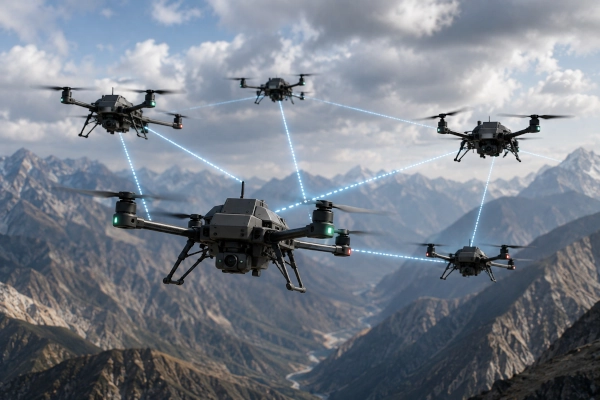
Andhra Pradesh’s ambition to build one of India’s most comprehensive drone-technology clusters has gained a major research partner, with IIT Hyderabad’s Technology Innovation Hub on Autonomous Navigation, or TiHAN, joining hands with the Andhra Pradesh Drones Corporation to support the development of the Drone City at Orvakal in Kurnool district.
TiHAN and the Andhra Pradesh Drones Corporation have signed a Memorandum of Understanding under which the IIT Hyderabad hub will serve as a technical and knowledge partner for the Drone City and the wider drone ecosystem being developed in the state.
The agreement brings together Andhra Pradesh’s industrial infrastructure and drone-development programme with one of India’s leading centres working on autonomous navigation, unmanned aerial systems, artificial intelligence, sensors and advanced mobility technologies.
TiHAN to Support Research, Testing and Technology Development
The partnership covers considerably more than conventional drone manufacturing. TiHAN is expected to provide technical, research and strategic inputs covering unmanned aerial vehicle platforms, sensors, payloads, artificial intelligence and machine learning, autonomous systems, communication technologies and related fields.
The two organisations will also cooperate on testing, certification, training, skill development, startup support and development of drone applications. Discussions surrounding the partnership have included areas such as Beyond Visual Line of Sight operations, autonomous drones, certification, manufacturing and testing.
This gives the Kurnool project access to an institution already specialising in many of the technologies that determine whether a modern drone can operate autonomously rather than simply being remotely controlled.
TiHAN works on areas including sensor fusion, autonomous navigation, artificial intelligence, remotely operated and unmanned vehicles, communications, edge computing, control systems, aerodynamics and robotics. Its IIT Hyderabad facility includes what TiHAN describes as India’s first autonomous navigation testbed for aerial and terrestrial systems.
Kurnool Drone City Designed as More Than a Manufacturing Park
The Drone City is being developed at the Orvakal Industrial Node near Kurnool as a dedicated cluster for drone research, development, manufacturing and testing.
The Andhra Pradesh Drone Policy 4.0, covering the 2024-29 period, envisaged Drone City as an ecosystem hub equipped with common facilities that could be used by manufacturers, researchers, startups and service providers. The state policy also committed ₹500 crore towards implementation of its broader drone strategy, including infrastructure, research, innovation and training programmes.
The project subsequently moved from policy planning to implementation. In November 2025, Union Commerce and Industry Minister Piyush Goyal and Andhra Pradesh Chief Minister N. Chandrababu Naidu laid the foundation stone for the Drone City.
The Centre described the project at the time as being developed across approximately 300 acres at the Orvakal Industrial Node, with the area dedicated to drone-related activities. The objective is to create an integrated location where companies can design, manufacture, test and develop unmanned systems instead of depending on widely dispersed facilities.
Building the Entire Drone Technology Chain
The significance of the project lies in the attempt to develop several parts of the drone value chain in one location.
India already has a rapidly growing number of companies producing airframes, autopilots, payloads, agricultural drones, surveillance systems and defence UAVs. However, development of a globally competitive drone industry requires much more than assembling aircraft.
Modern UAVs require electro-optical and infrared payloads, communications systems, navigation equipment, batteries and propulsion systems, flight-control computers, artificial intelligence, mapping technology and sophisticated software. They must also undergo flight testing, safety validation and regulatory certification before commercial deployment.
By linking research institutions, manufacturers, startups, testing agencies and government departments within the same ecosystem, Andhra Pradesh is attempting to reduce the distance between laboratory development and commercial production.
TiHAN’s involvement is particularly relevant because autonomous navigation is becoming one of the most important areas of global drone development.
From Remote-Controlled Drones to Autonomous Aircraft
The next generation of unmanned aircraft is increasingly expected to operate with much greater autonomy.
Instead of relying continuously on an operator transmitting instructions from the ground, advanced drones can use cameras, radar, lidar, satellite navigation, inertial-navigation systems and onboard artificial intelligence to understand their surroundings and make limited navigation decisions independently.
Such capabilities become particularly important in environments where communications links are weak or satellite-navigation signals are unreliable.
TiHAN’s work includes multi-sensor perception, path planning, autonomous control, artificial intelligence and communications technologies. Its research programmes cover UAVs ranging from small systems to heavier aircraft and emerging advanced-air-mobility platforms.
Bringing these capabilities into the Kurnool ecosystem could therefore help companies move beyond relatively simple drone platforms towards more sophisticated autonomous systems.
Testing and Certification Could Become a Major Advantage
One of the less visible obstacles faced by drone startups is access to suitable testing infrastructure.
Developing a prototype inside a laboratory is relatively straightforward compared with demonstrating that an aircraft can operate safely and reliably under real-world conditions. Companies need areas where they can test communications range, navigation, endurance, payload performance, collision avoidance and autonomous flight.
Testing becomes even more demanding for Beyond Visual Line of Sight operations, where the aircraft travels outside the direct view of its operator.
The cooperation between TiHAN and the Andhra Pradesh Drones Corporation therefore places considerable emphasis on testing and certification in addition to manufacturing.
If the proposed infrastructure develops as planned, companies operating from Drone City could potentially move through research, prototype development, testing, validation and production within the same larger ecosystem.
Startups Could Be Major Beneficiaries
The partnership could also strengthen the startup component of Andhra Pradesh’s drone programme.
TiHAN already operates incubation and technology-development programmes for companies working on autonomous navigation and associated deep technologies. IIT Hyderabad says the hub has incubated more than 55 startups while supporting dozens of research projects and technologies at advanced technology-readiness levels.
Connecting such capabilities with an industrial cluster could provide young companies with something that many deep-tech startups struggle to obtain: a pathway from research laboratory to test facility and eventually to manufacturing.
Drone startups frequently require specialised infrastructure but may not have sufficient capital to build independent testing grounds, laboratories and certification facilities. Common infrastructure at Kurnool could reduce those barriers.
Civilian and Strategic Applications Are Converging
The technologies being developed through such an ecosystem also have applications far beyond conventional commercial drone services.
Civilian UAVs are increasingly being used for agriculture, infrastructure surveys, mapping, disaster management, mining, logistics, power-line inspection and public safety. Andhra Pradesh has itself been exploring drone applications across a large number of government functions.
At the same time, many of the underlying technologies—autonomous navigation, secure communications, electro-optical sensors, artificial intelligence and operation beyond visual range—are also relevant to defence and homeland-security systems.
The distinction between civilian and strategic drone technology is therefore becoming increasingly narrow. A navigation system developed for industrial inspection may also be useful for reconnaissance, while autonomous obstacle avoidance developed for commercial drones can have applications in military unmanned systems.
This dual-use nature makes investment in domestic drone technology strategically important for India.
Andhra Pradesh Wants to Build a Drone Industry, Not Just Use Drones
Andhra Pradesh’s approach represents a shift from using drones as a service towards attempting to capture the manufacturing and technology behind them.
The state’s Drone Policy specifically seeks to promote research, manufacturing, testing and wider deployment of unmanned and autonomous systems. The Orvakal project provides the physical industrial base for that strategy, while partnerships such as the one with IIT Hyderabad provide the technological foundation.
The location also forms part of the wider Orvakal industrial development along the Hyderabad-Bengaluru economic corridor, giving prospective manufacturers access to a much larger emerging industrial ecosystem.
Kurnool Could Become a Test of India’s Drone-Cluster Model
The TiHAN partnership does not by itself make Kurnool a fully operational drone manufacturing centre. Infrastructure, investment, company participation and successful commercialisation will ultimately determine whether the project reaches its ambitions.
However, the combination being assembled at Orvakal is noteworthy.
A dedicated industrial zone provides space for manufacturing. Andhra Pradesh Drones Corporation provides the state-level institutional framework. Companies and startups bring commercial products. Regulatory and certification agencies provide the pathway to deployment, while IIT Hyderabad and TiHAN add research, autonomous-navigation expertise, testing and technology development.
That would make Kurnool important not merely to Andhra Pradesh’s technology ambitions but to India’s wider effort to build an indigenous and globally competitive unmanned-systems industry.
You may also like
-
DRDO Opens Indigenous Electro-Mechanical Actuator Technologies to Indian Industry
-
Pine Labs Expands in Singapore with Unified Merchant Payments Platform
-
VORAN Partners Italian Manufacturer to Build Light-Aviation Ecosystem in India
-
Hical Technologies Expands Rafale and Aerospace Manufacturing with New Bengaluru Facility
-
IZI Enterprise Wins DRDO Order for VANA Surveillance Drones
