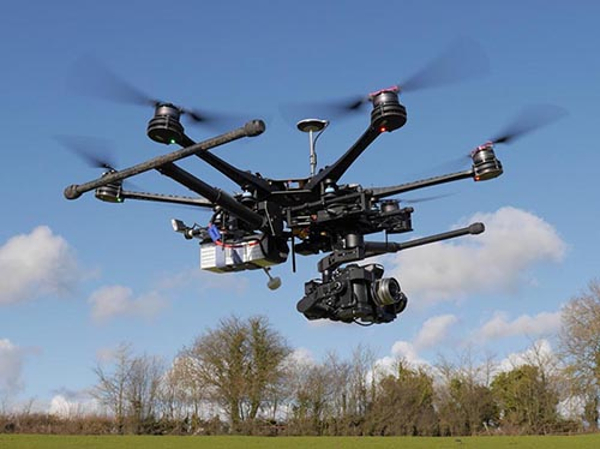
New Delhi, April 24, 2026: The Indian Air Force has launched the third edition of the Mehar Baba Competition, inviting Indian industry, start-ups, academic institutions and research organisations to develop next-generation drone and radar technologies. The theme of Mehar Baba Competition-3, or MBC-3, is “Collaborative Drone-Based Surveillance Radars.” Registrations for the competition will begin on April 27, 2026.
The competition aims to build a proof-of-concept system in which a collaborative swarm of Unmanned Aerial Systems functions as an airborne radar network. The proposed system is expected to detect, track and report aerial targets in a contested environment, while sending accurate target-location data to a centralised monitoring station.
According to the Ministry of Defence, meritorious participants will receive development funding from the Indian Air Force, while the top three winners will be honoured with awards. The initiative is designed to encourage indigenous innovation in advanced aviation, drone and radar technologies, especially in areas that have direct operational relevance for future air warfare.
The third edition was earlier announced by Minister of State for Defence Sanjay Seth during Aero India 2025. The IAF’s official Mehar Baba Competition page states that MBC was launched in 2018 to encourage academia, industry, start-ups and entrepreneurs to develop niche indigenous technologies under the broader Atmanirbhar Bharat framework.
The focus on collaborative drone-based radar surveillance is significant because future air defence and battlefield monitoring will increasingly depend on distributed sensors, unmanned platforms and networked detection systems. Instead of relying only on large fixed radar assets, a swarm of smaller aerial platforms could potentially create a flexible, mobile and survivable surveillance grid, especially in contested airspace where conventional systems may be targeted or jammed.
The competition is named in honour of Air Commodore Mehar Singh, popularly known as Mehar Baba, one of the legendary figures of the Indian Air Force. He was born in Lyallapur in 1915, joined the Royal Air Force College, Cranwell in 1934, and became known for exceptional flying skill and combat leadership. He was awarded the Distinguished Service Order at the age of 29 and later became the first IAF recipient of the Maha Vir Chakra.
One of Mehar Singh’s most remembered missions was leading the first contingent of the Indian Army to Srinagar in a Dakota aircraft in 1947. He is also credited with being the first pilot to land at Leh, then considered the highest airstrip in the world. By naming the competition after him, the IAF links modern aerospace innovation with a legacy of courage, experimentation and operational daring.
With MBC-3, the Indian Air Force is seeking to convert domestic technical talent into deployable battlefield solutions. The competition gives innovators a formal route to work on a real military requirement: a drone swarm that can act not merely as an observer, but as a distributed airborne radar system capable of strengthening India’s air surveillance architecture.
You may also like
-
JSR Dynamics Advances Indigenous Jet-Powered Weapons and Guided Rockets
-
Solar Defence Delivers Single Batch Supply of 450 Indigenous Nagastra-1R Loitering Munitions to Indian Army
-
Bharat Electronics Secures ₹533 Crore in New Orders for Drones, Avionics, Cybersecurity and Defence Systems
-
India and Cyprus Strengthen Naval Cooperation with Focus on Maritime Security and Joint Training
-
India and Czech Republic Agree to Expand Defence Industrial Cooperation During Rajnath Singh–Karel Havlíček Talks
