The Defence Research and Development Organisation has unveiled a new generation of Advanced Armoured Platforms in both tracked and wheeled configurations, marking a significant step in India’s effort to strengthen indigenous combat vehicle capability. The platforms were formally unveiled by Dr Samir V Kamat, Secretary, Department of Defence R&D and Chairman, DRDO, at DRDO’s laboratory premises in Ahilyanagar, Maharashtra, on April 25, 2026.
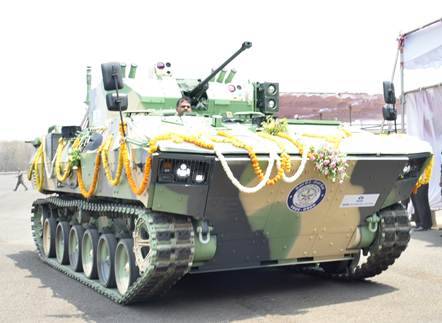
Designed and developed by the Vehicles Research & Development Establishment, the platforms have been created to address the changing operational needs of the Indian Defence Forces. Both variants combine mobility, protection and firepower, making them suitable for modern battlefield roles where speed, survivability and modular weapon integration are critical.
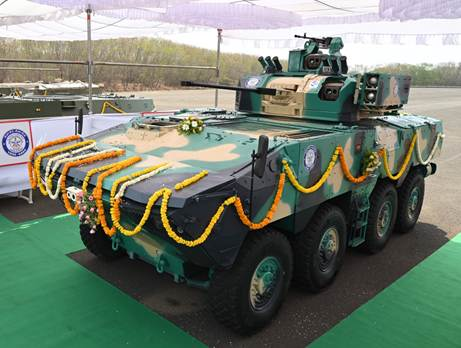
A key feature of the new platforms is the indigenously designed and developed 30 mm crewless turret. This turret is integrated with a 7.62 mm PKT gun and is also configured to launch Anti-Tank Guided Missiles, giving the vehicle a strong mix of infantry-support and anti-armour capability. The crewless turret design also enhances crew survivability by reducing exposure during combat operations.
The platforms are powered by high-performance engines paired with automatic transmission systems, giving them a strong power-to-weight ratio, higher speed potential, improved gradient-climbing ability and better obstacle-negotiation capability. DRDO has also incorporated modular blast and ballistic protection, with the platforms offering STANAG Level 4 and Level 5 protection standards.
Another major operational feature is amphibious capability. The platforms are equipped with hydro jets, allowing them to cross water obstacles more effectively. This gives field commanders greater flexibility in riverine, marshland and obstacle-heavy terrain, where conventional armoured mobility can become restricted.
The base design has been developed with multi-role adaptability in mind, meaning the same platform architecture can be configured for different battlefield missions. The current indigenous content stands at around 65 percent, with plans to raise it to 90 percent, strengthening India’s push for self-reliance in defence manufacturing.
The manufacturing of the platforms has been carried out by Tata Advanced Systems Limited and Bharat Forge Limited, supported by a network of MSMEs. This industry partnership highlights the growing role of private Indian defence manufacturers and smaller technology suppliers in building complex military systems.
The unveiling event was attended by senior DRDO scientists, Directors General from Armament & Combat Engineering Systems and Production, Coordination and Services Interaction, along with representatives from Tata Advanced Systems, Bharat Forge and other industry partners. Scientists and directors from several DRDO laboratories, including VRDE, ARDE, DMRL, HEMRL, CVRDE and R&DE Engineers, were also present.
You may also like
-
JSR Dynamics Advances Indigenous Jet-Powered Weapons and Guided Rockets
-
Solar Defence Delivers Single Batch Supply of 450 Indigenous Nagastra-1R Loitering Munitions to Indian Army
-
Bharat Electronics Secures ₹533 Crore in New Orders for Drones, Avionics, Cybersecurity and Defence Systems
-
India and Cyprus Strengthen Naval Cooperation with Focus on Maritime Security and Joint Training
-
India and Czech Republic Agree to Expand Defence Industrial Cooperation During Rajnath Singh–Karel Havlíček Talks
