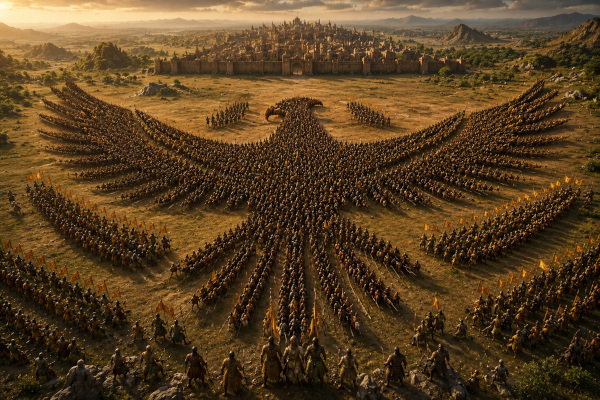
When Rama prepares the Vanara army for the assault on Lanka, the army does not move like an excited crowd rushing towards a fortress. It is shaped, organised and directed. The forces are arranged in the form of Garuda, the celestial eagle associated with speed, power, sharp vision and the destruction of serpents. This detail is more than a poetic image. It reveals a serious military idea inside the Ramayana: battlefield success requires formation, sector responsibility, controlled movement and symbolic morale.
Formation warfare is one of the oldest signs of organised military thought. A formation transforms individual fighters into a coordinated body. It gives an army shape, rhythm and direction. It helps commanders place strong fighters at decisive points, protect vulnerable elements, hold reserves, manage movement and apply pressure in a disciplined way. Rama’s Garuda formation shows that the Vanara army had moved from raw strength into structured combat power.
The symbolism of Garuda matters deeply. Garuda is fast, watchful and overwhelming. He dominates the sky, strikes with precision and is traditionally associated with the defeat of serpentine forces. In the Lanka campaign, this image carries both military and psychological value. The Rakshasa army represents a fortified, dangerous and deceptive adversary inside a powerful island citadel. By arranging his forces in the form of Garuda, Rama gives his army a visible identity of speed, dominance and righteous force. A formation becomes a message before it becomes an attack.
Ancient Indian warfare placed great importance on vyuha, or battle formation. A vyuha was a planned arrangement of troops suited to terrain, enemy disposition, command intent and operational objective. The Mahabharata gives several famous examples such as Chakra Vyuha, Makara Vyuha, Krauncha Vyuha and Garuda Vyuha. These formations were named after living forms because ancient strategists understood shape through movement, purpose and behaviour. A bird formation suggested speed and enveloping reach. A crocodile formation suggested a crushing central bite. A wheel formation suggested rotation, depth and encirclement.
Rama’s use of Garuda formation fits the needs of the Lanka battlefield. The army has crossed the sea, established a foothold, observed the enemy city and prepared for a multi-directional assault. Lanka is a fortified urban objective with gates, towers, walls, reserves and commanders assigned to sectors. Such a target demands disciplined organisation. The attacking army must prevent crowding, maintain direction, hold momentum and ensure that key commanders operate in the correct zones.
In a Garuda formation, the centre can be imagined as the body of the bird, the forward striking element as the beak, the flanks as the wings and the reserve or support elements as the tail and rear structure. The beak creates the primary point of pressure. The wings extend the army’s reach and threaten the enemy’s sides. The body provides mass and staying power. The rear keeps the formation alive through reinforcement, communication and control. This is exactly how modern armies think about force design, even when the language has changed from birds and beasts to brigades, task forces and combat groups.
Modern warfare still depends on formation logic. A mechanised infantry battalion, armoured brigade, carrier battle group, air assault formation or special forces column operates through assigned roles. Every element has a place and purpose. Reconnaissance elements look ahead. Armour or assault troops create the breakthrough. Infantry clears ground. Artillery shapes the battlefield. Engineers open routes. Air defence protects the force. Logistics keeps the system moving. Command posts maintain coordination. Formation is the architecture that allows these parts to fight as one organism.
The Garuda formation also reflects the principle of mass and manoeuvre. Mass means concentrating enough combat power at the decisive point. Manoeuvre means placing that power in a way that disrupts the enemy’s balance. Rama’s army needed both. A simple frontal crush against Lanka’s gates would waste strength. A shaped formation allowed pressure to be distributed across the battlefield while keeping the main thrust purposeful. This is the same principle modern commanders use when they shape a battlefield through multiple axes, supporting attacks, feints, reserves and decisive thrusts.
The beak of Garuda represents the spearpoint. In modern terms, this is the assault echelon or breakthrough element. It moves with focus, accepts the first shock and attempts to tear open the enemy’s defensive surface. In an urban or fortified battle, the spearpoint needs courage, speed and close coordination. Its task is to create the first rupture. Once the rupture appears, follow-on forces expand it, secure it and turn it into operational advantage.
The wings of Garuda represent lateral pressure. They prevent the enemy from concentrating all strength at one point. They create the sense of being stretched, watched and threatened from multiple directions. Modern commanders use similar logic through flank attacks, airborne insertions, amphibious pressure, artillery interdiction, drone surveillance and long-range fires. When a defender feels pressure across several sectors, command attention fractures and reserves become harder to commit cleanly.
The body of Garuda gives the formation weight. This is the main strength that sustains the battle after the first contact. A battlefield often begins with shock, but victory requires endurance. The centre must keep pushing, absorb enemy counter-action and hold captured ground. In the Ramayana’s world, this body is made of Vanara strength, momentum and command loyalty. In modern warfare, it would include infantry, armour, artillery, engineers, communications, medical elements and logistic support working as a combined force.
The tail and rear of the formation carry another important lesson. Armies win through continuity. A fighting force needs reserves, supply lines, casualty evacuation, messenger routes, rally points and command control. A formation that only strikes forward can lose shape after the first clash. A formation with rear depth can recover, reinforce and continue. This is why modern battle groups always maintain reserves and support echelons. The rear is where staying power is stored.
The Garuda formation also helps solve a psychological problem. Large armies can become confused when the battlefield opens. Noise, dust, fear, missiles, wounded comrades and shifting enemy movement can break cohesion. A recognisable formation gives fighters a mental map. Every warrior knows where he belongs. Every commander knows the direction of movement. The shape itself becomes a guide. In modern terms, this resembles battle drills, phase lines, control measures, formation markers and command nets that help units maintain order under stress.
Symbolism strengthens cohesion. A soldier fights better when he feels part of something larger than himself. Garuda was a sacred and powerful image. For Rama’s army, taking that form would have created confidence, identity and spiritual energy. It converted tactical arrangement into morale. Modern militaries still use symbols in the same way. Unit insignia, regimental colours, formation signs, callsigns, mottos and battle honours all create shared identity. These symbols make formations emotionally alive.
Formation warfare also shows command maturity. Rama does not rely only on the bravery of Hanuman, Angada, Sugriva, Jambavan, Nila and other great warriors. He places courage inside structure. This is the essence of good generalship. Heroism becomes more effective when guided by design. Modern warfare follows the same principle. Special forces, fighter pilots, tank crews and infantry units display extraordinary courage, yet their power becomes decisive when integrated into a larger operational plan.
The Lanka battlefield demanded such integration. Ravana’s side had fortified positions, experienced commanders, magical weapons, reserves and knowledge of the city. Rama’s side had momentum, moral purpose, alliance strength, reconnaissance from Hanuman and intelligence from Vibhishana. The Garuda formation converted these strengths into a visible battle order. It gave the army a body through which strategy could move.
Modern combined-arms warfare works in the same spirit. A modern formation brings together infantry, armour, artillery, aviation, drones, engineers, signals, cyber support, electronic warfare and logistics. Each arm supports the others. Infantry protects armour in close terrain. Armour gives shock power. Artillery breaks enemy positions. Drones reveal movement. Electronic warfare disrupts communications. Engineers clear obstacles. Logistics sustains tempo. The commander’s task is to shape these forces into a formation that can sense, strike, move and survive.
The Garuda analogy becomes even sharper when compared to air-land battle concepts. Garuda is a creature of vision and speed. A modern force seeks the same qualities through reconnaissance drones, satellites, battlefield surveillance radars, airborne early warning aircraft and networked command systems. The eye of Garuda becomes intelligence. The wings become manoeuvre. The claws become precision strike. The body becomes combat mass. The formation becomes a living system of observation and action.
In contemporary Indian military thinking, formation warfare is visible in the structure of integrated battle groups, mountain strike formations, naval task groups and air defence networks. Forces are organised for speed, concentration and theatre-specific response. The goal is to create formations that can move quickly, strike sharply and remain connected across domains. Rama’s Garuda Vyuha reflects the same timeless principle: strength must be arranged before it is unleashed.
The Indian Army’s modern battlefield formations are designed around terrain and mission. In mountains, formations emphasise mobility, acclimatised troops, artillery support, aviation lift and supply resilience. In deserts, speed, armour thrusts and mechanised movement gain importance. In plains, combined-arms balance becomes central. In island and coastal operations, amphibious coordination, naval cover and air support shape the plan. This mirrors the ancient idea that a vyuha must suit the battlefield.
The Navy offers another parallel. A carrier battle group or fleet formation has its own Garuda-like logic. The aircraft carrier forms the central body. Destroyers and frigates create protective wings. Submarines and maritime patrol aircraft extend the sensing and striking reach. Supply ships maintain endurance. Air defence layers protect the formation. The fleet moves as a single combat organism across the sea. Shape, spacing and role allocation decide survival and effectiveness.
Air warfare also depends on formation thinking. Fighter aircraft fly in tactical packages with leaders, wingmen, escorts, strike aircraft, electronic warfare aircraft and airborne controllers. Each aircraft has a defined role. A strike package entering hostile airspace resembles a modern aerial vyuha. It combines speed, deception, suppression, protection and precision. The form may be invisible to the civilian eye, yet it is as structured as any ancient battlefield arrangement.
The Garuda formation also teaches the importance of tempo. A formation must move with rhythm. Slow coordination gives the enemy time. Excessive haste breaks control. Rama’s army needed a speed that matched purpose. Modern commanders call this operational tempo: the ability to act faster than the enemy can understand, decide and respond. Garuda, as a symbol of rapid movement, perfectly captures this idea.
There is also a lesson in intimidation. A disciplined formation can shake the enemy before weapons strike. A defender watching an organised army approach in a powerful symbolic pattern sees discipline, leadership and confidence. In modern warfare, the same effect comes from armoured columns, naval formations, air packages, missile batteries, drone swarms and coordinated fire plans. Order itself becomes psychological pressure.
The Garuda Vyuha also points towards battlefield geometry. War is fought through space. The arrangement of forces affects visibility, reach, vulnerability and impact. A wide formation can stretch the enemy. A deep formation can sustain pressure. A narrow formation can penetrate. A layered formation can absorb attack. Rama’s arrangement shows that ancient commanders understood space as a weapon. Modern military planning uses maps, grids, phase lines, engagement areas and fire corridors for the same reason.
A formation also protects command. In a loose mass, orders fade quickly. In a shaped army, instructions flow through known lines. Commanders can control wings, centre, forward elements and reserves. This is vital in a battlefield where sound, distance and confusion can destroy coordination. Modern forces solve this through radios, data links, command posts and digital battle management systems. The principle remains identical: structure allows command to travel.
The Garuda formation carries one more subtle idea — unity of moral and military purpose. Rama’s army is not merely attacking Lanka as a physical objective. It is moving to restore dharma, rescue Sita and end Ravana’s tyranny. The formation gives that mission a visible sacred body. Garuda, the enemy of serpents, becomes a symbol of righteous force descending upon deception and oppression. In military history, armies often fight hardest when tactical action and moral purpose align.
This is why the Ramayana’s battlefield descriptions remain powerful for defence analysis. They show courage, but also planning. They show divine symbolism, but also practical command. They show warrior energy, but also force organisation. The Garuda formation proves that the epic understood war as a disciplined art where morale, intelligence, terrain, leadership and structure work together.
An army’s strength lies in arrangement as much as numbers. Soldiers need direction. Weapons need integration. Commanders need control. Logistics need depth. Morale needs symbols. Victory emerges when all these elements take shape before contact with the enemy. Rama’s Garuda Vyuha captures this principle with poetic brilliance and military clarity.
On the field before Lanka, the Vanara army becomes more than a vast host. It becomes Garuda — wide-winged, sharp-beaked, disciplined, watchful and ready to descend. In that moment, the Ramayana gives us one of its finest military insights: courage becomes decisive when organised into form. The shape of the army becomes the shape of intent. The formation becomes the first strike.
You may also like
-
Indian Navy Vice Chief Inspects Japan’s Mogami-Class Stealth Frigate as India-Japan Shipbuilding Cooperation Expands
-
Philippine Marine Wargames Reportedly Show BrahMos Can Penetrate Chinese Destroyer Air Defences
-
Safran Signs 18 Agreements with Indian Aerospace Suppliers, Expanding Make in India Manufacturing Partnerships
-
Indian Army’s Vajra Corps Certifies First Batch of Drone Operators, Strengthens Battlefield Surveillance
-
India to Seek 35% Increase in Defence Modernisation Budget for FY 2027–28
