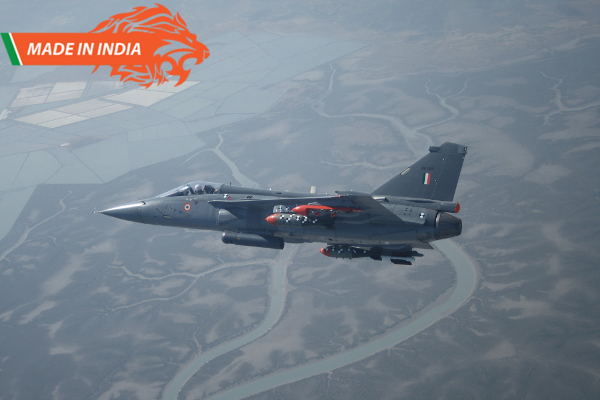
India’s indigenous electronic-warfare suite for the Tejas Mk1A is undergoing further development, with the Defence Research and Development Organisation seeking new hardware and associated qualification work for a modification kit for the aircraft’s Advanced Self Protection Jammer (ASPJ) pod.
The procurement has been issued by DRDO’s Centre for Airborne Systems Development and Integration (CASDIC) in Bengaluru, one of the laboratories responsible for developing the Tejas Mk1A electronic-warfare suite.
Modification Kit for the Tejas Jammer
The reference to an ASPJ Pod Modkit is significant because it shows that CASDIC is working on a modified configuration of the indigenous jammer rather than simply procuring generic electronic components.
It also requires software associated with the two systems, qualification testing and Environmental Stress Screening for the hardware.
What the procurement does establish is that hardware and software associated with the ASPJ are continuing to evolve.
What the ASPJ Does
The Advanced Self Protection Jammer is part of the indigenous electronic-warfare suite developed specifically for the LCA Tejas Mk1A.
DRDO says the suite was jointly developed by CASDIC in Bengaluru and the Defence Electronics Research Laboratory (DLRL) in Hyderabad. It combines an indigenous Radar Warning Receiver with the pod-mounted ASPJ.
The jammer is carried on an outboard station of the Tejas and is designed to protect the fighter against several categories of radar-guided threats.
According to DRDO, these include ground-based acquisition radars, fire-control radars, radar systems associated with anti-aircraft artillery and airborne multimode radars.
Its purpose is therefore defensive: to interfere with hostile radar systems attempting to detect, track or engage the aircraft.
Active Phased Array and DRFM Architecture
The ASPJ is considerably more sophisticated than a conventional noise jammer.
DRDO describes the system as being based on an Active Phased Array architecture and an ultra-wideband Digital Radio Frequency Memory, or DRFM, supported by an integrated cooling system.
DRFM technology allows an electronic-warfare system to capture radar signals digitally and generate precisely controlled responses.
The ASPJ incorporates several major subsystems, including an Exciter Receiver Processor, Active Transmit Receive Unit and Vivaldi Antenna Array Unit. Thermal management is provided by an Air Cycle Machine-based cooling arrangement.
This combination allows the pod to provide an active electronic countermeasure capability while remaining externally mounted on the fighter.
Why a Gain Equalizer Matters
One of the components sought under the latest modification programme is a gain equalizer.
In wideband radio-frequency systems, amplification can vary across different parts of the operating frequency range. A gain equalizer is used to compensate for those variations and maintain more consistent RF behaviour across the required band.
That function is relevant to a wideband electronic-warfare transmitter such as the ASPJ.
However, without DRDO releasing the engineering specifications of the new unit, it is not possible to determine whether the new equalizer is intended to expand operating bandwidth, improve signal quality, accommodate other modified hardware or simply meet revised performance and reliability requirements.
The inclusion of both hardware and software nevertheless indicates that CASDIC is addressing the ASPJ as an integrated electronic system rather than carrying out a simple component replacement.
Qualification Work Included
The procurement also covers Environmental Stress Screening and Qualification Testing.
These are important steps for equipment intended for fighter-aircraft operations, where electronics must function despite vibration, temperature variations and other demanding environmental conditions.
The tender seeks ESS work for 34 units and separate qualification activities associated with the DCHA and equalizer.
This points to a modification that will have to be tested and qualified before it can form part of the approved pod configuration.
India Has Already Built an ASPJ Supply Chain
An important part of the ASPJ programme is that DRDO has already established an Indian industrial supply chain around it.
In its official description of the Tejas Mk1A EW suite, DRDO said industry partners had participated in development and that the supply chain for line-replaceable units, subsystems and components had been established.
The organisation also envisaged transferring the system to an industrial partner responsible for sourcing approved components, integration, testing, certification and delivery.
DRDO’s production plan called for the selected industrial partner to be capable of supplying around 10–12 electronic-warfare suites annually to meet Indian Air Force requirements.
Production and maintenance infrastructure is also intended to include system test rigs, automatic test equipment and specialised ground-support equipment.
DRDO Continues to Indigenise ASPJ Technologies
The latest procurement is not an isolated effort.
DRDO has previously identified additional ASPJ technologies for domestic development under its Technology Development Fund.
These include indigenous development of continuous-wave travelling-wave tubes and pulse travelling-wave tubes for the ASPJ, indicating an effort to progressively localise some of the specialised high-power RF technologies required by the jammer.
DRDO’s current technology-development roadmap also includes several capabilities directly relevant to future electronic warfare, including AI and machine-learning algorithms for EW, smart jamming against software-defined and cognitive military radios, wideband digital receivers, multifunction RF chips and advanced thermal-management systems.
That wider work suggests the electronic-warfare architecture surrounding Indian combat aircraft will continue to evolve as new threats and radar technologies emerge.
Electronic Warfare Is Central to Tejas Mk1A Survivability
The ASPJ forms an important part of the capability difference between the original Tejas configuration and the more advanced Mk1A.
Modern fighters have to contend with increasingly sophisticated ground-based and airborne radars. Improving an aircraft’s survivability therefore depends not only on weapons and manoeuvrability but also on its ability to detect hostile emissions and disrupt the systems attempting to track it.
DRDO’s indigenous suite addresses both sides of that requirement: the Radar Warning Receiver detects and analyses radar threats, while the ASPJ provides active countermeasures.
The latest CASDIC tender shows that development has not stopped with the original configuration.
The precise improvement associated with the DCHA and Gain Equalizer modification kit remains undisclosed, but the procurement confirms that DRDO is continuing to refine the indigenous ASPJ architecture that will provide the Tejas Mk1A with its principal podded electronic self-protection capability.
References
Defence Research and Development Organisation — EW Suite for LCA Mk1A
Official DRDO technical description of the Radar Warning Receiver and Advanced Self Protection Jammer developed jointly by CASDIC and DLRL.
Department of Defence Research and Development / CASDIC — Tender CASDIC/27ATT015/MMD, published September 7, 2026
Procurement for DCHA and Gain Equalizer for ASPJ Pod Modkit, including hardware, software, ESS and qualification testing.
DRDO Technology Development Fund — Electronic-Warfare Development Requirements
Official DRDO listing covering indigenous CW and Pulse TWT development for ASPJ.
DRDO — Electronic Warfare Technology Foresight
Official roadmap covering AI/ML for EW, smart jamming, advanced RF electronics and related electronic-warfare technologies.
You may also like
-
ICAR Scientists Develop Indigenous Protective Gloves for Cotton Farmers, Sign Commercial Manufacturing Agreement
-
India Moves Towards Five-Year Assured Orders for Defence Startups Under New Procurement Reforms
-
BHEL–Coal India Joint Venture Begins Construction of ₹25,016 Crore Indigenous Coal Gasification Project in Odisha
-
Zen Technologies Introduces Indigenous Hyper-Strike Falcon AI-Guided Counter-Drone Interceptor
-
L&T and Germany’s SCHOTTEL Expand Partnership for Controllable Pitch Propeller Systems in Indian Shipbuilding
