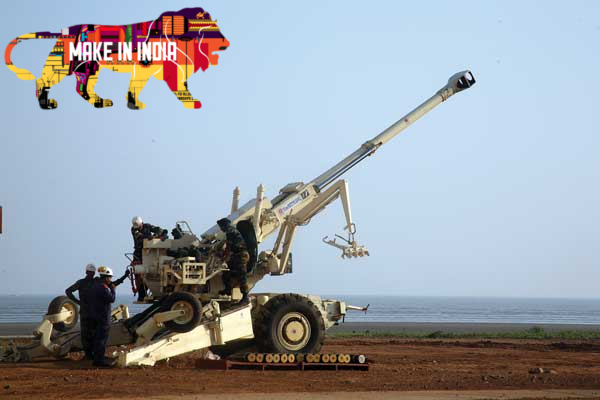
The first batch of Dhanush artillery guns referred to as ‘Desi Bofors’ will be inducted in the Indian Army on March 26. By the end of the year, a regiment comprising 18 guns are likely to be pressed into action.
Sources said the first batch is likely to have five guns that will soon be deployed on the China and Pakistan frontiers.
Dhanush, an indigenous artillery gun of 155 mm x 45mm calibre on the lines of Bofors, has a better rate of fire and a strike range of 38 kilometres. The weapon is the first long-range artillery gun to be produced in India. 81% of its components are indigenously sourced. The scale would go up to 90 per cent by 2019.
Last month, the Army and Ministry of Defence gave clearance for bulk production order of 118 of these guns to the Ordnance Factory Board (OFB). The Indian Army is going in for mediumisation of artillery to phase out field guns that can be replaced with weapons that are easy to be transported to high alitutdes and have a better range.
“Dhanush is equipped with inertial navigation-based sighting system, auto-laying facility, on-board ballistic computation and an advanced day and night direct firing system. The self-propulsion unit allows the gun to negotiate and deploy itself in mountainous terrains with ease,” MoD had said in a statement last month.
As a part of this plan, the Indian Army also plans to induct M777 Howitzers from USA. The cost of acquiring 145 such guns is more than Rs 5,000 crore. While 25 guns will come to India in a fly away condition, the rest will be assembled at the proposed Assembly Integration and Test facility for the weapon system in India, in partnership with Mahindra.
Source: IT
Image Courtesy: IDR
You may also like
-
Astra Microwave Expands Counter-Drone Capabilities with Layered Detection and Neutralisation Systems
-
MDL Begins Development of Indigenous Lithium-Ion Battery System for Project-75(I) Submarines
-
Tarang Shakti Delegates from 28 Countries Visit HAL and BEL to Explore India’s Defence Manufacturing Ecosystem
-
India’s 114 Rafale Fighter Jet Programme Moves Towards Final Decision with Focus on Indigenous Integration
-
Embraer and Mahindra Identify Nagpur as Potential C-390 Millennium Assembly Hub in India
