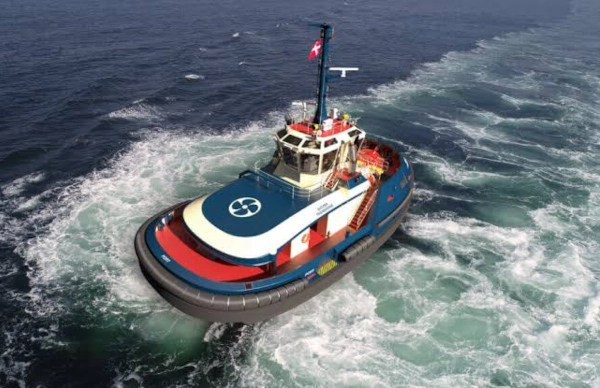
India’s Cochin Shipyard Limited has begun construction of four next-generation battery-electric harbour tugs for global towage major Svitzer, marking an important expansion of the public-sector shipbuilder’s capabilities in advanced electric vessels and green maritime technology.
Construction formally commenced with a steel-cutting ceremony at Cochin Shipyard on September 2, 2026. The four vessels belong to Svitzer’s TRAnsverse 2600e class, an advanced 26-metre tug design developed for demanding harbour and terminal operations. Cochin Shipyard and Svitzer describe the vessels as being among the most advanced green tugs currently under construction globally.
The latest milestone follows a shipbuilding agreement concluded between the two companies in December 2025. Under that contract, Cochin Shipyard will construct a minimum of four battery-electric TRAnsverse 2600e tugs at its Kochi facilities, while the agreement includes an option for as many as four additional vessels. The initial four are intended to support Svitzer’s global fleet renewal and growth programme, while the partnership also creates the possibility of future deployment of similar vessels at Indian ports.
The project is significant because it brings the construction of sophisticated battery-powered harbour vessels into an Indian public-sector shipyard at a time when ports around the world are examining ways to reduce emissions from their support fleets.
Harbour tugs are relatively small vessels, but they perform demanding work. They assist large cargo ships, container vessels and tankers while manoeuvring into and out of ports, operating in confined waters where very high thrust, rapid response and precise control are required. Electrifying such vessels therefore involves considerably more than replacing a diesel engine with a battery.
Each of the four Svitzer tugs being constructed at Cochin Shipyard will be primarily powered by a 4.8 MWh battery system, according to technology supplier Kongsberg Maritime. The Norwegian marine-technology company has been selected to supply an integrated electrical, propulsion and automation package covering the four vessels, with options associated with four additional ships.
The propulsion system will include two Kongsberg US L Drive azimuth thrusters, each fitted with a 2.8-metre nozzle and driven by a 2,000 kW permanent-magnet motor. Azimuth thrusters can rotate their direction of thrust, providing the manoeuvrability required when a tug is operating extremely close to much larger vessels.
Kongsberg is also supplying the vessels’ DC and AC electrical switchboards, shore-charging equipment and centralised automation systems. Its K-Chief and K-Chief Power Management System will integrate the battery, propulsion and onboard electrical architecture, illustrating the technological complexity involved in constructing a modern battery-electric workboat.
The TRAnsverse design itself was developed jointly by Svitzer and naval architecture firm Robert Allan Ltd. Instead of following the conventional layout of many harbour tugs, the design uses a patented towing arrangement, double-ended hull characteristics and in-line propulsion with omnidirectional thrust.
According to Svitzer, the configuration expands the tug’s dynamic operating envelope by as much as 50%, allowing it to work effectively across a wider range of weather, sea-state and vessel-handling conditions. The broader TRAnsverse family is available in 26-metre, 29-metre, 32-metre and 35-metre variants and can use electric, hybrid, dual-fuel or conventional propulsion depending on customer requirements.
The four vessels being built in Kochi are the fully electric 26-metre TRAnsverse 2600e variant.
Svitzer says the TRAnsverse concept has already accumulated more than 3,000 commercial towage jobs, while 18 vessels of the wider class are currently under construction globally. The Indian contract therefore brings Cochin Shipyard into an established international tug-building programme rather than an experimental one-off project.
For Cochin Shipyard, that could be one of the project’s most important aspects. Svitzer said it evaluated shipyards around the world before selecting CSL, meaning the Indian yard had to compete internationally for construction of the vessels.
Building the first four units in Kochi establishes Indian industrial capability in high-specification electric tug construction, including the integration of large marine batteries, sophisticated power electronics, electric propulsion, charging systems and advanced vessel automation.
CSL Chairman and Managing Director Jose V. J. said the shipyard expects the partnership with Svitzer to strengthen further and described the project as part of its contribution towards maritime-sector decarbonisation. Svitzer, meanwhile, has indicated that it wants to deepen its engagement with India’s maritime supply chain and potentially expand its green-tug construction pipeline in the country.
The development also coincides with India’s own transition towards cleaner harbour vessels.
The Ministry of Ports, Shipping and Waterways launched the Green Tug Transition Programme in August 2024 with the objective of progressively replacing conventional diesel-powered harbour tugs with greener alternatives. The programme is being implemented in phases extending to 2040.
During the first phase, running from October 2024 through December 2027, major ports are beginning with battery-electric vessels. Subsequent phases envision a steadily increasing proportion of India’s operational tug fleet complying with green-tug standards, while technologies such as methanol, hydrogen, hybrid propulsion and other emerging low-emission systems may also be adopted as they mature.
By March 2026, the government reported that Deendayal Port, Jawaharlal Nehru Port, Visakhapatnam Port and V.O. Chidambaranar Port had already placed work orders for electric tugs under the programme.
Cochin Shipyard is already participating directly in that transition through another programme. In January 2026, Polestar Maritime placed an order on CSL for two 60-tonne bollard-pull battery-electric green tugs that are to operate at Jawaharlal Nehru Port under the GTTP. Those vessels will be jointly constructed by CSL and its subsidiary Udupi Cochin Shipyard, with their batteries being sourced domestically.
The Svitzer project should therefore be distinguished from those government-backed GTTP orders. The four TRAnsverse 2600e vessels are being constructed for Svitzer’s international fleet requirements rather than being identified as GTTP vessels for a particular Indian port.
Their importance for India nevertheless extends beyond the immediate customer.
Once an Indian shipyard develops the engineering knowledge, workforce skills and supply-chain experience needed to integrate large battery systems, high-power electric motors, azimuthing propulsion, automation and shore charging into commercial vessels, the same industrial ecosystem can support subsequent domestic orders.
This is particularly relevant as India’s Green Tug Transition Programme begins generating demand for new vessels at major ports.
The government has set a broader objective under Maritime Amrit Kaal Vision 2047 to reduce greenhouse-gas emissions associated with port vessels, while initiatives such as the GTTP, renewable-energy adoption at ports, shore power and electrification of port equipment are intended to progressively lower the carbon intensity of maritime operations.
Battery-electric tugs are particularly suited to some harbour operations because they repeatedly operate over relatively short distances and can return frequently to port charging infrastructure. During battery-electric operation they can eliminate direct propulsion emissions from conventional diesel engines, while charging them from renewable electricity can further reduce the emissions associated with their energy use.
Electric propulsion can also reduce local exhaust emissions and noise around densely populated ports, although the overall environmental benefit ultimately depends on factors including the electricity used for charging, battery manufacturing and vessel utilisation.
For Cochin Shipyard, the programme fits into a much broader transformation. The PSU remains an important builder and repairer of Indian naval and commercial vessels, but it is increasingly seeking international orders and specialised high-value shipbuilding programmes.
Its growing portfolio now includes conventional and green harbour tugs, autonomous and specialised vessels, naval ships and other technologically advanced platforms. Electric shipbuilding provides another segment in which Indian yards can compete for international maritime contracts.
The four Svitzer TRAnsverse 2600e vessels are particularly noteworthy because the project combines an Indian public-sector shipyard with an internationally proven tug design and advanced global electric-propulsion technology, while establishing the construction and integration capability in India.
The steel-cutting ceremony of September 2 therefore represents more than the beginning of four individual vessels. It marks another step towards building an Indian industrial base capable of manufacturing increasingly sophisticated zero- and low-emission commercial ships.
As global ports move towards cleaner harbour fleets and India simultaneously expands its own Green Tug Transition Programme, the ability to construct vessels such as the TRAnsverse 2600e domestically could place Cochin Shipyard in a strong position in an emerging international market for advanced green maritime vessels.
References
Cochin Shipyard Limited
Cochin Shipyard begins construction of Svitzer’s advanced battery-electric tugs in India
Published: 2 September 2026.
Official CSL announcement confirming commencement of construction, the four-vessel programme and its connection with India’s wider maritime manufacturing ambitions.
Svitzer
Cochin Shipyard begins construction of Svitzer’s advanced battery-electric tugs in India
Published: 2 September 2026.
Primary company source detailing the steel-cutting milestone, TRAnsverse programme and Svitzer’s selection of CSL.
Cochin Shipyard Limited
Cochin Shipyard to build next-generation electric TRAnsverse tugs for Svitzer
Official announcement of the December 2025 shipbuilding agreement for four 26-metre vessels, with an option for four more.
Kongsberg Maritime
Integrated technology package for Svitzer’s next generation full-electric tug series
Published: 5 May 2026.
Primary technical source confirming the 4.8 MWh battery system, twin 2,000 kW permanent-magnet propulsion motors, azimuth thrusters, shore charging and integrated electrical architecture.
Press Information Bureau — Ministry of Ports, Shipping and Waterways
Green Tug Transition Program
Official Government of India information covering the objectives and phased implementation of India’s GTTP.
Image Courtesy: SVITZER
You may also like
-
Indian Semiconductor Companies Propose New Manufacturing and Chip Design Investments in Madhya Pradesh
-
CSIR-CRRI Partners with Industry to Develop Advanced Indigenous Airport Runway and Pavement Materials
-
Paras Semiconductors Secures 43 Acres in Madhya Pradesh for Proposed ₹6,200 Crore Advanced Chip Packaging Facility
-
Petronet LNG Plans ₹1,200 Crore Joint Venture for Ten Compressed Biogas Plants Across India
-
India Seeks South Korean Shipbuilding Partnerships as Sarbananda Sonowal Begins Four-Day Visit to Busan
