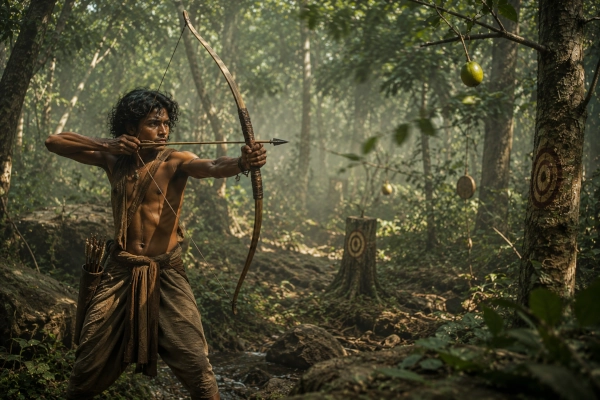
Subrahmanya Bhujangam
The term ‘Bhujangam’ indicates the shape and movement of the ‘serpent’. The verse in this stotram is composed like the movement of a serpent. Lord Subramanya / Muruga is also conceived and worshiped as a great divine serpent.
Moral stories collected from around India
The term ‘Bhujangam’ indicates the shape and movement of the ‘serpent’. The verse in this stotram is composed like the movement of a serpent. Lord Subramanya / Muruga is also conceived and worshiped as a great divine serpent.
Lord Shiva had three sons and three daughters. Shiva’s three daughters are worshipped even today in different parts around the world in different forms. His three sons were Kartikeya, Ganesha and Ayyappa. Lord Shiva’s three daughters were Ashok Sundari, Manasa, Jyothi and Ekaveera devi.
Rama gave Hanuman his ring, to present the ring to Sita. In order to reach Lanka and find Sita, Hanuman leapt over the ocean, escaping and devouring Rakshasis Surasa, Simhika and Kakhini that he met on the way.
Rishi Marichi or Mareechi or Marichi literally means a ray of light from either the moon or the sun, and Marichi is the chief of the Maruts (‘the shining ones’). He is the Manasaputra of the cosmic creator Bramhma, who created Marichi from the eyes; he is one of the Nine Brahmaṇas alluded to in the puraṇas.
One of the twelve enchanting principal forests of Vraja that is being recreated with the vast greens around the Vrindavan Chandrodaya Mandir at Krishna Bhumi is the forest of Talavana. The forest gets its name from the ‘Tala’ or Palm trees that grew in abundance in this specific part of Vrindavana. Situated about six miles south of Mathura and two and half miles south-west of Madhuvana is the forest of Talavana.
There have been at least three Avvaiyars at various periods of Tamil history. The earliest Avvaiyar is believed to have lived in the Sangam period and her poems are found in the Purananuru, Kurunthogai and Natrinai. The second Avvaiyar lived in the 12th Century and was a contemporary of Kambar. Many poems and the Avvai Kural, comprising 310 kurals in 31 chapters, belong to this period. The third Avvaiyar is the most widely known for her ‘Vinayagar Agaval’ ,‘Aathi Soodi’, ‘Kondrai Vendhan’, ‘Nalvazhi’ and ‘Moodhurai’.
In every Shiva temple the stone image of Dakshinamurthy is installed, facing south, on the southern circumambulatory path around the sanctum sanctorum. He sits under the auspicious vata vruksha facing the south direction to give knowledge. The Daksinamurti Upanisad, which is in a dialogue format between Savanaka Rishis and Markandeya, gives a clear imagery and salient features of Daksinamurthy.
Angirasa literally means the sap of the body or essence of the body. It is usually a reference to the breath in the body, which is considered the lord of the organs.
Vishwakarma Prajapati is the Supreme cosmic creator god also known as Swayambhu Brahman (self existing) or Narayana/Purusha in the vedic texts. Vishwakarma is called ‘Devashilpi’ or ‘The Architect of Gods’ . The literal meaning of Vishwakarma is ‘all-creator’, vishwa means ‘all’ and karman means ‘doer’. Vishwakarma is visualised as Ultimate reality (later developed as vishwa Brahman) in the Rig Veda, from whose navel the Hiranyagarbha emanates. Hiranyagarbha refers to our universe and the literal translation is – The Golden womb.
When the five elements governed by Lord Shiva (Pancha Mahabhoota – Earth, Water, Fire, Air, and Ether) united with Shakti (Pure Consciousness), Lord Skanda was born. Shiva is called Panchaanana – Lord with five heads. These five heads represent the five elements in Nature.