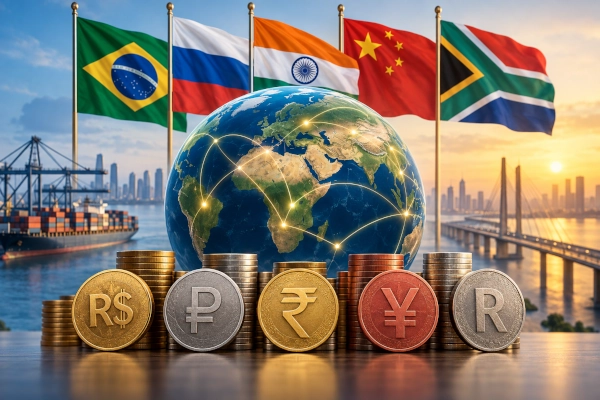
The idea of a single BRICS currency has attracted growing attention as the grouping expands its economic influence and seeks deeper financial cooperation among emerging economies. However, the official BRICS position is more measured. There is currently no agreed plan to introduce a common currency comparable to the euro. Instead, BRICS countries are working on mechanisms that could allow more trade, investment and financing to take place in national currencies while making cross-border payments faster, cheaper and less dependent on a limited number of existing international financial channels.
This distinction is particularly important as India prepares to host the 18th BRICS Summit in New Delhi on September 12 and 13, 2026. The stronger and more realistic story is not the imminent creation of a single BRICS currency, but the gradual construction of a financial architecture that could allow BRICS economies to conduct significantly more business in their own currencies.
From a BRICS Currency to BRICS Currencies
The clearest official clarification on the currency question came during Brazil’s BRICS presidency in 2025, when Brazilian BRICS Sherpa Ambassador Maurício Lyrio said that the creation of a common BRICS currency was not under discussion. He explained that the focus was instead on reducing the cost of commercial and financial transactions among member countries through greater use of local currencies and improved cross-border payment mechanisms.
That position is consistent with decisions taken by BRICS leaders themselves. The 2025 Rio de Janeiro Declaration did not announce a new common currency. Instead, it instructed BRICS finance ministers and central bank governors to continue discussions on the BRICS Cross-Border Payments Initiative and acknowledged progress by the BRICS Payment Task Force in examining greater interoperability between national payment systems.
The objective is to make international payments faster, cheaper, more transparent, more accessible and more secure. Such improvements could support higher levels of trade and investment among BRICS economies without requiring members to surrender control over their national currencies.
Connecting National Currencies Rather Than Replacing Them
The emerging BRICS model is therefore based on connecting existing currencies rather than replacing them. The process has been developing for several years. At the 2023 Johannesburg Summit, BRICS leaders encouraged greater use of national currencies in international trade and financial transactions and supported stronger correspondent banking networks and mechanisms for settlements in local currencies.
For countries such as India, this approach offers greater flexibility than a common monetary system. The rupee can continue to be managed by the Reserve Bank of India while being used more extensively in bilateral and multilateral trade arrangements. Similar arrangements can be developed around the yuan, real, rouble, rand and the currencies of newer BRICS members.
The Reserve Bank of India has also noted that BRICS financial discussions include promotion of settlements in national currencies and greater flexibility within the Contingent Reserve Arrangement through consideration of alternative eligible currencies. This indicates that the grouping is gradually expanding the role of member currencies across both trade and financial cooperation.
UPI Could Play a Role in BRICS Payment Connectivity
India’s digital-payment capabilities give it an important position in this evolving system. Prime Minister Narendra Modi has previously told BRICS leaders that greater trade in local currencies and smoother cross-border payments could strengthen economic cooperation. He has also highlighted the Unified Payments Interface, or UPI, as a platform through which India could cooperate with other BRICS economies.
The longer-term possibility is that national digital-payment platforms could become more interconnected. An Indian importer, for example, could potentially make a payment in rupees while an exporter in another participating economy receives settlement through compatible banking or payment infrastructure in its own currency.
Such arrangements would not create a new currency. Instead, they would make existing currencies easier to use across borders.
BRICS Cross-Border Payments Initiative Takes Shape
The BRICS Cross-Border Payments Initiative has become one of the most important elements of the grouping’s financial agenda. The initiative is examining how payment infrastructure across member economies can become more interoperable and how international transactions can be made faster, safer and less expensive.
The future architecture could involve national instant-payment systems, commercial banking networks, digital financial infrastructure and potentially central-bank digital currencies operating with greater compatibility across borders.
This does not mean that BRICS has announced a replacement for SWIFT or created a single alternative international financial network. Official BRICS documents instead point toward expanding settlement options and improving connectivity between existing national systems. The emphasis is on reducing friction and increasing choice rather than immediately replacing the current global financial architecture.
Local-Currency Financing Gains Importance
The BRICS financial agenda extends well beyond trade settlement. Local-currency financing is also becoming increasingly important. The BRICS Interbank Cooperation Mechanism has been encouraged to explore ways of financing projects and programmes in national currencies.
The New Development Bank has an important role in this process. Expanding lending in local currencies can reduce currency risks for borrowers whose revenues are generated domestically but whose debts are denominated in foreign currencies. This is particularly relevant for infrastructure and industrial projects with long repayment periods.
Greater use of national currencies could therefore extend into infrastructure finance, industrial investment, development lending and other financial instruments across BRICS economies.
India Pushes Wider International Use of the Rupee
India has already made regulatory changes aimed at facilitating greater international use of the rupee and enabling local-currency settlements with partner countries. The Reserve Bank of India has supported arrangements that expand the range of currencies that can be used for international payments and receipts.
This gives India a practical foundation for deeper BRICS financial cooperation. Rather than waiting for a hypothetical common currency, India can expand rupee-based trade settlement, develop direct currency arrangements and connect its payment infrastructure with participating economies.
Such mechanisms could gradually increase the rupee’s role in international commerce while preserving full national control over monetary policy.
BRICS Already Has a Financial Institutional Base
BRICS does not need a common currency to develop a stronger financial system because it already possesses institutions capable of supporting deeper economic cooperation. The New Development Bank was established in 2014 to finance infrastructure and sustainable-development projects, while the BRICS Contingent Reserve Arrangement was created with an initial size of $100 billion to provide liquidity support when member economies face short-term balance-of-payments pressures.
BRICS leaders are now looking at strengthening these institutions. The 2025 declaration supported further improvements to the Contingent Reserve Arrangement, including consideration of additional eligible payment currencies.
The grouping has also advanced work on the BRICS Multilateral Guarantees initiative, designed to reduce investment risks and mobilise more private capital for infrastructure and sustainable-development projects.
Together, these mechanisms are beginning to form the foundations of a wider BRICS financial ecosystem.
India’s 2026 Chairship Could Accelerate Financial Cooperation
India’s BRICS chairship comes at an important stage in this process. During 2026, Indian-led discussions have continued to emphasise financial inclusion, fintech and smoother international trade payments.
At the first BRICS SME Working Group meeting in April, member countries discussed fintech-driven systems capable of improving access to finance while enabling more efficient global trade payments. This demonstrated how payment connectivity is increasingly being linked with the needs of smaller businesses rather than being treated purely as a central-bank issue.
BRICS Trade Ministers meeting in Jaipur in August also advanced work on the Strategy for BRICS Economic Partnership 2030 and adopted the Jaipur Consensus and Guiding Principles aimed at addressing the MSME trade-finance gap.
The financial agenda is therefore becoming increasingly connected with trade, investment, digital infrastructure and business growth.
Why a Common Currency Remains Difficult
Creating a genuine common currency would require a level of economic and monetary integration far beyond anything BRICS has currently agreed. A system comparable to the euro would require extensive coordination over monetary policy, financial regulation, exchange-rate management, capital movements and potentially fiscal policy.
BRICS countries have very different economic structures, monetary systems, inflation conditions and policy priorities. They are also spread across several continents and maintain varying relationships with global financial markets.
Giving a supranational institution control over monetary policy would therefore be considerably more difficult than simply increasing the use of national currencies in trade.
For this reason, the present BRICS approach is much more practical. Member countries can deepen financial integration while retaining control over their own currencies and central banks.
From One BRICS Currency to a Network of BRICS Currencies
The emerging model can therefore be described as a network of BRICS currencies rather than a single BRICS currency. The rupee, yuan, real, rouble, rand and other participating currencies could become easier to exchange, settle and use for trade and investment through increasingly interconnected financial systems.
If successful, this could reduce transaction costs, provide companies with additional settlement options and increase the share of international commerce conducted outside traditional third-country currencies.
The process would likely be gradual. However, even without a single BRICS banknote or supranational central bank, wider use of national currencies could still produce significant changes in the structure of global trade finance.
A Financial Architecture Is Emerging, Not a New Currency
The BRICS currency debate is therefore often framed too narrowly. The most important development is not an imminent replacement for the dollar, euro or other major international currencies. It is the gradual construction of a financial architecture in which BRICS members can conduct more trade, investment and development financing through their own currencies and interconnected payment systems.
There is no official common BRICS currency at present. What is taking shape instead is potentially more practical: a network of national currencies, payment platforms, development institutions and settlement mechanisms designed to reduce barriers to cross-border commerce.
As India hosts the BRICS Summit in New Delhi in September 2026, progress on cross-border payments, local-currency trade, financial interoperability and development financing will therefore be more important to watch than speculation about the launch of a single BRICS currency.
You may also like
-
Tarang Shakti Delegates from 28 Countries Visit HAL and BEL to Explore India’s Defence Manufacturing Ecosystem
-
Swiss President Guy Parmelin to Visit India as EFTA Economic Partnership Deepens
-
Vietnam Expands Business and Investment Links Across India’s Major Economic Hubs
-
India’s GST Collections Rise 14.7% to ₹2.04 Lakh Crore in September
-
SberIndia Lending to Indian Companies Quadruples as India-Russia Trade Finance Expands
