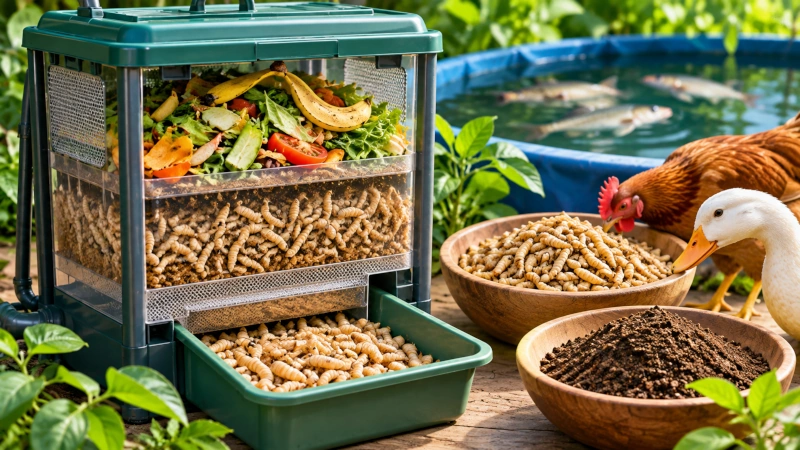
Researchers at the Birla Institute of Technology and Science (BITS) Pilani, Hyderabad Campus, have developed an innovative, low-cost biological waste-processing system capable of converting food waste into protein-rich biomass suitable for potential use in animal feed. The system, which costs approximately ₹2,500 to fabricate, uses black soldier fly larvae to transform organic waste into valuable biological resources, offering a promising approach to decentralised waste management and sustainable animal nutrition.
The development, announced on 11 November 2026, represents an advancement in the application of biological processes to resource recovery. The technology can process vegetable waste, fruit residues and cooked food waste through the natural feeding activity of insect larvae, producing nutrient-rich biomass within approximately two weeks.
The system was developed by Professor Sankar Ganesh Palani, Assistant Professor in the Department of Biological Sciences at BITS Pilani Hyderabad Campus, along with research graduate Dr Atun Roy Choudhury. Their innovation combines low-cost materials, biological waste conversion and a compact design that could make the technology accessible to institutions, commercial establishments and communities seeking alternatives to conventional organic waste disposal.
Using Black Soldier Fly Larvae to Convert Organic Waste
The technology uses the black soldier fly (Hermetia illucens), an insect whose larvae are capable of consuming and processing different types of biodegradable organic material.
Black soldier fly larvae feed on decomposing vegetable matter, fruit residues, cooked food waste and other suitable organic substrates. During their approximately two-week larval feeding stage, they consume substantial quantities of organic matter and convert part of it into insect biomass.
Unlike conventional waste-processing methods that primarily focus on decomposition, this biological approach can recover nutrients from discarded food materials and transform them into potentially useful products.
The researchers have designed the system to exploit the natural feeding behaviour of black soldier fly larvae while creating controlled conditions for their growth and collection.
The approach offers an alternative to conventional composting, which generally requires several weeks or months to process organic waste, depending on the materials involved and environmental conditions.
By converting food waste into insect biomass, the system could contribute to reducing the quantity of biodegradable material requiring conventional disposal while recovering nutrients that would otherwise be lost.
Low-Cost System Designed Using Readily Available Materials
One of the most significant features of the innovation is its affordability. According to the researchers, the system can be fabricated for approximately ₹2,500 using materials commonly available from hardware suppliers.
The design consists of an egg-laying and hatching vessel connected to a separate harvesting bucket. This arrangement supports the growth of black soldier fly larvae and facilitates their collection after they mature.
A filtration layer measuring approximately seven to eight centimetres in thickness is created using coconut coir and sand. The layer helps filter leachate, the liquid generated during the processing of organic waste.
The filtered liquid is subsequently recirculated through the system to maintain moisture levels between 50 and 60 per cent, creating conditions suitable for larval activity and waste conversion.
The design also facilitates the movement of mature larvae towards the harvesting bucket, reducing the need for manual handling during collection.
The enclosed structure is intended to help address unpleasant odours, which can be a significant challenge in conventional organic waste handling and treatment facilities.
Its compact construction makes the system potentially suitable for locations where space, investment and infrastructure availability are limited.
Initial Trials Record Two Kilograms of Larvae Daily
The researchers have reported encouraging results from preliminary testing of the biological waste-processing system.
During initial trials conducted over a 20-day observation period, the prototype produced approximately two kilograms of black soldier fly larvae per day.
The reported output indicates the potential of controlled insect-based waste processing to generate useful biomass from organic waste streams.
However, the observed production figures represent preliminary experimental results rather than independently established commercial-scale performance. Additional evaluation would be necessary to determine the system’s long-term productivity, processing capacity, maintenance requirements and economic viability under different operating conditions.
The performance of black soldier fly larvae can also vary depending on the composition of the waste, temperature, moisture availability and other environmental factors.
Further testing could help establish standard operating conditions and assess the technology’s suitability for different categories of organic waste.
Protein-Rich Biomass for Poultry, Fisheries and Animal Nutrition
An important advantage of the system is its ability to recover biological material that could potentially be used as an alternative ingredient in animal feed.
According to the researchers, black soldier fly larvae contain approximately 20 per cent protein and 25 per cent fat, providing nutritional components that could be useful in feed formulations.
Protein is an essential component of animal nutrition, supporting growth, tissue development and metabolic functions. Conventional feed production frequently depends on ingredients such as soybean meal, fishmeal and other protein sources.
Insect-derived protein has attracted research interest because it offers the possibility of recovering nutrients from suitable organic materials and incorporating them into animal feed production.
The biomass produced by the BITS Pilani system could potentially be used in formulations intended for poultry, pig farming and aquaculture.
For India’s rapidly expanding aquaculture industry, alternative protein ingredients could become increasingly relevant as producers seek reliable and economically viable feed resources.
However, the use of insect-derived materials in commercial animal feed requires appropriate processing, quality control, nutritional assessment and compliance with applicable safety and regulatory requirements.
The reported nutrient composition alone does not establish that the harvested larvae are ready for unrestricted commercial feed use.
Residual Organic Material Could Support Soil Improvement
In addition to producing insect biomass, the waste-processing system generates residual organic material known as frass.
Frass is the material remaining after insect larvae consume and process organic substrates. It may contain partially decomposed organic matter, insect waste and other biological residues.
The researchers have identified this material as a potential soil amendment that could contribute to organic matter recycling and soil improvement.
Depending on its composition and processing, frass may have applications in agriculture and horticulture. Its suitability would require evaluation of nutrient content, biological safety and possible contaminants.
The ability to recover both insect biomass and residual organic material makes the technology relevant to circular bioeconomy models, where waste materials are treated as resources for producing additional useful products.
Such systems seek to reduce the loss of nutrients from food production and consumption while creating opportunities for their recovery and reuse.
Potential Applications in Hotels, Hospitals and Educational Institutions
The researchers believe the technology could be deployed in establishments that generate regular quantities of segregated biodegradable waste.
Potential applications include hotels, educational institutions, hospitals, residential societies and other facilities where food waste can be collected separately from plastics, metals and other non-biodegradable materials.
A small biological processing unit could allow such establishments to treat suitable organic waste closer to its point of generation, potentially reducing transportation requirements and dependence on centralised disposal facilities.
For educational institutions and residential communities, the system could also serve as a demonstration of biological waste management and resource recovery.
Its low fabrication cost may make it accessible to organisations that cannot invest in larger composting or biomethanation facilities.
Nevertheless, practical deployment would require suitable waste segregation, hygienic handling, appropriate operating conditions and safeguards against the introduction of unsuitable materials into the biological processing system.
Waste streams containing chemicals, hazardous substances or other contaminants would require particular attention because these materials could affect insect growth and the safety of the recovered biomass.
Supporting India’s Circular Bioeconomy
The BITS Pilani development reflects the growing importance of biological technologies in India’s efforts to improve resource efficiency and reduce waste.
Organic waste generated by households, markets, restaurants and institutions represents a substantial resource that can potentially be converted into useful products through appropriate treatment technologies.
Conventional approaches include composting, anaerobic digestion and biomethanation. Insect-based biological conversion offers an additional pathway that combines waste treatment with biomass production.
The use of black soldier fly larvae is particularly relevant to the circular bioeconomy because it creates opportunities to recover nutrients from biodegradable materials rather than allowing them to be lost through disposal.
The approach could also complement India’s broader efforts to strengthen waste segregation, promote decentralised waste management and develop sustainable agricultural inputs.
Research into insect-based protein production may contribute to future innovations in animal nutrition, waste-processing technologies and environmentally responsible manufacturing.
Scope for Further Research and Commercial Development
Although the prototype has demonstrated promising preliminary performance, additional research will be important before the technology can be considered ready for widespread commercial deployment.
Future evaluations could examine the volume of waste processed per unit, consistency of larval production, energy and water requirements, biological safety and the economics of continuous operation.
Research may also be required to determine how different food waste compositions influence larval growth, nutrient recovery and the quality of residual organic material.
The system’s low construction cost offers an advantage for further experimentation and pilot-scale adoption. However, its commercial viability will also depend on operating expenses, labour requirements, feedstock availability and the market value of the recovered products.
The researchers’ work could provide a foundation for developing modular systems that can be adapted to different institutional and agricultural requirements.
Advancing Affordable Biological Waste Management Technologies
The development of a ₹2,500 black soldier fly-based waste-processing system at BITS Pilani Hyderabad Campus demonstrates the potential of combining biological science with practical, low-cost engineering.
By using insect larvae to process food waste and recover protein-rich biomass, the researchers have developed a prototype that addresses multiple aspects of sustainable resource management.
The reported production of approximately two kilograms of larvae per day during initial trials provides an encouraging indication of the system’s capabilities, while its compact design and use of readily available materials could support further experimentation and local adaptation.
With additional research, safety validation and operational testing, the technology could contribute to decentralised organic waste treatment and the development of alternative biological resources for animal nutrition.
The innovation highlights the growing role of Indian academic institutions in developing affordable technologies that connect environmental sustainability, biotechnology, agricultural applications and resource-efficient production.
You may also like
-
Cochin Shipyard and SFO Technologies Develop India’s First Indigenous Hybrid Laser Arc Welding System
-
BSF Issues ₹49.3 Lakh Tender for Drone Simulation and Maintenance Facility in Bengaluru
-
India Targets First Made-in-India Civil Aircraft Within Two Years as Indigenous Aviation Manufacturing Gains Momentum
-
India Ranks First in Macroeconomic Resilience Among World’s Ten Largest Economies: ASSOCHAM
-
Sikkim Large Cardamom: The GI-Tagged Heritage of the Eastern Himalayas’ Aromatic Black Spice
