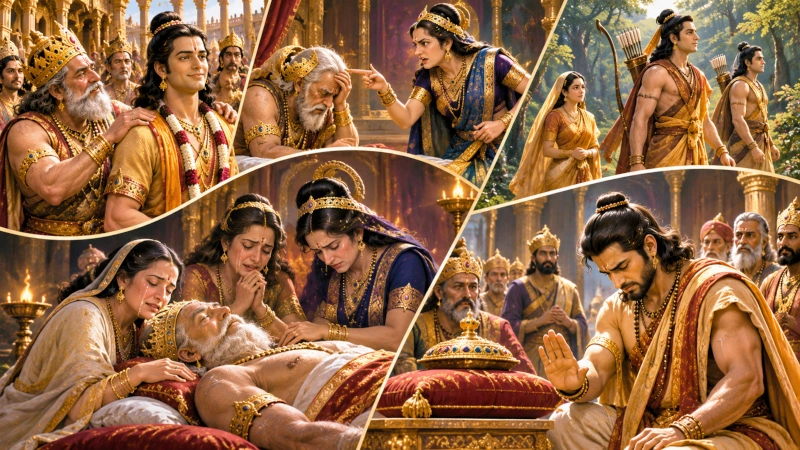
Ramayana Diplomacy Series | Vālmīki Rāmāyaṇa | Ayodhyā Kāṇḍa, Sargas 99–112
Introduction: A Kingdom Confronts a Crisis of Political Legitimacy
The Vālmīki Rāmāyaṇa contains several profound examinations of political authority, succession, diplomacy and the responsibilities of rulers towards their kingdoms. Among these, the meeting between Rāma and Bharata at Citrakūṭa stands as one of the epic’s most significant discussions concerning political legitimacy, the obligations of leadership and the relationship between personal duty and the stability of the state. The episode presents an extraordinary political crisis in which the individual chosen to receive the throne refuses to accept it, while the prince recognised as the rightful successor declines to return from exile because he considers himself bound by an earlier royal promise.
The crisis emerges following the death of King Daśaratha and the exile of Rāma, whose installation as the next ruler of Ayodhyā had previously been announced. Through the intervention of Queen Kaikeyī, Daśaratha had been compelled to fulfil two earlier promises, requiring Rāma to spend fourteen years in exile and Bharata to receive the kingdom. These developments created an unprecedented situation for the royal establishment. Its king had died, its intended successor had departed into the forest, and the prince designated to benefit from the altered succession arrangement refused to accept the throne.
Bharata, who had been absent when these decisions were taken, rejected his mother’s actions and resolved to bring Rāma back to Ayodhyā. Accompanied by royal advisers, family members and a substantial assembly of citizens and attendants, he travelled to Citrakūṭa to persuade his elder brother to return and assume the responsibilities of kingship. What followed was not merely an emotional meeting between two brothers but an extended political negotiation concerning the legitimacy of authority, the obligations arising from royal promises and the practical necessity of maintaining stable government.
The discussions, described primarily in Ayodhyā Kāṇḍa, Sargas 99–112, developed into an examination of competing interpretations of Dharma. Bharata argued that Rāma possessed the strongest claim to the throne and that the kingdom required his leadership. Rāma maintained that their father’s promise must be honoured and that he could not abandon his exile merely because circumstances had become politically difficult.
The central diplomatic significance of the Citrakūṭa dialogue lies in its demonstration that a serious dispute over political authority can be resolved through negotiation, mutual recognition and adherence to shared principles rather than through coercion or armed confrontation.
The eventual settlement, symbolised by Rāma’s sandals and Bharata’s willingness to administer the kingdom on his brother’s behalf, established an extraordinary arrangement in which political responsibility was exercised without a personal claim to ultimate sovereignty. Although Ayodhyā was a hereditary monarchy rather than a modern constitutional state, the episode raises enduring questions concerning political legitimacy, succession, the limits of authority and the responsibilities of those who exercise power temporarily.
The Political Crisis: Succession, Royal Promises and the Death of Daśaratha
The crisis confronting Ayodhyā originated in the conflict between Daśaratha’s intention to install Rāma as his successor and the obligations arising from his earlier promises to Kaikeyī. Rāma, as Daśaratha’s eldest son and the prince chosen for succession, had already received the support of the royal establishment and the people of Ayodhyā. Preparations for his installation had begun when Kaikeyī demanded the fulfilment of two boons previously granted by the king. She insisted that Bharata should receive the kingdom and that Rāma should spend fourteen years in the forest.
Daśaratha was devastated by these demands but considered himself bound by his promises. Rāma accepted the obligation to enter exile, maintaining that his father’s word must be honoured even at great personal cost. His decision reflected an understanding that the integrity of royal authority depended upon the fulfilment of commitments, particularly when those commitments had been solemnly undertaken by the reigning monarch.
The subsequent death of Daśaratha transformed the situation into a crisis of governance. Ayodhyā was left without its reigning monarch, while the intended successor remained in exile. Bharata, who had taken no part in securing the promises, returned to discover that the political settlement had been altered in his favour under circumstances he regarded as unacceptable. Although the royal promise provided the basis for his proposed succession, Bharata refused to treat it as sufficient justification for occupying the throne.
The fundamental political problem was the separation of the recognised moral claim to authority from the immediate practical requirement to maintain a functioning government.
Bharata’s refusal prevented the crisis from developing into a conventional struggle between rival claimants. Rather than mobilising supporters to consolidate his own position, he sought to restore Rāma’s authority. His conduct demonstrated that political legitimacy could be evaluated according to principles extending beyond the immediate possession of power.
The first principle of legitimate government illustrated by the episode is that the opportunity to acquire political authority does not automatically establish a moral entitlement to exercise it.
Bharata’s Decision: Restoring Legitimacy Rather Than Acquiring Power
Bharata’s response to the events in Ayodhyā distinguished him from a conventional claimant seeking to exploit a succession crisis. He openly condemned the circumstances that had led to Rāma’s exile and refused to accept the kingdom as a personal reward. His objective was to persuade Rāma to return and assume the position that Bharata believed rightfully belonged to him.
The journey to Citrakūṭa consequently represented more than a family reunion. It was a political mission intended to restore the established order of succession and resolve the uncertainty surrounding the kingdom’s leadership. Bharata did not travel alone. He was accompanied by senior members of the royal household, ministers, priests and others associated with the administration of Ayodhyā. Their presence reflected the wider political importance of the mission, which concerned not merely the relationship between two brothers but the future of an entire kingdom.
The strategic significance of Bharata’s decision lies in his willingness to subordinate personal political advantage to what he understood as the rightful and legitimate exercise of authority.
Bharata’s approach also demonstrated that a succession dispute need not result in violent competition among members of a ruling family. By seeking Rāma’s agreement rather than attempting to impose his own interpretation of events, he created the conditions for a negotiated resolution. The mission was founded upon persuasion, recognised relationships and the authority of shared principles rather than the threat of military coercion.
The episode therefore introduces an important distinction between possessing the means to exercise political authority and choosing to exercise that authority only under conditions regarded as legitimate. Bharata possessed the opportunity to become king, but his concern for the moral foundations of rulership prevented him from treating the throne as an object of personal ambition.
The enduring principle is that political restraint can strengthen legitimacy more effectively than the immediate acquisition of power, particularly when a ruler’s claim remains morally contested.
Lakṣmaṇa’s Suspicion: The Danger of Misinterpreting Political Intentions
Before Bharata reaches Rāma’s hermitage, the approaching royal entourage creates considerable concern. The Vālmīki Rāmāyaṇa records in Sarga 97 that Lakṣmaṇa observes signs of a large force approaching Citrakūṭa and initially suspects that Bharata may intend to attack Rāma. The suspicion arises from the political circumstances surrounding the exile. Since Bharata has been designated to receive the kingdom, Lakṣmaṇa fears that his arrival with an armed entourage may represent an attempt to eliminate a potential rival.
Rāma rejects this interpretation and expresses confidence in Bharata’s character and intentions. Rather than accepting the presence of a large force as conclusive evidence of hostility, he considers his brother’s known conduct and the relationship between them. His response prevents the situation from deteriorating into an unnecessary confrontation before Bharata has an opportunity to explain his mission.
The diplomatic lesson is that military movements and political missions must be interpreted through reliable assessments of intention rather than assumptions arising solely from appearances or earlier disputes.
The incident illustrates the importance of restraint in crisis management. A political leader who immediately interprets every unexpected movement as hostile risks creating the very conflict he fears. Rāma’s confidence in Bharata and his refusal to authorise a premature response preserve the opportunity for dialogue.
Effective political leadership requires the ability to distinguish a perceived threat from an actual hostile intention, particularly when premature military action could destroy the possibility of peaceful settlement.
The episode also demonstrates that accurate intelligence must include an understanding of political motives. The presence of armed personnel may reveal military capability, but it does not necessarily establish the purpose for which that capability has been assembled. Rāma’s judgment therefore incorporates both the visible circumstances and his knowledge of Bharata’s character.
The Meeting at Citrakūṭa: Emotional Reunion and Political Negotiation
The meeting between Rāma and Bharata, described in Sargas 99–100, begins with extraordinary emotion. Bharata approaches the forest dwelling and sees Rāma wearing the garments of an ascetic rather than the royal clothing appropriate to a prince. Overcome by grief, he falls before his elder brother, demonstrating both his affection and the distress caused by the circumstances of the exile.
Rāma receives Bharata with concern and affection. Their encounter demonstrates that the political disagreement has not destroyed their personal relationship. This becomes an important foundation for the subsequent negotiations because the brothers do not approach one another as hostile claimants competing for sovereignty. Instead, they recognise their shared responsibilities towards their father, family and kingdom.
The discussions initially concern the circumstances in Ayodhyā. Rāma questions Bharata about the welfare of the kingdom, the condition of its administration and the responsibilities of kingship. These inquiries demonstrate that exile has not eliminated Rāma’s concern for political stability or his understanding of the obligations associated with royal authority.
The strategic significance of the meeting is that mutual respect and a shared commitment to institutional stability can provide the foundation for resolving disputes even when the parties disagree over the proper exercise of political authority.
The encounter also demonstrates that diplomacy is not limited to negotiations between adversaries. Serious disagreements can arise among individuals who share common values but interpret their obligations differently. In such circumstances, successful negotiation requires the identification of a settlement that respects the principles regarded as binding by both sides.
Rāma and Bharata do not disagree over whether Ayodhyā requires responsible government. Their disagreement concerns how that responsibility can be fulfilled without violating the obligations associated with Daśaratha’s promises and the rightful succession.
Rāma’s Questions: The Foundations of Responsible Government
One of the most significant political passages associated with the meeting occurs in Ayodhyā Kāṇḍa, Sarga 100, where Rāma questions Bharata about the administration of the kingdom. His inquiries extend across matters of governance, including the selection of capable ministers, the protection of confidential deliberations, the maintenance of military readiness, the welfare of soldiers and the proper administration of justice.
Rāma also addresses the management of public finances, the importance of experienced advisers and the need to prevent weaknesses within the governing establishment. His questions reveal a sophisticated understanding of political administration, particularly the relationship between capable leadership, institutional discipline and the security of the kingdom.
Rāma does not regard kingship merely as a hereditary privilege. He treats it as a responsibility requiring knowledge, judgment and constant attention to the welfare of the people. The effectiveness of a ruler depends not only upon personal virtue but also upon the ability to appoint competent officials, maintain reliable institutions and ensure that the resources of the kingdom are administered responsibly.
The central principle of statecraft emerging from Rāma’s questions is that legitimate authority must be accompanied by competent administration, responsible consultation and the protection of public welfare.
The passage also establishes that political stability cannot depend exclusively upon the character of an individual ruler. The kingdom requires functioning institutions, capable officials, reliable military arrangements and established procedures through which important decisions are examined before implementation.
Rāma’s attention to these matters demonstrates that the responsibilities of government continue even during a succession crisis. Although he remains in exile, he recognises that Ayodhyā must be protected from administrative disorder and political uncertainty.
The continuity of administration is an essential requirement of political stability, particularly when the question of who should exercise supreme authority remains unresolved.
The discussion therefore broadens the Citrakūṭa encounter beyond the dispute between the brothers. It establishes the practical responsibilities that any eventual settlement must preserve if the kingdom is to remain secure and prosperous.
Bharata’s Appeal: The Claim of the Rightful Successor
After the brothers learn of Daśaratha’s death and perform the appropriate rites, Bharata renews his appeal for Rāma to return to Ayodhyā. His argument rests upon the belief that Rāma, as the eldest son and intended successor of Daśaratha, possesses the strongest claim to the throne.
Bharata also emphasises Rāma’s personal qualities and suitability for kingship. He maintains that the kingdom should not be deprived of a ruler whose wisdom, courage and commitment to Dharma make him exceptionally qualified to govern. His appeal is therefore based upon both the traditional principle of succession and the practical needs of Ayodhyā.
Importantly, Bharata does not seek concessions for himself. He repeatedly expresses his willingness to relinquish the position that Kaikeyī had attempted to secure for him. His objective is the restoration of Rāma to the throne rather than the negotiation of personal advantage.
The diplomatic significance of Bharata’s position lies in his attempt to restore political legitimacy by persuading the person he regards as the rightful ruler to exercise authority voluntarily.
Bharata does not demand that Rāma abandon his moral principles. Instead, he argues that returning to Ayodhyā would better fulfil the responsibilities associated with kingship and the expectations of the kingdom. His position reflects the belief that the welfare of the people and the continuity of government require the presence of a capable sovereign.
The disagreement consequently concerns competing interpretations of duty rather than a contest driven by personal ambition. Bharata believes that the immediate welfare of Ayodhyā requires Rāma’s return, while Rāma believes that the obligation arising from Daśaratha’s promise must first be fulfilled.
The strategic challenge is therefore to reconcile two legitimate concerns: the need for continuity in political leadership and the obligation to preserve the moral foundations upon which royal authority rests.
Rāma’s Response: The Authority of a Binding Promise
Rāma refuses Bharata’s request, but his refusal does not arise from indifference towards Ayodhyā or an unwillingness to assume political responsibility. Instead, he maintains that Daśaratha’s promise must be honoured and that the fourteen-year exile cannot be abandoned before its completion.
The king had undertaken to fulfil Kaikeyī’s boons, and Rāma had accepted the resulting obligation. Returning prematurely would therefore violate a commitment he considered binding. His position reflects the belief that the integrity of royal authority depends upon the fulfilment of solemn promises, even when circumstances make those promises difficult to honour.
Rāma consequently distinguishes between the desirability of returning to Ayodhyā and the legitimacy of doing so before the promised period has ended. Although the kingdom requires effective leadership, he does not consider political convenience sufficient justification for disregarding the obligations associated with Dharma.
The fundamental political principle illustrated by Rāma’s response is that rightful authority must operate within accepted obligations rather than treating immediate political advantage as sufficient justification for abandoning them.
The argument also demonstrates the importance of consistency between promises and actions. A ruler who treats solemn commitments as disposable whenever circumstances become difficult risks weakening the credibility of the political order. For Rāma, adherence to his father’s word is therefore inseparable from the moral integrity expected of a sovereign.
The preservation of political legitimacy requires leaders to recognise limits upon their own choices, even when disregarding those limits might provide an immediate practical advantage.
The disagreement remains unresolved because Bharata and Rāma place different emphasis upon the obligations confronting them. Bharata concentrates upon rightful succession and the needs of the kingdom, while Rāma concentrates upon fulfilling the promise governing his exile. Neither seeks personal advantage at the expense of the other, making the dispute a profound examination of competing duties rather than personal ambition.
Jābāli’s Intervention: Political Pragmatism and Moral Obligation
The negotiations become particularly significant when Jābāli, one of the learned advisers present at Citrakūṭa, attempts to persuade Rāma to abandon his exile. In Ayodhyā Kāṇḍa, Sarga 108, Jābāli advances an argument challenging the practical value of remaining bound by obligations towards the deceased Daśaratha.
His reasoning emphasises the immediate circumstances confronting Rāma and suggests that returning to Ayodhyā would be preferable to continuing a difficult forest existence for the sake of an earlier promise. The intervention introduces a different philosophical perspective into the discussions, focusing upon practical consequences rather than the continuing authority of inherited obligations.
While Bharata appeals to rightful succession and the welfare of the kingdom, Jābāli challenges the philosophical assumptions underlying Rāma’s refusal. The debate therefore expands beyond the immediate question of who should occupy the throne into a broader examination of the relationship between political necessity and established moral principles.
The diplomatic significance of Jābāli’s intervention is that serious political deliberation may involve competing philosophical frameworks, not merely disagreements over facts or the immediate interests of the participants.
Rāma rejects Jābāli’s reasoning in Sarga 109 and strongly defends the importance of truthfulness and righteous conduct. He maintains that the authority of a ruler cannot be separated from adherence to truth and Dharma, and that abandoning solemn commitments for immediate advantage would undermine the principles supporting legitimate government.
The exchange demonstrates that political decisions may involve considerations extending beyond their immediate practical consequences. A policy may appear advantageous in the short term while conflicting with principles regarded as essential to the credibility of political authority.
The central lesson is that a policy may be practically attractive yet remain unacceptable when it requires the abandonment of obligations regarded as foundational to legitimate rule.
Vasiṣṭha’s Counsel: The Role of Institutional Authority
The debate continues when Sage Vasiṣṭha, the royal preceptor of the Ikṣvāku dynasty, intervenes. In Sargas 110–111, Vasiṣṭha explains the lineage of the royal family and urges Rāma to accept Bharata’s appeal.
His intervention carries particular significance because he represents the continuity of the royal tradition and possesses recognised authority as a teacher and adviser to the ruling family. The dispute is therefore not being resolved solely through the private preferences of Rāma and Bharata. Senior figures associated with Ayodhyā’s political and religious establishment participate in examining the competing claims.
The strategic significance of Vasiṣṭha’s intervention is that established institutions and respected advisers can provide continuity and legitimacy during periods of political uncertainty.
Rāma nevertheless maintains that the obligation to honour Daśaratha’s promise remains binding. He does not reject Vasiṣṭha’s standing or the importance of royal tradition. Rather, he interprets his duty towards his father as requiring completion of the exile.
The exchange demonstrates how respected authorities can disagree over the appropriate application of shared principles. Although Vasiṣṭha and Rāma are committed to Dharma, their interpretations of the immediate requirements of duty differ.
The existence of a common moral and political framework does not eliminate disagreement, but it provides a foundation upon which competing positions can be examined without resorting to force.
The participation of Bharata, Jābāli and Vasiṣṭha also illustrates the importance of multiple perspectives in political decision-making. The eventual settlement emerges after a substantial exchange of arguments rather than from the unexamined preference of a single individual.
Bharata’s Final Appeal: The Limits of Persuasion
As the discussions continue, Bharata becomes increasingly distressed by Rāma’s refusal to return. His repeated appeals demonstrate the strength of his conviction that Ayodhyā requires Rāma’s leadership and that he himself should not occupy the throne.
In Sarga 111, Bharata reaches the point of expressing his willingness to remain at Citrakūṭa rather than return without his brother. The impasse reveals the limits of persuasion when two individuals remain committed to different interpretations of duty.
Rāma recognises Bharata’s sincerity, but he cannot accept a settlement requiring him to abandon his father’s command. Bharata recognises Rāma’s moral determination, but he cannot willingly assume the position he believes belongs to his elder brother.
The diplomatic problem is no longer the absence of goodwill or mutual trust. It is the inability of either party to abandon a principle regarded as essential to the legitimacy of the eventual settlement.
The solution therefore requires a different approach. Rather than continuing to insist upon the acceptance of one position over the other, the brothers must identify an arrangement that preserves both Rāma’s commitment to exile and Bharata’s refusal to claim the throne personally.
This becomes the foundation of the eventual pādukā settlement, which resolves the immediate political crisis without requiring either brother to surrender his central moral position.
The strategic importance of the negotiations lies in their movement from competing demands towards an alternative institutional arrangement capable of accommodating the essential obligations of both parties.
The Pādukā Settlement: Separating Sovereignty from Administration
The decisive resolution occurs in Ayodhyā Kāṇḍa, Sarga 112, when Bharata requests Rāma’s sandals as the visible symbol of his authority. Rāma places his feet upon the sandals and gives them to Bharata, who receives them with reverence.
Bharata undertakes to return to Ayodhyā’s vicinity and administer the kingdom during the remaining period of Rāma’s exile. He makes clear that he will do so on Rāma’s behalf rather than as an independent sovereign claiming the throne for himself.
The arrangement provides a solution to the central political disagreement. Rāma can fulfil his obligation to remain in exile for fourteen years, while Bharata can preserve the administration of Ayodhyā without treating himself as the rightful possessor of the kingdom.
The central constitutional principle illustrated by the settlement is the distinction between the recognised source of political legitimacy and the person entrusted with exercising administrative authority.
The sandals serve as the visible representation of Rāma’s continuing sovereignty. Bharata’s role becomes that of a custodian responsible for governing the kingdom until the rightful ruler returns.
Although this was not a constitutional regency established through a written legal instrument in the modern sense, it was a morally binding arrangement grounded in dynastic duty, personal commitment and the recognition of Rāma’s authority.
The pādukā settlement demonstrates how a crisis of succession can be resolved by separating the exercise of governmental responsibility from the personal possession of sovereign authority.
The arrangement preserves the continuity of the kingdom without requiring either brother to abandon the principle he considers essential. Rāma’s exile continues according to the promise made by Daśaratha, while Ayodhyā receives the administration necessary to maintain political stability.
Nandigrāma: Governance as a Sacred Trust
Following the settlement, Bharata returns towards Ayodhyā carrying Rāma’s sandals. The subsequent chapters describe his decision to establish himself at Nandigrāma rather than enjoy the privileges associated with kingship in the royal palace.
In Ayodhyā Kāṇḍa, Sarga 115, Bharata ceremonially installs the sandals and conducts the affairs of the kingdom in Rāma’s name. He adopts an austere way of life, reflecting his determination to remain a custodian rather than a sovereign enjoying the rewards of royal authority.
The symbolism is particularly important because Bharata possesses the practical ability to govern. He can exercise administrative power, issue instructions and oversee the functioning of the kingdom, yet he refuses to transform that responsibility into a personal claim to kingship.
The strategic significance of Bharata’s administration lies in the principle that temporary political authority should be exercised as a responsibility held in trust, not as an opportunity for personal enrichment or the permanent acquisition of power.
The arrangement also establishes a clear endpoint. Bharata expects Rāma to return after completing the fourteen-year exile, and his own position is explicitly connected to that anticipated restoration. His authority is therefore limited by the purpose for which he has accepted it.
A temporary governing arrangement becomes more legitimate when its purpose, source of authority and conditions for termination are clearly understood.
Bharata’s conduct illustrates a form of political restraint in which the possession of administrative power does not become a justification for disregarding the authority of the person on whose behalf it is exercised.
Diplomatic Significance: Resolving a Political Crisis Without Coercion
The Citrakūṭa dialogue illustrates a distinctive form of political negotiation because neither Rāma nor Bharata attempts to impose a settlement through military strength.
Bharata arrives with a substantial royal entourage but does not employ it to compel Rāma’s return. Rāma, despite possessing the recognised claim to succession, does not demand that Bharata abandon his responsibilities towards the kingdom or leave Ayodhyā without effective leadership.
Instead, both brothers examine their obligations through discussion, persuasion and the intervention of respected advisers. Their negotiations are guided by a shared concern for Dharma and the stability of Ayodhyā rather than by competing personal ambitions.
The eventual settlement succeeds because it identifies the underlying concerns that neither party is prepared to compromise. Rāma must honour his father’s promise, while Bharata must avoid personally appropriating the throne. The pādukā arrangement accommodates both concerns by allowing Rāma to remain in exile while Bharata maintains the administration of the kingdom in his name.
The principal diplomatic lesson is that successful negotiation does not always require one party to abandon its fundamental position. A durable settlement can emerge by identifying an alternative arrangement that protects the essential interests and obligations of everyone involved.
The episode also demonstrates that political legitimacy is strengthened when those involved willingly accept limitations upon their own authority. Rāma refuses to return prematurely, even though doing so would provide an immediate opportunity to exercise royal power. Bharata refuses to assume independent sovereignty, even though circumstances have made the throne available to him.
Their conduct prevents the succession crisis from becoming a struggle for personal supremacy.
The most important achievement of the Citrakūṭa settlement is that the brothers transform competing claims concerning duty into a shared arrangement for preserving the continuity and legitimacy of government.
Modern Constitutional Parallel: The British Regency of 1811
An instructive modern comparison can be found in the British Regency established in 1811, when King George III’s incapacity created a serious problem concerning the exercise of royal authority.
George III remained the reigning monarch, but his inability to discharge his duties required a formal arrangement through which the responsibilities of government could continue. The Regency Act of 1811 established his eldest son, George, Prince of Wales, as Prince Regent, enabling him to exercise royal functions on behalf of the king.
The arrangement preserved the distinction between the person who remained sovereign and the individual authorised to exercise the sovereign’s powers. George III continued as king until his death in January 1820, when the Prince Regent succeeded him as George IV.
The historical circumstances differed substantially from those described in the Rāmāyaṇa. The British Regency arose from the incapacity of a reigning monarch and was governed by parliamentary legislation, while the Citrakūṭa settlement arose from Rāma’s exile, Bharata’s rejection of the throne and the obligations associated with Daśaratha’s promises.
Nevertheless, both arrangements illustrate the possibility of maintaining governmental continuity while distinguishing between the recognised holder of sovereign authority and the individual exercising political responsibilities.
The common constitutional principle is that the continuity of government need not require the permanent transfer of sovereignty when an accepted arrangement allows another person to exercise administrative authority on behalf of the recognised ruler.
The comparison also demonstrates the importance of legitimacy and clearly defined responsibilities during periods when the normal exercise of royal authority becomes impossible. In Britain, the regency was established through legislation. At Citrakūṭa, the arrangement rested upon Dharma, personal honour, dynastic legitimacy and the symbolic authority of Rāma’s sandals.
The enduring lesson is that political stability can be preserved when the exercise of authority is separated from personal claims to its permanent possession and is governed by recognised limitations.
Strategic Lessons for Political Leadership and Statecraft
The Citrakūṭa negotiations contain several important lessons concerning political legitimacy, diplomacy, governance and the responsibilities of those entrusted with authority. Their significance extends beyond the immediate succession crisis because the episode examines the conditions under which political power can be exercised without undermining the moral foundations of government.
The first lesson concerns the distinction between obtaining political power and possessing a legitimate claim to exercise it. Bharata had the opportunity to assume the throne through the succession arrangement demanded by Kaikeyī, but he refused to treat that opportunity as sufficient justification for kingship. The legitimacy of political authority cannot be determined solely by the ability to acquire or exercise power; it must also be evaluated according to the principles and obligations recognised by the political community.
The second concerns the importance of continuity in government. Daśaratha’s death and Rāma’s exile created a situation in which Ayodhyā required effective administration despite uncertainty over succession. The pādukā arrangement ensured that the kingdom could continue functioning without requiring Rāma to abandon his commitment. Political stability depends upon institutions and arrangements capable of maintaining administration even when the normal exercise of sovereign authority is interrupted.
The third concerns the value of dialogue in preventing conflict. Bharata approached Rāma with the genuine intention of resolving the dispute rather than imposing his will through military force. Their discussions created the conditions for a peaceful settlement despite the seriousness of their disagreement. Diplomatic negotiation becomes most effective when the parties recognise one another’s legitimate concerns and seek arrangements that preserve essential principles rather than pursuing personal victory.
The fourth concerns the relationship between political authority and moral obligation. Rāma refuses to disregard his father’s promise merely because returning to Ayodhyā would be politically convenient. The credibility of political leadership depends upon its willingness to honour binding commitments, particularly when fulfilling those commitments requires personal sacrifice.
The fifth concerns the independence of advisers. Jābāli and Vasiṣṭha offer arguments intended to persuade Rāma to return, demonstrating that the debate includes multiple perspectives concerning the responsibilities of kingship. Responsible decision-making requires an environment in which competing interpretations can be examined respectfully before a final course of action is accepted.
The sixth concerns the management of temporary authority. Bharata administers Ayodhyā on Rāma’s behalf and refuses to treat the responsibility as a permanent transfer of sovereignty. Political authority entrusted for a limited purpose should remain subject to the conditions under which it was granted and should not be converted into personal ownership of the office.
The seventh concerns the importance of public symbols in sustaining legitimacy. Rāma’s sandals become the visible representation of the authority under which Bharata governs. Political symbols can strengthen institutional continuity when they communicate a widely recognised understanding of the source and limits of governmental authority.
The eighth concerns the management of competing obligations. Rāma and Bharata both seek to uphold Dharma, yet their immediate interpretations of duty differ. The settlement allows each to fulfil his responsibility without forcing the other to abandon his convictions. The most successful political settlements often arise not from eliminating disagreement but from designing arrangements that allow apparently conflicting obligations to coexist.
Finally, the episode illustrates the importance of personal restraint among those who possess political power. Neither brother attempts to exploit the crisis for personal advantage. The stability of a political order is strengthened when its leaders regard authority as a responsibility to be exercised for the welfare of the kingdom rather than a possession to be acquired at the expense of others.
Conclusion: The Constitutional Wisdom of Citrakūṭa
The meeting between Rāma and Bharata at Citrakūṭa stands among the most significant examinations of political legitimacy, succession and responsible government in the Vālmīki Rāmāyaṇa.
The crisis originates in Daśaratha’s promises to Kaikeyī, which result in Rāma’s fourteen-year exile and create an opportunity for Bharata to assume the throne. The subsequent death of Daśaratha leaves Ayodhyā without its reigning monarch, while Bharata refuses to accept the kingdom under the circumstances that have brought it into his possession.
Rather than exploit the situation, Bharata travels to Citrakūṭa and attempts to persuade Rāma to return. The resulting dialogue presents two deeply held interpretations of duty. Bharata believes that restoring Rāma to the throne is necessary to preserve rightful succession and the welfare of Ayodhyā, while Rāma maintains that honouring his father’s promise is essential to Dharma and the moral integrity of the royal house.
Their disagreement is serious, but it does not become a contest for personal power. Through continued discussion, the intervention of respected advisers and the mutual recognition of their obligations, the brothers arrive at an extraordinary settlement. Rāma remains in exile, while Bharata accepts responsibility for administering the kingdom under the symbolic authority of his elder brother’s sandals.
The central political lesson of Citrakūṭa is that the continuity of government and the legitimacy of sovereign authority can be preserved through an arrangement that separates administrative responsibility from the personal possession of power.
The episode also demonstrates that disagreement over fundamental principles need not produce institutional collapse when the participants are committed to finding a settlement consistent with their shared responsibilities.
Bharata’s willingness to govern without claiming sovereignty and Rāma’s determination to fulfil his father’s promise establish a political arrangement founded upon restraint, trust and moral accountability.
The enduring diplomatic principle is that a political crisis can be resolved without coercion when leaders place institutional stability, mutual respect and shared obligations above the pursuit of personal advantage.
The significance of the settlement extends beyond the immediate circumstances of Ayodhyā. It offers an understanding of government in which the authority to rule is inseparable from the duty to protect the kingdom and respect the limits imposed upon political power.
Through the conduct of Rāma and Bharata, the Rāmāyaṇa demonstrates that the highest form of leadership does not always consist in acquiring authority. It may instead require the wisdom to decline power, preserve legitimate institutions and accept responsibility without seeking personal reward.
The greatest achievement of the Citrakūṭa dialogue was not the victory of one brother’s argument over the other, but the creation of a political settlement that allowed both to uphold Dharma while protecting Ayodhyā from the consequences of a succession crisis.
The episode ultimately preserves one of the most important principles of Indian political thought: authority achieves its highest legitimacy when it is exercised as a sacred responsibility, restrained by duty and directed towards the welfare of the people rather than the ambitions of the ruler.
Scriptural References: Vālmīki Rāmāyaṇa, Ayodhyā Kāṇḍa, Sargas 99–112, particularly Sarga 100 concerning Rāma’s questions on governance; Sargas 102–107 concerning Bharata’s appeals and Rāma’s commitment to his father’s promise; Sarga 108 concerning Jābāli’s intervention; Sarga 109 concerning Rāma’s defence of truth and Dharma; Sargas 110–111 concerning Vasiṣṭha’s counsel and the final deliberations; and Sarga 112 concerning the transfer of Rāma’s sandals to Bharata. The subsequent return to Ayodhyā and Bharata’s administration from Nandigrāma are described in Sargas 113–115.
You may also like
-
Indian Ocean Navigation Before European Colonial Expansion: Monsoon Winds and Maritime Trade
-
Vāmana Overturns Bali’s Conquest: Strategic Diplomacy, Ritual Obligation and Victory Without Conventional Warfare
-
India Reaffirms Its Position on Indus Waters Treaty Amid Pakistani Minister’s Visit
-
India and Portugal Commit to Five-Year Strategic Roadmap for Bilateral Cooperation, 2027–2032
-
India and Canada Conclude Sixth Round of CEPA Negotiations in New Delhi
